

However, using this service without understanding its mechanisms can lead to additional costs or less-than-optimized choices. Indeed, behind the simplicity of this tool lies a business model based on high commissions and a logic of visibility for establishments.
In this article, we take an in-depth look at Booking, Here's an overview of the tool, its advantages and limitations, and the best strategies for using it intelligently.
As the Statista :
“Booking Holdings is one of the world's leading online travel companies in terms of sales and market share.”
(Source: https://www.statista.com/topics/2704/bookingcom/)
Booking: definition and operation for owners
What is Booking for an owner?
Booking is an online distribution platform (OTA - Online Travel Agency, as in Airbnb, Abritelor Holidu), which enables accommodation owners (hotels, rentals, bed & breakfast) to offer their properties to a global audience. For professionals, this tool acts as an intermediary between the establishment and the end customer, facilitating visibility and reservation management.
From a simple point of view, Booking is therefore a customer acquisition channel that replaces or complements a classic website. Unlike a direct booking, here the owner depends on the algorithm and rules imposed by the platform.
According to INSEE :
“Digital platforms are playing a growing role in tourism distribution and profoundly changing customer relations.”
(Source: https://www.insee.fr/fr/statistiques/)
This shows that Booking is not just a tool, but a key player in the market.
How does the platform work on the owner's side?
It works on a simple but powerful model: the platform matches supply and demand, then takes a commission on each confirmed booking.
Key steps :
- Housing registration
- Creation of an optimized facility file
- Setting prices and availability
- On-line publishing and internal indexing
- Receiving reservations
- Payment of commission
On average, commission ranges from 10 % and 25 % depending on visibility and options selected.
As the French Competition Authority :
“Platforms like Booking strongly influence the prices and distribution conditions of accommodations.”
(Source: https://www.autoritedelaconcurrence.fr)
In this respect, Booking is different from commission-free vacation rental sites such as cparici.com, PAP Vacances, Amivac, LVP Direct, or pour-les-vacances.com
Business model explained simply
The business model is based on three main pillars:
- Commission on every reservation
- Paid visibility (classification boost)
- Partner programs (e.g. Genius)
👉 This means that the more an owner invests in this tool, the more visibility he gains... but also dependency.
A simple definition to remember
👉 Booking is a reservation platform that acts as a business introducer in exchange for a commission on each customer.
Why Booking is essential but risky
A powerful lever for customer acquisition
Pour un propriétaire, la plateforme représente aujourd’hui l’un des canaux d’acquisition les plus puissants dans le secteur touristique. Grâce à sa visibilité internationale, la plateforme permet de remplir rapidement un hébergement, même sans notoriété préalable.
In concrete terms, being present on this platform enables us to capture a global customer base without having to invest heavily in marketing. The internal algorithm highlights establishments according to criteria such as reviews, conversion rate and price competitiveness.
According to Statista :
“Booking.com attracts hundreds of millions of visitors every month worldwide.”
(Source: https://www.statista.com/topics/2704/bookingcom/)
👉 This means that an owner can benefit immediately from a flow of customers, which would be impossible with a single site.
Gradual dependence on the platform
However, using Booking often leads to dependency. The more bookings an establishment generates via this channel, the more difficult it becomes to do without it.
The problem is simple:
👉 the platform controls visibility, rules and commercial conditions.
This includes :
- plant classification
- pressure on prices
- cancellation policies
As the French Competition Authority :
“Platforms can create a situation of economic dependence for professionals.”
(Source: https://www.autoritedelaconcurrence.fr)
👉 In practice, an owner depends on this tool to maintain his occupancy rate.
Commissions that reduce profitability
One of the main drawbacks is cost. The average commission is between 10 % and 25 %, which directly impacts owners' margins.
Let's take a simple example:
| Night price | Commission | Real income |
|---|---|---|
| 100 € | 15 % | 85 € |
👉 Over the course of a year, this represents several thousand euros paid back to the platform.
This financial pressure is forcing many professionals to raise their prices or look for alternatives.
A constant war for visibility
On this platform, visibility is not fixed. It depends on many factors:
- participation in programs (Genius, Preferred)
- conversion rate
- competitive pricing
- volume of notices
👉 This creates real competition between establishments.
To remain visible, owners must often :
- lower their prices
- accept more conditions
- invest in paid options
Case study: a dependent hotel
An independent hotel in a tourist zone can accommodate up to 70 % of its bookings via Booking.
Consequences:
- strong commercial dependence
- loss of customer control
- lower margins
👉 Ce modèle montre que la plateforme est à la fois une opportunité et un risque stratégique.
Definition to remember
Booking is a powerful acquisition lever, but one that can create economic dependency and reduce owners' profitability? The question arises.
How to optimize your visibility on Booking
Understanding Booking's algorithm
Pour un propriétaire, la plateforme fonctionne comme un moteur de recherche interne. La visibilité d’un établissement dépend d’un algorithme qui classe les hébergements selon leur performance.
This algorithm is based on several criteria:
- conversion rate (click → reservation)
- quality of customer reviews
- price competitiveness
- availability rate
- speed of response
👉 The operation is similar: performance = visibility.
Optimize your business listing
The listing is the central performance element on the platform. A well-optimized listing greatly increases the conversion rate.
Key elements to work on :
- Professional photos
- clear, attractive title
- detailed description
- comprehensive equipment
- transparent rules
👉 An optimized card helps to reassure and convert faster.
Improve your conversion rate
The conversion rate is a decisive factor. It measures the number of visitors who actually make a reservation.
To improve it :
- offer a competitive price
- activate free cancellation
- simplify conditions
- display wide availability
👉 The higher this rate, the more the platform favors the establishment.
Managing customer reviews intelligently
Reviews play a major role in ranking on the platform. They influence both visibility and purchasing decisions.
Best practices :
- respond to all opinions
- solve problems quickly
- encourage positive feedback
According to BrightLocal :
“87 % of consumers read online reviews before making a decision.”
(Source: https://www.brightlocal.com/research/local-consumer-review-survey/)
👉 Reviews are a direct driver of performance.
Use visibility programs
To quickly increase its visibility, owners can activate certain programs:
- Genius
- Preferred Partner
- promotions
👉 These tools boost ranking, but reduce margin.
Adjust your pricing strategy
Price is a key factor. Too high a price reduces visibility, while a competitive price improves ranking.
Effective strategies :
- adjust according to demand
- monitor competition
- limited offers
A good pricing strategy improves overall performance on the platform.
Definition to remember
Optimizing your visibility means improving your performance (price, reviews, conversion) to appear at the top of the results.
Is it a good idea to reduce your dependence on Booking?
Why reduce your dependence on Booking
Pour de nombreux propriétaires, la plateforme représente une source majeure de réservations. Cependant, cette dépendance peut rapidement devenir problématique. Lorsqu’un établissement génère une grande partie de son chiffre d’affaires via cette plateforme, il perd progressivement le contrôle de sa stratégie commerciale.
This dependence entails several risks:
- lower profitability (high commissions)
- loss of direct customer relationship
- difficulty in developing an own brand
👉 In the long term, relying solely on this tool weakens the business model.
As the French Competition Authority :
“Economic dependence can limit companies” commercial freedom."
(Source: https://www.autoritedelaconcurrence.fr)
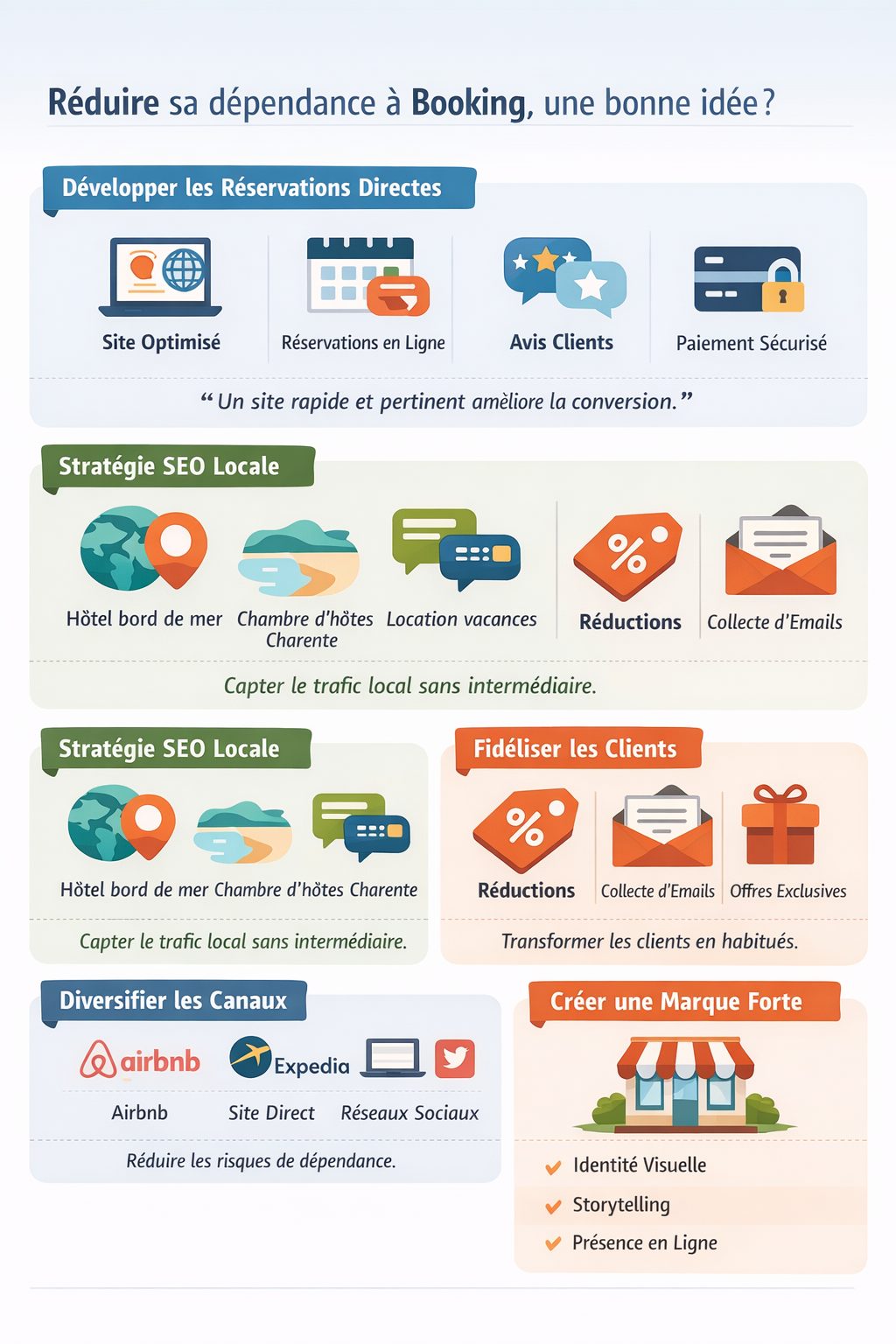
Develop direct bookings
The first strategy is to develop direct reservations. This means creating a high-performance, SEO-optimized website.
An effective site must include :
- a simple booking engine
- professional photos
- customer reviews
- secure payment
👉 The aim is to offer a credible alternative to the platform.
According to Google :
“A fast, relevant site greatly improves user conversion.”
(Source: https://developers.google.com/search/docs)
Implementing a local SEO strategy
Search engine optimization is a powerful lever. By positioning themselves on local searches, owners can attract customers without going through an intermediary.
Example queries:
- hotel bord de mer Royan
- bed and breakfast with swimming pool Charente
- vacation rentals Atlantic
👉 An effective SEO strategy allows you to generate qualified traffic without depending on the platform.
Building customer loyalty
A customer acquired via the platform can become a direct customer... provided the relationship is well managed.
Effective strategies :
- offer a discount for a future direct booking
- collect emails
- offer exclusive benefits
👉 The aim is to turn a customer into a loyal one.
Diversifying distribution channels
Reducing dependency also means diversification. It's risky to depend on a single channel.
Alternatives :
- Airbnb
- Expedia
- direct site
- social networks
👉 Multiplying channels helps limit risks.
Case study: anti-dependency strategy
An owner can initially generate 80 % of its bookings via Booking. After implementing a digital strategy :
- 50 % direct
- 30 % platform
- 20 % other
👉 Result:
- margin increase
- greater autonomy
- risk reduction
Creating a strong brand
The real lever for breaking out of dependency is branding. An identifiable establishment naturally attracts customers.
Key actions :
- visual identity
- storytelling
- online presence
👉 A strong brand naturally reduces dependence on the platform.
Alternatives to Booking for homeowners
Why look for alternatives to Booking
For homeowners, Booking reste un canal puissant, mais il n’est pas toujours le plus rentable. Les commissions et la dépendance poussent de plus en plus d’hébergeurs à rechercher des alternatives à la plateforme afin de reprendre le contrôle de leur activité.
👉 The aim is not to do away with the platform, but to create a balance between visibility and profitability.
OTAs: direct alternatives to Booking
Les OTAs (Online Travel Agencies) fonctionnent sur le même modèle que la plateforme : visibilité contre commission.
Main OTAs
- Expedia
- Hotels.com
- Agoda
👉 These platforms offer visibility comparable to the platform, but with the same constraints:
- high commissions (10 to 30 %)
- algorithm dependency
- little customer control
👉 In practice, use these OTAs as a complement to Booking allows us to diversify... without really solving the underlying problem.
Private rental websites
Unlike OTAs, these platforms allow owners to receive commission-free direct bookings, a real alternative to the platform.
CPARICI
- price : 39€/year
- model: commission-free
- advantage: accessible, direct visibility
👉 CPARICI is positioned as a cost-effective alternative to Booking, ideal for owners looking to maximize their profitability.
PAP Vacances
- price : 189€/year (standard)
- services: messaging, contracts, customer reviews
- advantage: strong credibility
👉 PAP Vacances permet de remplacer une partie du trafic issu de la plateforme par des réservations directes.
Amivac
- price: from 139/year
- traffic: millions of visitors
- advantage: extensive network
👉 Amivac offers high visibility without commission, unlike Booking.
LVP Direct
- status : association loi 1901
- cost : 30/year
- model: collaborative
👉 LVP Direct is a very cost-effective alternative to the platform, with a non-profit model.
Pour-les-vacances.com
- price : 55/year
- duration: 12 months
- advantage: simplicity
👉 This type of platform generates commission-free bookings, unlike the platform.
Booking alternatives comparison chart
| Type | Platform | Cost | Commission | Ideal for |
|---|---|---|---|---|
| OTA | Booking | 10-25% | Yes | Volume |
| OTA | Expedia | 10-30% | Yes | Volume |
| Direct | CPARICI | 39€/year | No | Profitability |
| Direct | PAP Vacances | 189€/year | No | Security |
| Direct | Amivac | 139/year | No | Visibility |
| Direct | LVP Direct | 30/year | No | Economy |
| Direct | Pour-les-vacances | 55/year | No | Simplicity |
What's the best alternative to Booking?
👉 The choice depends on your strategy:
- maximum visibility → OTAs + Booking
- maximum profitability → direct sites
- optimum balance → mix of both
👉 La meilleure approche consiste à utiliser la plateforme pour le volume et les plateformes directes pour la marge.
Recommended strategy
Ideal distribution :
- 40 % via Booking
- 30 % via direct sites
- 30 % other platforms
👉 This strategy greatly reduces dependence on Booking.
FAQ Booking for owners
Is Booking profitable for an owner?
Booking can be profitable if used correctly. The platform generates bookings quickly, but commissions reduce the margin.
👉 To maximize profitability, we recommend :
- increase prices slightly
- limit certain periods
- develop direct bookings
👉 Profitability therefore depends on the strategy adopted.
How much commission does Booking charge?
The Booking generally varies between 10 % and 25 % according to several criteria:
- type of establishment
- location
- activated programs
According to French Competition Authority :
“Platform commissions can significantly impact professional margins.”
(Source: https://www.autoritedelaconcurrence.fr)
👉 It's essential to integrate this cost into your strategy.
Can commissions be avoided?
It's impossible to avoid commissions altogether, but it is possible to reduce them.
Solutions :
- develop direct bookings
- limit availability
- use other platforms
👉 The aim is to reduce dependence on Booking.
Is Booking compulsory for rentals?
No, Booking is not mandatory. Many owners only use :
- their website
- commission-free platforms
- local networks
👉 However, not using this platform can reduce visibility, especially in the early days.
How can I get more bookings without Booking?
To generate bookings without going through this intermediary, several strategies are available:
- Local SEO
- Google Hotel Ads
- peer-to-peer platforms
- social networks
👉 These alternatives help reduce dependency.
Does Booking control prices?
Indirectly, the platform influences prices via its algorithm. The most competitive establishments are ranked higher.
👉 This leads owners to :
- adjust their prices
- remain competitive
- keep up with the competition
How do you get out gradually?
Getting out of Booking is difficult, but a gradual transition is possible.
Steps :
- create a high-performance site
- develop SEO
- customer loyalty
- diversify channels
👉 The aim is to gradually reduce dependency.
Is Booking right for small businesses?
Yes, Booking is particularly well-suited to smaller structures, offering immediate visibility.
However :
- strong competition
- reduced margins
👉 A small structure should use this tool as a start-up lever, then evolve towards a more autonomous model.

 Français
  English
  Deutsch