

Description of the municipality of Nice
Nice is France's fifth-largest city and the capital of the department of Alpes-Maritimes. Fondée par les Grecs il y a plus de 2 500 ans sous le nom de Nikaïa, elle a traversé les époques en conservant des traces de son riche passé. La vieille ville, avec ses ruelles étroites et ses bâtiments colorés, témoigne de l’architecture baroque et de l’influence italienne. Cours Saleyafamous for its flower market and local produce, is the perfect place to immerse yourself in the atmosphere of Nice.
Visit beaches from Nice
The town is famous for its pebble beaches, which stretch along the Promenade des Anglais. Among the most famous is Castel beach, located at the foot of the Château hill, offering a breathtaking view of the Baie des Anges. The more discreet Plage de la Réserve is appreciated by locals for its peaceful atmosphere. For those seeking a more exclusive experience, the Plage de l'Opéra offers top-of-the-range services in an elegant setting.
Sights in and around Nice
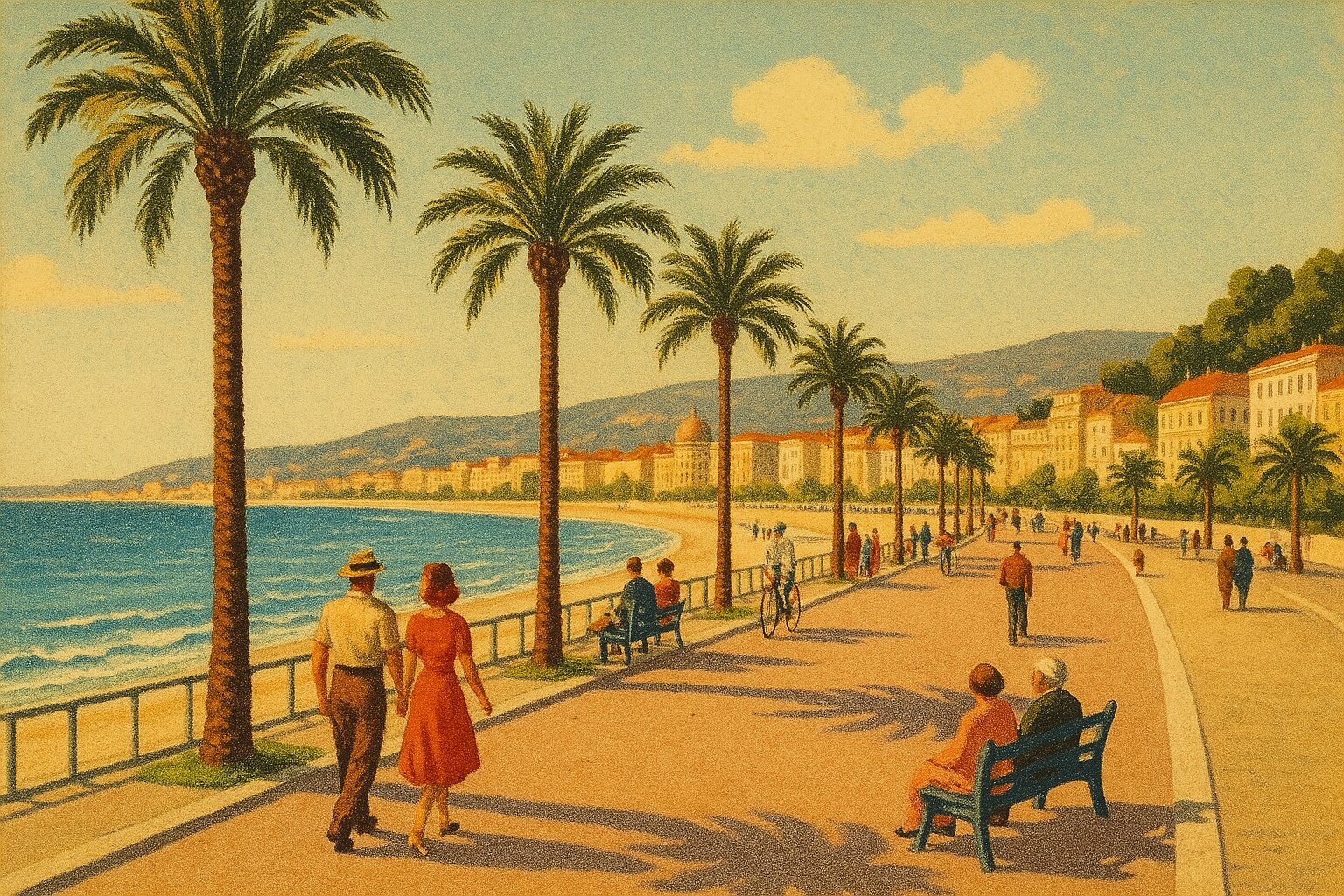
The Promenade des Anglais
This emblematic avenue runs for several kilometers along the seafront. Created in the 19th century, it is lined with palm trees and offers panoramic views of the Mediterranean. It's a popular promenade for locals and tourists alike.
Parc Phœnix
Located to the west of the city, this seven-hectare botanical and zoological park is home to a wide variety of exotic plants and animals. Its tropical greenhouse is one of the largest in Europe.
Masséna Museum
Housed in a Belle Époque villa, this museum traces the history of Nice from the First Empire to the Belle Époque. The museum's gardens, designed by landscape architect Édouard André, are also open to the public.
Nice-Cimiez archaeological museum
Situé sur la colline de Cimiez, ce musée présente les vestiges de l’ancienne cité romaine de Cemenelum, avec des thermal baths et un amphithéâtre. Les collections offrent un aperçu de l’histoire antique de la région.
The Paillon promenade
Also known as the "coulée verte", this promenade runs for over a kilometer through the town center. It features green spaces, playgrounds and a family-friendly water mirror.

The region around Nice
Villefranche-sur-Mer
Just a few kilometers from the city, this picturesque village is known for its deep harbor and colorful alleyways. The 16th-century citadel of Saint-Elme offers panoramic sea views.
Èze
Perched on a hill overlooking the Mediterranean, Èze is a medieval village renowned for its cobbled streets and exotic garden. The garden offers a breathtaking view of the coast.
Antibes
This coastal town is famous for its marina, the largest in Europe, and the Picasso Museum, housed in the Château Grimaldi. Antibes's Provencal market is also not to be missed.
Monaco
Just 20 kilometers from Nice, the Principality of Monaco is synonymous with luxury and glamour. The princely palace, the Monte-Carlo casino and the exotic garden are star attractions.
Weather in Nice: Climate, Seasons and Forecasts
Visit weather in Nice is influenced by a Mediterranean climate, characterized by hot, dry summers and mild winters. Located on the French Riviera, between the sea and mountains, Nice enjoys a exceptional sunshine with over 300 days of sunshine a yearThis makes it one of France's most pleasant cities in terms of climate.
Nice's year-round climate
Spring: mild, pleasant weather
From March to MaySpring in the city is marked by a gradual rise in temperatures. In March, temperatures oscillate between 10°C and 17°Cwhile in May they reach 14°C to 22°C. Days are generally sunny, although a few showers are possible, especially in April.
It's the ideal time to enjoy seaside walks and first terrace meals, without the summer crowds.
Summer: sun, warmth and blue skies
From June to SeptemberSummer in Nice is hot and dry. Temperatures vary between 20°C and 30°Cwith peaks of up to 35°C during heat waves. The sea breeze brings a slight coolness, making the heat more bearable.
July is often the hottest month of the year, with a average temperature of 27°C. Rainfall is rare and sea water fluctuates between 22°C and 26°Cideal for swimming.
Autumn: mild and unstable
From october to decemberAutumn in Nice remains pleasant, with mild temperatures (15°C to 25°C in October, 10°C to 18°C in November). However, this is also the season when the Mediterranean episodes can cause intense precipitation and sometimes flooding.
November is often the rainiest month, but temperatures remain mild compared to other French regions.
Winter: mild and sunny
From january to februaryNice's winters are relatively mild, with temperatures between 5°C and 15°C. It can be chilly in the morning, but the sun is often out, making for pleasant days. Snow is extremely rare in the city, although the countryside around Nice and the Alpes-Maritimes region offer beautiful ski resorts ski within an hour's drive.
Nice weather forecast: what to expect?
- For a summer holiday : Wear light clothing, sunglasses and sun protection.
- For winter A light jacket is generally sufficient, but bring a sweater for cool evenings.
- For spring and autumn A waterproof jacket can be useful in case of rain.
With its mild, sunny climatethe weather in Nice makes it an ideal year-round destination, whether for summer bathing or winter escapades under the Mediterranean sun.
OGC Nice: Club Niçois history and presentation
Introduction
L'OGC Nice (Olympique Gymnaste Club de Nice) is a French soccer club based in Nice. Niceon the Côte d'Azur. Founded in 1904one of the most historic clubs in French soccer, it competes in the top flight. Ligue 1. Known for its attacking style and strong identity, OGC Nice has won several national titles and continues to be a major player on the French soccer scene.
In this article, we take a look at club history, its highlights, its iconic players, its list of achievements, and its significance in the landscape French soccer.

The origins and foundation of OGC Nice
L'OGC Nice was founded in 1904 under the name Gymnaste Club de Nicean association focused primarily on gymnastics and athletic sports. It was not until 1924 the soccer section took on major importance and the club adopted its current name: Olympique Gymnaste Club de Nice.
In the 1920s and 1930s, the club played in local and national amateur competitions, before achieving professional status in the same year. 1932the year of the creation of the France professional soccer.
The Golden Age: The 1950s, a Golden Period
Visit 1950s mark the club's heyday with four French championship titles and two French Cups. Under the direction of Jean Luciano and with players like Just Fontaine, Victor Nurenberg and César GonzalesOGC Nice dominates French soccer.
Championship titles
OGC Nice gets its first French championship title in 1951followed by a second in 1952. After a break, the club returned to the forefront of the scene, winning two further titles in 1956 and 1959.
French Cups
The Gym also won two French Cups during this period, in 1952 and 1954confirming their status as one of the top teams in French soccer.
These successes enabled the club to make a name for itself in Europe, thanks in particular to its first participations in the European Championship. European Champion Clubs' Cupthe forerunner of the Champions League.
The Transition Decades (1960-1990)
After the golden age of 1950sOGC Nice has had its ups and downs.
Alternation between Ligue 1 and Ligue 2
The 1960s and 1970s were marked by irregular performances. The club oscillated between Ligue 1 and Ligue 2without ever regaining its former glory. There were a few remarkable seasons, notably in 1973when Nice finishes vice-champion of France behind the Nantes.
A difficult period in the 1980s
Visit 1980s are particularly complicated. OGC Nice has been relegated several times in League 2 and is struggling to get back up to speed. Despite some good runs in French CupThe club is unable to compete with the league's top teams.
The 1990s and the Progressive Return to the Foreground
French Cup victory in 1997
The soccer club is smiling again 1997 by winning the French Cup to Guingamp after a penalty shoot-out. The trophy enabled the club to revive its glorious past and compete in a European competition the following year.
A Sportingly Unstable Club
Despite this success, OGC Nice is experiencing further difficulties in Ligue 1 alternating once again between Ligue 1 and Ligue 2. It wasn't until the early 2000s that the club has succeeded in stabilizing its position in the elite of French soccer.
The Modern Era: From Stabilization to European Ascendancy
Since the years 2010The club is undergoing a revival thanks to improved management and European ambitions.
The Claude Puel years and the rise to power
With Claude Puel to lead the team between 2012 and 2016The soccer club is becoming more structured, and is enjoying a number of solid seasons in Ligue 1. At 2013the club finishes 4ᵉ of the championshipand thus qualified for the Europa League.
Lucien Favre's Impact and the 2016-2017 Season
The arrival of Lucien Favre at 2016 marks a turning point. With a talented roster including players such as Mario Balotelli, Jean Michaël Seri and Alassane PléaOGC achieves exceptional season in 2016-2017ending 3ᵉ of Ligue 1 and qualifying for the Champions League.
OGC Nice under the INEOS era
Visit 2019, l'INEOS companydirected by Jim Ratcliffeacquired OGC Nice with the ambition of making it a major club in France and Europe. Since then, the club has been recruiting talented players and aiming for regular European League places.
OGC Nice Legendary Players
Many players have left their mark on the club's history. They include :
- Just Fontaine Best scorer in the history of the World Cup, he played for Club niçois before shining with Reims.
- Hugo Lloris : Trained at the club, he has become one of France's finest goalkeepers.
- Jean-Pierre Rivière Former president, he played a key role in modernizing the club.
- Mario Balotelli A whimsical attacker, he left his mark with some impressive performances during his time here.
Allianz Riviera Stadium
From 2013OGC Nice is a Allianz Riviera stadiuma modern 35,000 seats. This stadium replaces the old Ray stadium and offers Nice fans an infrastructure worthy of a major club.
OGC Nice honours list
OGC Nice has a respectable track record with :
- 4 French Championship titles (1951, 1952, 1956, 1959)
- 3 French Cups (1952, 1954, 1997)
- Several European Cup appearances
Conclusion
L'OGC Nice is a historic club in French soccer, which has experienced moments of glory and more difficult times. Today, with the support of the INEOSthe club's ambition is to play a major role in the Ligue 1 and Europe. Thanks to a stable management, a modern stadium and passionate fansThe future looks bright for Les Aiglons.
The club continues to grow, and the next few seasons will be crucial in confirming its ambitions on the national and international scene.
Nice-Matin: History, Influence and Role of the Côte d'Azur Newspaper
Nice-Matin is a French regional newspaper founded in 1945, covering mainly the Côte d'Azur and the Alpes-Maritimes department. Anchored in the media landscape of southeastern France, it is recognized for its local investigations, exclusive reports and commitment to local residents. Thanks to its proximity to readers, it has become a benchmark for local, economic, political and cultural news.
The origins of Nice-Matin: a post-war newspaper
Foundation and first steps
Nice-Matin was created in 1945, at the end of the Second World War, in a context of reconstruction and democratic renewal. Its initial aim was to offer reliable, accessible information to the region's inhabitants. From the outset, the paper distinguished itself with a balanced editorial line and a resolutely regionalist tone, highlighting local issues and success stories.
A strong local presence
Since its creation, Nice-Matin has established itself as a major player in local news, thanks to specific editions covering several geographical areas, including Nice, Cannes, Antibes, Grasse and Menton. This proximity to readers has helped forge its identity and reputation.

A key player in the Provence-Alpes-Côte d'Azur information market
Wide and varied media coverage
Nice-Matin covers a wide range of subjects, from thepolitical news and economics to culture, news and sport. Its team of journalists covers municipal events as well as major national issues impacting the region.
The paper also offers in-depth investigations on topics such as tourism, real estate, the environment and local innovations. This diversity of content enables Nice-Matin to reach a wide audience, from young working people to retirees, professionals and students.
A media committed to local life
Nice-Matin is much more than a newspaper: it's a real player in local life. It regularly organizes debates, conferences and events designed to bring citizens closer to information and local decision-makers. For example, its forums on housing, mobility and the economy attract large numbers of participants every year.
Our commitment is also reflected in our solidarity initiatives and partnerships with local associations, supporting social and environmental causes.
The evolution of the newspaper in the digital age
The switch to digital and the diversification of media
Like many regional newspapers, Nice-Matin has had to adapt to the digital revolution. In the 2000s, it developed a web platform with online articles, videos and interactive content. The website nicematin.com has become a benchmark for those wishing to follow local news in real time.
In addition to its website, Nice-Matin has invested in social networksFacebook, Twitter and Instagram, to reach a wider, younger audience. These platforms make it possible to disseminate information quickly and interact with readers.
The rise of participatory journalism
With the advent of digital technology, Nice-Matin has also launched a number of new initiatives. participatory journalismwhere readers can suggest topics, share their experiences and interact with journalists. This model encourages greater citizen involvement in the construction of local news.
Challenges and issues for the future of Nice-Matin
Competition and market adaptation
The local press market is constantly evolving, with increasing competition from online media and free content platforms. To maintain its readership, Nice-Matin must constantly innovate, offering exclusive, high value-added content.
In-depth investigations, multimedia reports and attractive subscription offers are just some of the ways the newspaper builds reader loyalty.
Editorial independence and business model
Like many regional newspapers, Nice-Matin has gone through difficult times financially. After several buyouts and restructurings, the newspaper was taken over in 2019 by its own employees in the form of a Collective Interest Cooperative Society (SCIC). This model guarantees a degree of editorial independence and preserves the newspaper's primary mission: to inform citizens in complete transparency.
Innovation as a growth driver
To ensure its long-term survival, Nice-Matin is exploring new formats, including podcaststhe thematic newsletters and interactive events. These initiatives aim to modernize the newspaper while strengthening its ties with the local community.
Frequently asked questions
When is the best time to visit Nice?
Spring and autumn offer pleasant temperatures and moderate tourist numbers. However, summer is ideal for enjoying beaches and festivals.
Getting around Nice
Nice has a network well-developed streetcar and bus network. The city is also great for walking, especially along the Promenade des Anglais.
What are Nice's typical dishes?
Local specialties include socca, a chickpea flour cake, and salade niçoise.
Are there any sandy beaches in Nice?
Nice's beaches are mainly pebbled. For sandy beaches, we recommend Antibes or Cannes.
What are the major events in Nice?
The Nice Carnival in February and the Nice Jazz Festival in July are the city's major cultural events.
Where can you find local produce in Nice?
The Cours Saleya is famous for its flower market and stalls selling local produce.


