

All you need to know about Basque pelota: history, disciplines, equipment and practice
Visit pelota is much more than a sporta living part of culture and identity the countrythe Basque Country in an age-old sporting tradition. Its blend of speed, technique and conviviality makes it an exciting spectacle, linking villages around vibrant pediments. In this comprehensive article, we explore the pelota in all its facets: its origins, its terrain, its equipment, its disciplines, its rules, its organizations, its champions, as well as its current place in local tourism and practice.
Origins and evolution of Basque pelota or pelota des basques
Visit pelota has its roots in ancient games, no doubt inspired by the jeu de paume in Europe. Rock engravings at Mutriku already illustrate the beginnings of an ancestral game. In the 17th century, the Basques adapted this popular game, using sticks to grip the ball and sometimes bare hands to divide the space between walls and volleys.
During the XIXᵉ century, the introduction of the rubber enables the design of more resistant and long-lasting balls. In 1857, Jean Dithurbide invented the chisteraa wicker instrument that has become emblematic of the pelotaThis marked the beginning of a professional organization, with spectacular tournaments and competitions.
The formal structure emerged in the 1920s: the Fédération Française de Pelote Basque (FFPB) was founded in 1921 and the Fédération Internationale (FIPV) in 1929, paving the way for world championships and international recognition. Since then, pelota has gone from strength to strength, with practitioners spread across three continents.
Grounds and practice areas
Visit pelota is essentially played out in three settings:
Fronton free space (wall on left): outdoor enclosure with a central wall, a back wall and sometimes a side wall, width 10 to 12 m, length 30 or 36 m depending on the discipline.
Wall on left (without side wall): similar, often used for armchair games (paleta, frontenis, frontball).
Trinquetinterior space with front wall, cutaway, right side wall, back wall; inspired by the "tripots du jeu de paume".
The dimensions vary: a 30 m wall for disciplines such as pala, and up to 36 m for the games of bare hand or grand chistera.
Internationally, this architecture has been adapted: trinquet in Buenos Aires, Cuban pediment, or left wall in California. In France, pediments are scattered throughout every village, often along a boulevard, creating a lively cultural space.

Material & equipment
The pelota
In the heart of pelotathe pelota itself is precision-engineered: a core of boxwood or rubber, surrounded by wool and then goat leather. Depending on the specialty, its size ranges from 60 to 74 mm for light balls, up to around 70-75 g for heavy balls used on the left-hand wall or on the right-hand wall. bare hand .
The pelotari's outfit
As a general rule, players wear white pants, a polo shirt bearing the federation or club logo, and protective gear such as glasses and a helmet on the face and head - mandatory for fast disciplines such as cesta-punta.
Instruments
Chisterawoven wicker gloves in a variety of sizes; small (joko garbi), large (cesta-punta), remonte.
Paleta / palaSolid or hollow wooden snowshoe with rubber cover, several models depending on the discipline.
XareHand-held mesh racket for throwing or returning the ball.
These instruments represent the genius of local craftsmanship: in particular, the chistera is an objet d'art, boosting Basque culture around the country.
Main disciplines
Visit pelota is divided into two main categories.
Direct games (without instrument) :
Bare hand - the oldest form, where the ball is thrown by hand.
Rebot, pasaka, laxoa - variants integrating rebounds, skilful decisions, geographical strategies of the fronton .
Indirect games (with instruments) :
Joko garbi (small chistera)
Pala & paleta gum (hollow or solid)
FrontenisSpanish version with racket
Xarenet racket
Grand chistera / cesta-puntawith the most spectacular of chisteras: bullets launched at speeds of up to 300 km/h .
The size of the fronton is adapted to the discipline: small frontons for bare hands, wide and long fields for cesta-punta. Each variant has its own world, its own tactics, and its own time slots (some are nocturnal in summer).
Rules and procedure
The common goal of pelota is simple: reach a certain number of points before your opponent. Traditionally 40, but 22 for certain formats, 30 or 40 depending on specialty.
Points6 games of 6 points, or a direct score of 40.
Hunting: wall location technique that rebalances exchanges, especially at rebot.
Faults: double bounce, exit (pasa), forbidden contact (atxiki), pompa (ceiling bounce), etc.
FormulasSingle (1v1), double (2v2), teams (e.g. 5v5 rebot). Visit service adapts to the discipline (volley, over the service line).
Each game relies as much on physical stamina as on strategy, player placement and controlled angles - a subtle art mastered during structured training courses.
Organizations and competitions
FFPBFounded in 1921, it manages pelota in France, with some 271 affiliated clubs in 2022. It organizes competitions, training courses and tournaments.
FIPVFounded in 1929 in Pamplona, it now has 27 member countries, promoting international distribution.
World ChampionshipsOrganized every 4 years since 1952, the last edition was held in Biarritz in 2022.
Olympic GamesPresentation in 1900 as an official sport, demonstration in 1924; since then, pelota has not returned to the Olympic program, but the historical recognition is profound.
In addition to classic tournaments, exceptional venues such as the Cesta Punta Internationals in Saint-Jean-de-Luz attract an international audience.
Pala pelota: a must for this traditional sport
Visit pala pelote basque is one of the emblematic instruments used in several disciplines of the pelota. Traditionally made from beech wood or modern composite materials, the pala is used to strike the pelota with power and precision against the walls of the building. pediments and trinquets.
There are several types of pala, each adapted to a particular discipline:
Pala corta Short and handy, ideal for fast play.
Pala larga Longer, for powerful strikes.
Paleta gum lightweight and often used for school competitions.
Visit pala pelote basque is at the heart of indirect games, where it offers spectacular and strategic exchanges. Its handcrafted manufacture bears witness to Basque know-how handed down from generation to generation.
Today, many clubs offer introductory courses and tournaments where the pala is highlighted, allowing visitors to discover an authentic facet the country.
Fronton pelote basque: the beating heart of Basque villages
Visit fronton pelote basque is much more than a playground: it's a cultural symbol and a gathering place in the heart of the villages of the Basque Country. It is on these emblematic walls that the frenzied games of pelotaa traditional discipline that combines technique, agility and conviviality.
There are several types of pediment:
Fronton free space A single wall, often located in a large village square.
Wall on left covered or semi-covered fronton with a side wall for fast games.
Trinquet A closed room with complex bounces, inherited from jeu de paume.
Every summer, these pediments come to life with cesta punta, bare handor paletaattracting locals and visitors alike. They are also the scene of initiations to discover this emblematic sport. the country.
Visit fronton pelote basque embodies a living heritage, at the crossroads of sport and tradition, offering everyone an authentic experience of the Basque Country.
Pelote basque chistera: the most spectacular discipline in the Basque Country
Visit pelote basque chistera is one of the most emblematic and spectacular variants of the pelota. Played in the big leagues pediments and sometimes in trinquetIt is distinguished by the use of a wicker glove called the chisterawhich propels the pelota at impressive speeds, sometimes exceeding 300 km/h.

Visit grand chistera (or cesta punta) is the best-known version, often played on 54 m courts. Invented in the XIXᵉ century, it helped raise pelota to an international level, thanks in particular to shows and tournaments organized in Spain, France and as far afield as the United States (where the jai-alai is very popular).
This discipline demands great technique, precision and perfect coordination. The player, called pelotarimust catch the ball in the hollow of the chistera and powerfully throw it back against the wall.
Every summer, Basque villages organize tournaments that attract both local enthusiasts and tourists keen to discover this tradition. the country.
Basque pelota bat: an essential instrument in pala and paleta games
Visit pelota batalso known as pala or paletais an essential element in many disciplines of the pelota. Unlike the bare hand or the use of chisteraThe bat comes in the form of a racket made of wood or composite materials, adapted to the different variations practised on the pediments or in trinquet.
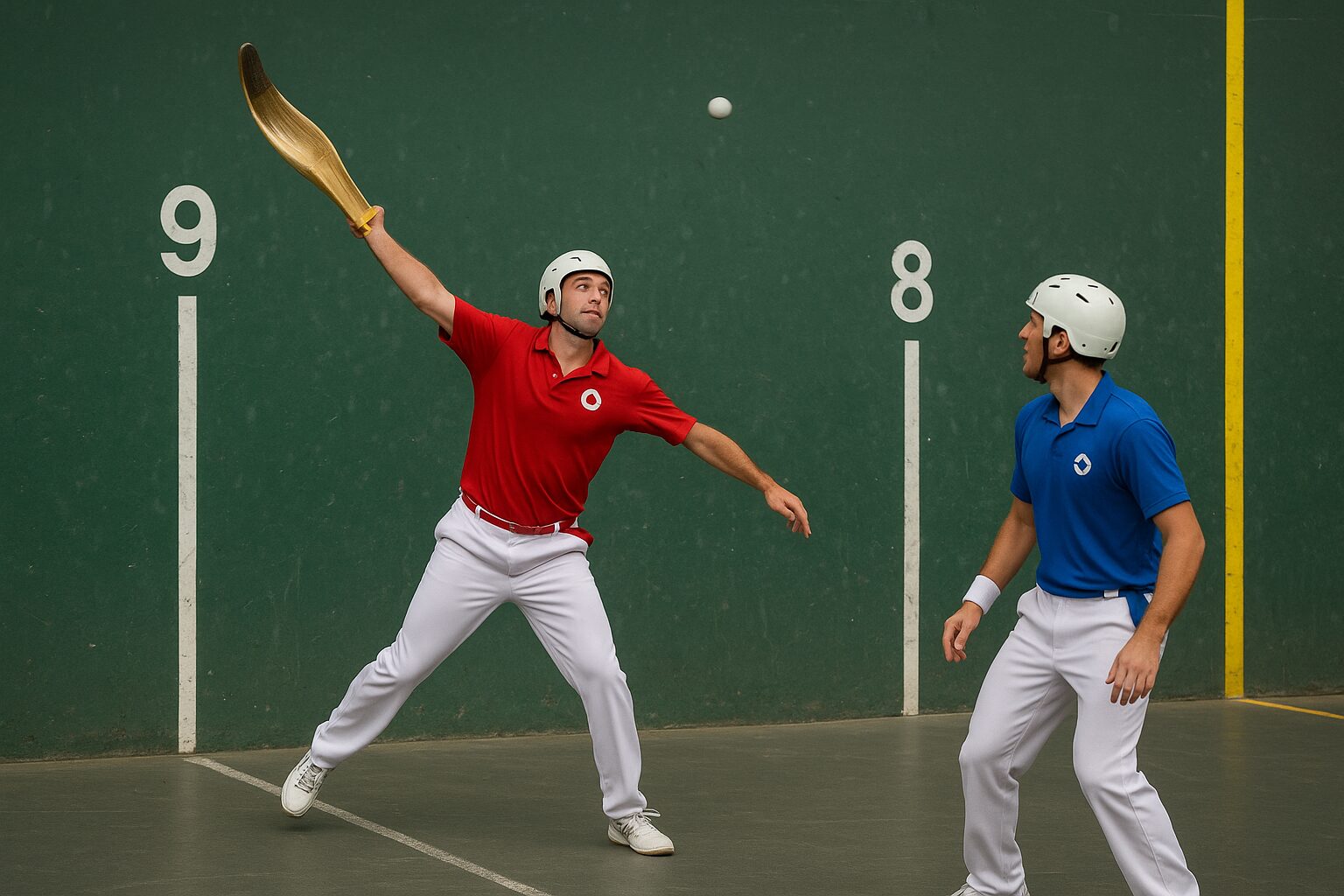
What is a pelota bat?
Traditionally made from beech or ash wood, the pala is designed to hit the pelota with power and precision. There are several types of bat:
Pala corta Short and light, suitable for fast play.
Hollow rubber paleta Ideal for beginners and school competitions.
Paleta solid rubber Used in more technical left-wall matches.
Each model is selected according to the level of the player and the type of pelota (rubber, leather).
Craftsmanship
The art of making a Basque pelota bat has been handed down from generation to generation in the Basque Country. Local craftsmen take care to balance weight and flexibility to guarantee comfort and performance.
Practice and competitions
Bat disciplines are accessible to everyone, from youngsters to adults. Many clubs in the Basque Country offer introductory courses, allowing you to discover this tradition. the country and practice on the left wall.
Union basque pelote: promoting tradition and sport in the heart of the Basque Country
L'Union Basque Pelote is a key player in the pelota in the region, federating some fifty enthusiastic sports clubs. From the outset, this structure has worked to develop unity, team spirit and sporting excellence around the emblematic disciplines of the Basque Country: bare hand, chistera, paleta, pala and xare.
A committed, structured association
The Union Basque Pelote regularly organizes championshipsclub meetings and finals, notably at the trinquet or at the municipal fronton. For example, the Union Basque finals at the Villefranque trinquet brought together the under-age, youth and adult categories, demonstrating a strong commitment to youth and the passing on of knowledge.. Broad membership of the structure guarantees complete sports coverage of the region.
Competitions for all
The competitions orchestrated by the Union Basque Pelote cover a wide range of categories, including young shoots to experienced pelotaris. School, amateur and elite events help to preserve local traditionsThese finals are often open to the public, free of charge and very popular. These finals are often open to the public, free of charge and very popular.
Promoting Basque pelota at all levels
In addition to official matches, the Union Basque Pelote organizes introductory events, summer courses and demonstrations in the Basque Country. Basque villages. The aim: to share the passion for pelota while developing the practice of disciplines such as cesta-punta (large chistera), the frontenis or the joko garbi.
Cooperation with national and international federations
This union works closely with FFPB (French Federation of Basque Pelota, founded in 1921) and the FIPV (International Federation, founded in 1929) to guarantee the harmonization of rules, sports calendars and the training of referees and coaches. Thanks to these partnerships, regional pelotaris have access to national and international competitions, guaranteeing the promotion of their talent.
Networking and communication
The Union Basque Pelote is also active on social networks (Facebook, Instagram, Reels), where it relays results, photos, videos and calendars upcoming events. This visibility modernizes communication around a traditional sport and boosts public involvement..
Why theUnion Basque Pelote is essential?
Local structuringThe pelota association: it coordinates pelota companies to ensure consistency in competitions.
TransmissionWe invest in training for young people and supervisors.
Radiationthrough open events and national/international collaborations.
Innovationmodern distribution via social networks, improving the visibility of pelota.
Thanks to theUnion Basque PeloteThis age-old sport retains its vitality, while adapting to contemporary practices and expectations. It is the bridge between tradition and modernity, between villages, academies and international events.
Comité Pelote Basque: guardian of the sporting traditions of the Basque Country
Visit pelote basque committeeor Comité Territorial de Pelote Basqueplays a central role in the promotion and organization of the pelota in the region. Based in Hasparren, it federates clubs and pelotaris to preserve, structure and modernize this traditional discipline. the country.
Mission and actions
The committee has several key missions:
Organization ofsporting events : finals of games such as grand chisterathe joko garbithe left wall and the bare handwith presentation of tables and charts from July 2025 .
Calendar events: in July, the Bidart (grand chistera) and Cambo-les-Bains (joko garbi) finals attract local athletes and visitors alike. .
Communication: newsletters, online news, videos, social networks to keep pelotaris and enthusiasts informed.
Frameworks and regulations
The committee publishes articles of associationthe pilotari charter and the sports regulationsIt is also involved in training coaches and referees. It is also involved in training coaches and referees.
Specialties covered
All pelota are represented: cesta punta, paleta solid rubber, xare, rebot, pasakaand of course the big chisteraemblematic of the Place Libre pediment. These variants are accessible both outdoors (fronton) and indoors. trinquetwith technical support and infrastructure.
Territorial structuring
Headquartered at 7 place du Jeu de Paume in Hasparren, the committee acts as an active liaison between federations (FFPB, FIPV) and local clubs. . It is responsible for coordinating competitions, training and the promotion of the sport. pelota family, amateur and elite.
Visit pelote basque committee is therefore a key player in ensuring the continuity and quality of our events, and in structuring this age-old sport.
Basque Pelota League: driving force behind the development of pelota in the Basque Country
Visit basque pelota league plays a major role in structuring and promoting the pelota in France and around the world. It coordinates clubs, organizes regional competitions and supports the transmission of this emblematic sport. the country.
It covers all disciplines: bare hand, chistera, paleta, pala and xare. Each year, the league offers a rich calendar of championships, cups and finals that bring together the best of the best. pelotaris in the pediments and trinquets territory.
Visit basque pelota league also supports young players through training courses, internships and school events. It relies on a solid network of affiliated clubs to maintain the dynamism of the sport and preserve this cultural heritage.
With modern communications via social networks and partnerships with national and international federations, the league ensures the visibility and influence of the pelota beyond its borders.
Champions and legendary anecdotes
Visit pelota is packed with legendary figures:
Perkain (1793), the first recognized bare-hand champion.
Gaskoina (Irun, 1846), initiator of official competitions.
Modern period : Jean Urruty, Robert Mousseigtpillars of the 1920s-1950s.
Recent international champions to come...
The story is enriched by anecdotes: pelota challenges on horseback, traveling shows, shared experiences between clubs competing with pride.
Contemporary practice & tourism
Today, the pelota remains a local and tourist phenomenon:
Each village organizes tournaments in pediment in the evenings, especially in summer.
From initiations are available everywhere: Biarritz, Saint-Jean-de-Luz, Bidart, Bassussary (museum and club).
Tourist activity including demonstrations, museum visits and summer courses.
Pelota is exported to Argentina, Mexico, the United States (Jai-Alai in Miami) and Spain.
Transmission via schools, clubs, youth camps and universities is essential to ensure the survival of this traditional sport.
FAQ
What's the difference between bare hands, pala and chistera?
Bare hand is a fast, physical, open-handed game; pala/paleta use wooden or rubber rackets; chistera is a woven wicker glove that propels the ball at high speed, particularly in cesta-punta.
How does the flush system work?
The main rebound point is marked on the wall: whoever reaches this point gains the advantage, forcing the opponent to play in a specific area.
How is a ball made?
It consists of a core of boxwood or rubber, wrapped in wool and then sewn with leather. The balls vary in size, weight and hardness according to their use.
Where can you learn to play pelota?
Numerous clubs and frontons in the French Basque Country (Biarritz, Bayonne, Hendaye...) offer supervised introductory courses, often adapted to families and tourists.
When will the next World Championships be held?
The next Basque Pelota World Championships are scheduled for 2026, following the previous edition in Biarritz in 2022 (exact dates to be confirmed when FIPV makes its official announcement).
Conclusion
Visit pelota is a treasure trove of tradition, skill and sharing that spans the ages. From its ancient origins to contemporary tournaments, it embodies the cultural and sporting vitality of the Basque Country. Whether you're a player or a spectator, discovering Basque pelota means coming into contact with a heritage that's rooted in pediments, villages and hearts. So why not give it a try?
To explore the historical roots, visit this article on the online encyclopedia.👉 See the detailed article on the origin and practice of this traditional sport.
