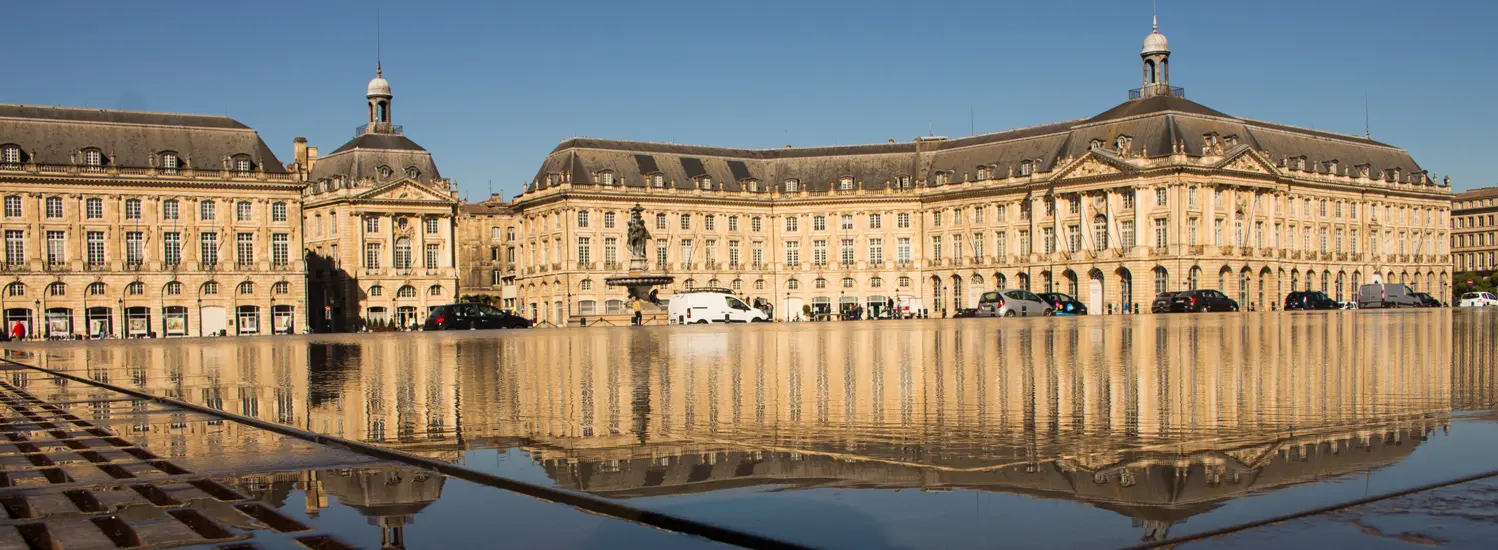
Water mirror in Bordeaux
Looking for a unique and enchanting experience in Bordeaux? Don't miss the Miroir d'Eau, recognized as the world's largest! This article entitled 'miroir d'eau Bordeaux' is your ultimate guide to exploring this wonderful place.
It offers a breathtaking view on the majestic Place de la Bourse and the quays of the Garonne. This monument is a true feat of urban design, captivating you with its aquatic illusions and mystical mists, conjuring up dreamlike atmospheres and invigorating water effects.
You'll find all the reasons why this place is a must-see, tips for organizing your visit, as well as suggestions for enriching activities around the Miroir d'eau.
Discover why Bordeaux is nicknamed the "Pearl of Aquitaine" and how the Miroir d'Eau has become one of its most precious jewels.
Why Bordeaux's Miroir d'Eau is a must-see
The Bordeaux Water Mirror transcends the notion of a fountain to become an emblematic work of art, a symbol of the city, and a shared living space.
Here are the reasons why this exceptional place should be on your list when you visit Bordeaux.
A little history
Created between 2005 and 2006 during the redevelopment of the quays on the left bank of the Garonne, the Miroir d'eau is located in the extension of the Place de la Bourse, an 18th-century work by architect Jacques Gabriel, commissioned by King Louis XV.
The Place de la Bourse, now home to the Chamber of Commerce and Industry and the National Customs Museum, reflects the economic and cultural prestige of Bordeaux during the Age of Enlightenment. Le Miroir d'eau celebrates this heritage by capturing the magnificence of the square and its facades decorated with mascarons and ironwork.
Unique architecture and design
At 3,450 m2, the Miroir d'Eau is the largest in the world. Composed of granite slabs topped with 2 cm of water, it features an ingenious system that creates a play of mirrors and fog. The project is the joint work of landscape architect Michel Corajoud, fountain designer Jean-Max Llorca and architect Pierre Gangnet, who cleverly reused an old underground warehouse to house the machinery and reservoir.
The Miroir d'Eau is a technical and artistic tour de force, offering visitors a spectacle of light, reflections and perspectives. It's a place to stroll, cool down, play and marvel, stimulating all the senses.
Symbolism and cultural impact
The Miroir d'Eau, a flagship feature of the quays renovated by Michel Corajoud, showcases Bordeaux's historical and natural heritage. It symbolizes the inseparable link between the city and the Garonne, the driving force behind its identity and evolution. It also represents Bordeaux's modernity and innovation, testifying to its ability to reinvent itself over time.
The Miroir d'Eau is a meeting place for residents and visitors alike, a place for relaxation, celebration and contemplation. Listed as a UNESCO World Heritage site, it is the most photographed site in Bordeaux, embodying one of the city's major symbols and serving as a source of inspiration the world over.
Plan your visit to the Miroir d'eau
Discover Bordeaux's Miroir d'Eau, the largest in the world, and enjoy an unforgettable experience thanks to its breathtaking visual and sound spectacles. Follow our advice to organize your visit and enjoy every moment of this exceptional site.
When to go: The best times
Open daily from 10am to 10pm, except in winter for maintenance, the Miroir d'Eau is ideal for a visit between April and October, when the weather is mild. Summer, from late June to early September, marks the high tourist season and offers a welcome coolness. To avoid the crowds, opt for May, June, September or October, when the weather is mild and the colors beautiful. Enjoy its reflections, mists and lights at different times of day, depending on the weather and the season.
How to get there
Located on the Quai de la Garonne, opposite the Place de la Bourse, in the heart of Bordeaux, the Miroir d'Eau is easily accessible. Here are your options:
- By streetcar: Take line C to Place de la Bourse station, a stone's throw from the Miroir d'Eau. Consult the map and timetables on the TBM.
- By bus: Lines 1, 2, 3, 15 and 45 serve the area. Timetables are available on the TBM website.
- By train: From Bordeaux Saint-Jean station, 3 km away, take streetcar C or a bus, or enjoy a pleasant walk along the Garonne.
- By car: Find a parking lot near the Miroir d'eau, such as the Bourse-Jean Jaurès, Victor Hugo or Camille Julian parking lots. See Bordeaux Parking for rates and availability.
- By bike: Bordeaux has an excellent network of cycle paths and Vcub, so you can park near the Miroir d'eau at the Quinconces or Place de la Bourse stations.
Tips for a successful visit
Maximize your Water Mirror experience with these tips:
- Dress accordingly and choose footwear suited to the weather. In summer, bring a towel and a change of clothes if you plan to cool off.
- Respect the area by following safety and cleanliness instructions. It's essential not to pollute or damage the area, and to respect the bathing ban for health and safety reasons.
- Take part in various events and guided tours, such as the discovery of the Miroir d'Eau's technical underside, cruises on the Garonne, and regular cultural events.
- Explore the surrounding attractions, including the Place de la Bourse, the National Customs Museum, the quays of the Garonne for panoramic views, and Bordeaux's rich historic center.
Around the Water Mirror: Enriching experiences
Bordeaux's Miroir d'Eau is much more than just a place to contemplate, it's the perfect starting point for exploring the cultural, recreational and gastronomic riches of the city and its surroundings. Whether you're looking for art, leisure or culinary delights, the Miroir d'Eau is the place to be.
Here are a few recommendations to help you make the most of your visit to Bordeaux.
Place de la Bourse at your fingertips
Opposite the Miroir d'Eau is the splendid Place de la Bourse, one of Bordeaux's jewels. Built in the 18th century by architect Jacques Gabriel for King Louis XV, it symbolizes the economic and cultural heyday of the Enlightenment. Today, it houses the Chamber of Commerce and Industry, as well as the National Customs Museum, which presents the evolution of trade and taxation in France.
Visit the Place de la Bourse and its buildings, stroll along the cobblestones and admire the facades decorated with mascarons and ironwork, and don't miss the Trois Grâces fountain, emblematic of the square since 1869.
Activities and relaxation
The Miroir d'Eau is a haven of peace, ideal for relaxation and entertainment. Between walks, water games and moments of wonder, the Miroir d'eau offers an enchanting spectacle with its shimmering, misty effects.
Children enjoy splashing around, while adults find it a pleasant place to meet and share. The Miroir d'Eau is also the venue for cultural and festive events such as concerts, shows and screenings.
Take a behind-the-scenes look at the Miroir d'Eau to learn more about its workings and history, or admire it from the Garonne on a boat or ferry cruise.
Local gastronomy and shopping
Around the Miroir d'Eau, a multitude of restaurants, cafés and boutiques invite you to savor Bordeaux gastronomy and enjoy a shopping spree. Bordeaux is famous for its authentic cuisine, made from fresh, high-quality ingredients.
Enjoy dishes such as oysters from the Arcachon basin, foie gras, caviar from Aquitaine, asparagus from Blaye, canelés or macaroons from Saint-Émilion, and indulge in the famous wines of Bordeaux.
Restaurants to suit all tastes and budgets, from traditional bistros to luxury brasseries, including vegetarian and exotic options, welcome you. Surrounding boutiques offer a variety of goods, from luxury brands to popular boutiques, from souvenirs to antiques, not forgetting local designers. Whether it's fashion, beauty, leisure or homeware, you're sure to find what you're looking for.
Conclusion
As you've already guessed, Bordeaux's Miroir d'Eau is a flagship attraction, promising memorable moments. Whether you're looking for culture, leisure or culinary delights, the Miroir d'Eau is sure to satisfy all your desires. It's the largest water mirror in the world, and offers breathtaking visual and sound shows.
It reflects the magnificence of the Place de la Bourse, one of the architectural gems of Bordeaux. The Miroir d'Eau is a powerful symbol of the connection between Bordeaux and the Garonne, having shaped the city's history and development. It also represents Bordeaux's modernity and innovation, testifying to its ability to renew and energize itself over the centuries.
It's a popular meeting place for locals and visitors alike, who come here for moments of relaxation, celebration or admiration. Don't miss the chance to explore the Miroir d'Eau de Bordeaux, the most spectacular mirror in the world!
FAQ
Operating hours of the water mirror in Bordeaux
The Bordeaux water mirror is open all week, from 10am to 10pm. Its operating cycle alternates between mirror effects, with a thin 2 cm layer of water on a granite surface, and fog effects up to 2 meters high.
Water mirror activation times
The water mirror is activated daily between 10am and 10pm, creating a visual cycle with mirror and fog effects emerging from a granite slab, up to 2 meters high.
Water mirror mechanism
The water mirror operates through a system of pumps, channels and injectors that orchestrate the mirror and fog effects. The water is stored in an underground reservoir and rises to the surface via the interstices in the granite slab.
Reasons for stopping the water mirror
There are two main reasons why the water mirror may be out of service: it enters a winter maintenance period from November 6 to early April, during which water features are suspended; or it may be inoperative following damage, such as that caused by disgruntled farmers on March 17, 2024, who damaged the electrical system and nozzles.