
Declaring a furnished holiday home
The declaration of a furnished holiday home is a mandatory step in the legal operation of short-term rental accommodation. This formality enables the authorities to control the activity and regulate this type of accommodation on the territory. Understanding these steps is therefore essential to avoid sanctions and secure your project.
Declaration at the town hall
To operate a furnished holiday home, In the case of short-term rentals, the owner must make a prior declaration to the town hall of the municipality in which the property is located. This obligation applies to most short-term furnished rentals.
The procedure is usually carried out using a dedicated Cerfa form, which can be submitted either online or on paper. According to Service-Public.fr :
“Tourist accommodation must be declared to the town hall, with certain exceptions.”
This procedure informs the commune of the existence of the accommodation and ensures compliance with local regulations.
Registration number
In some large cities, a furnished holiday home must have a registration number. This number must appear on all ads published online.
This number is issued by the local council after the declaration has been made, and is used to check compliance with rental limits, particularly for principal residences.
This obligation applies particularly in areas where real estate pressure is high, in order to regulate the market.
Authorization for change of use
In some communes, the conversion of a dwelling into a furnished holiday home requires authorization for change of use. This rule mainly applies to second homes located in large urban areas.
The aim is to limit the massive conversion of properties into tourist rentals. Operating a property without authorization can result in severe penalties.
Depending on local regulations, this authorization may be subject to compensation, i.e. the conversion of commercial premises to residential use in order to balance the real estate stock. Compliance with this obligation is essential if you are to operate this type of property legally.
Energy compliance and DPE: the new obligations
In 2026, the profitability of a meublé de tourisme will no longer depend solely on its location, but also on the quality of its service. Energy Performance Diagnosis (DPE). Law no. 2024-1039, known as the “Le Meur Law”, brought furnished tourist accommodation into line with the rules for conventional rentals in terms of energy decency.
From now on, for a property to be considered “decent” and be available for seasonal rental, it must comply with a strict timetable:
A ban on renting out “thermal flats”: Classified homes G are now prohibited for rental. Classified accommodation F will follow shortly (by 2028).
Change of use : In many municipalities, authorization for a change of use is now conditional on presentation of an ECD graded at least E (and soon D).
Control powers : Mayors now have the option of suspending a registration number if the owner cannot prove that the property is energy efficient.
Cparici's advice: Before you invest or renovate, check your property's energy label. A good DPE is not just an ecological argument, it's a legal obligation to guarantee the long-term future of your rental business.
Classification of meublé de tourisme (optimized version)
The furnished holiday home is an official system for assessing the quality and comfort of short-term rental accommodation. This system plays an essential role in the credibility of the offer, online visibility and tax benefits available to the owner.
What is the official ranking?
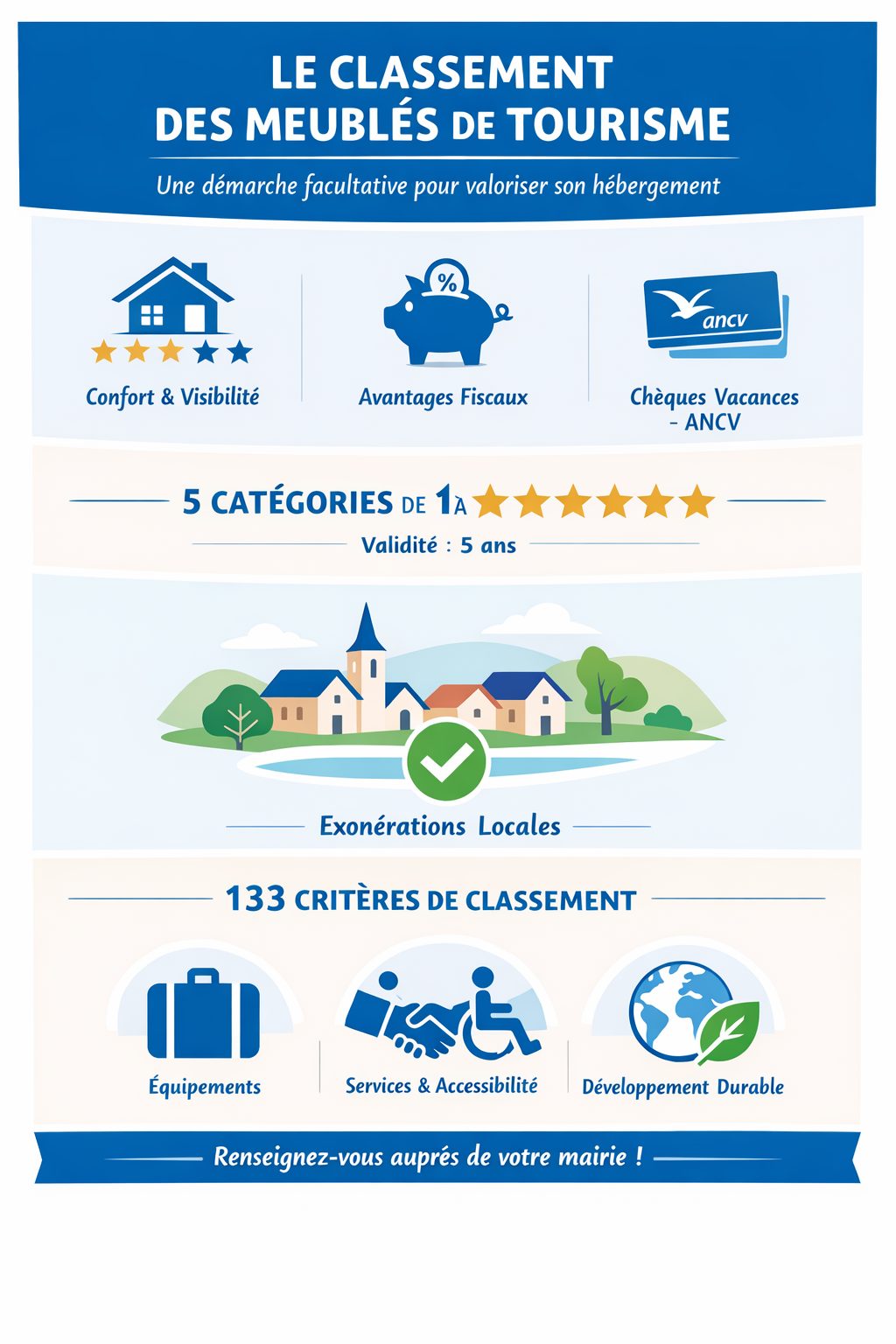
The furnished holiday home is a voluntary procedure carried out by accredited organizations. It awards a rating from 1 to 5 stars according to precise criteria.
According to Atout France :
“The aim of the classification is to indicate to the customer a level of comfort and service.”
This system is based on an evaluation grid comprising dozens of criteria: facilities, services, accessibility, environmental performance. This approach brings official recognition to the property.
Classification categories
Visit furnished holiday home can be classified into 5 categories, ranging from 1 to 5 stars. Each level corresponds to an increasing standard of quality.
Here's an overview:
| Ranking | Comfort level |
|---|---|
| 1 star | basic |
| 2 stars | standard |
| 3 stars | comfort |
| 4 stars | superior |
| 5 stars | luxury |
A well-ranked property attracts more customers and enables higher rates. Rating thus becomes a strategic lever for improving profitability.
Advantages of classification
The furnished holiday home offers several major advantages, both fiscal and commercial.
Key benefits include
- higher tax allowance (up to 71%). Please note that from 2026, the allowance will be reduced to 50% (instead of 71%) with a ceiling of 77 700 €.
- better visibility on platforms
- enhanced credibility with travellers
- possibility of accepting vacation vouchers
According to official French tourism data, a classified property enjoys a significant competitive advantage in the market.
Investing in this approach optimizes both the profitability and attractiveness of the property. Some organizations are accredited for classification, for example, Clévacancesor Gîtes de France.
We also need to differentiate between the meublé de Tourisme classification and other seasonal rental labels.
Find out more about labels for vacation rentals, it's this way!
Tax treatment of furnished tourist accommodation (optimized version)
The taxation of furnished holiday home is a key factor in optimizing the profitability of this type of investment. This type of rental benefits from a specific tax framework, which is often more advantageous than that of conventional rental, but requires a clear understanding of the regimes and obligations involved.
Tax regimes
Visit furnished holiday home comes under the category of industrial and commercial profits (BIC). Two main tax regimes apply: micro-BIC and régime réel.
The micro-BIC system is the simplest. It allows you to benefit from a flat-rate deduction on the income generated. On the other hand, the "régime réel" allows you to deduct all operating expenses.
According to impots.gouv.fr :
“Income from furnished rentals is taxed in the BIC category.”
The choice therefore depends on the level of income and associated expenses.
Tax allowances
One of the main advantages of furnished holiday home lies in the tax allowances. Under the micro-BIC system, a classic dwelling benefits from an allowance of 50%, while a listed property can benefit from an allowance of up to 71%.
Update 2026
- For a Furnished non-classified the allowance rises to 30% (instead of 50%) with a revenue ceiling lowered to 15 000 €.
Furnished listed the allowance rises to 50% (instead of 71%) with a ceiling of 77 700 €.
Note: The 71% allowance only survives in very specific rural areas (“non-tensioned zones”).
This means that only part of the income is taxed, considerably improving profitability. This is a major lever for investors.
LMNP and LMP status
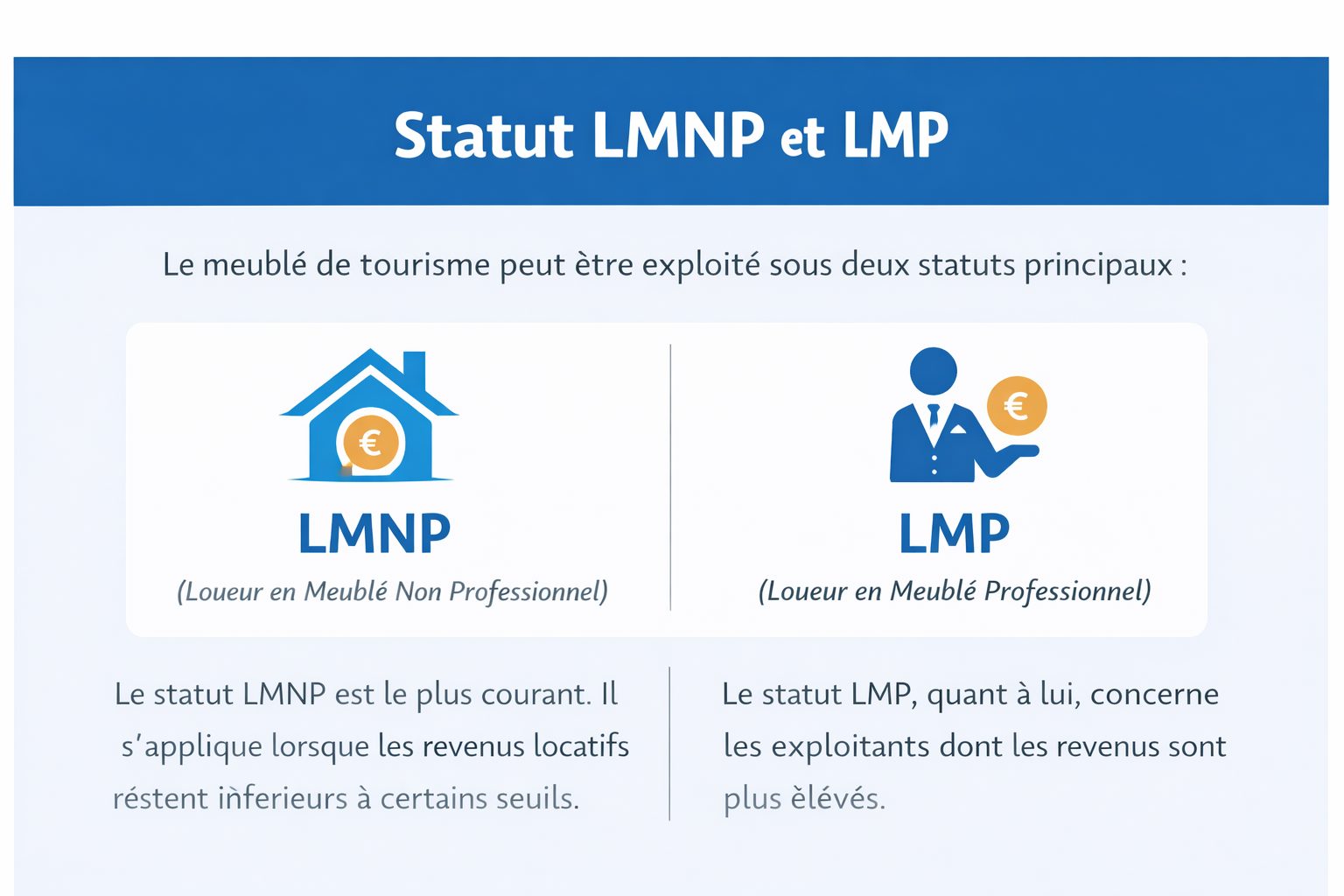
Visit furnished holiday home can be operated under two main statuses: LMNP (loueur en meublé non professionnel) or LMP (loueur en meublé professionnel).
LMNP status is the most common. It applies when rental income remains below certain thresholds. LMP status, on the other hand, applies to operators with higher incomes.
These statuses influence taxation, particularly in terms of deducting expenses and taxing capital gains.
Taxes and obligations
The operation of a furnished holiday home also involves the payment of certain taxes, the most important of which is the tourist tax, generally collected from travelers.
Depending on the municipality, other obligations may apply, such as social security contributions or the territorial economic contribution.
Tax issues therefore require rigorous management to avoid mistakes and maximize gains.
Profitability of meublé de tourisme (final validated version)
The profitability of furnished holiday home is one of the main reasons why many investors turn to this type of rental. This model offers an income potential that is often superior to that of conventional rental, but depends on several key factors that are important to analyze.
Observed average earnings
A furnished holiday home can generate significant income, particularly in tourist areas or large cities. On average, a short-term property can earn between 20% and 40% more than a long-term rental.
According to market studies relayed by platforms such as Airbnb, The most successful hosts optimize their occupancy rates and prices to maximize revenue.
However, profitability varies greatly according to location, property quality and management. A well-located property can generate significantly more income than a poorly positioned one.
Profitability factors
Several factors directly influence performance:
- location tourist areas or city centers
- seasonality High and low season
- housing quality equipment and decoration
- price management dynamic strategy
- online visibility
A property that is well-optimized according to these criteria can achieve a high occupancy rate and generate regular income. Conversely, poor positioning can significantly reduce performance.
Expected expenses
The profitability of furnished holiday home must be analyzed in the light of costs. These costs can significantly reduce profits if they are poorly anticipated.
The main expenses include :
- cleaning charges
- maintenance and repairs
- platform commissions
- condominium charges
- taxation
Good management helps optimize profitability by controlling these expenses.
Case study of a meublé de tourisme (optimized version)
Analyze a concrete case of furnished holiday home provides a better understanding of profitability mechanisms, real costs and tax choices. This study is based on a realistic example of practices observed in France.
Example of a tourist rental apartment
Let's take the example of a furnished holiday home located in a tourist town on the Atlantic coast. The 40 m² apartment is rented on a short-term basis throughout the year.
This accommodation is offered at an average rate of €90 per night, with an occupancy rate of 65% over the year. This level of performance is common in attractive areas.
Gross annual income can be estimated as follows :
- 90 x 365 days x 65% = €90 21 352 €
This type of result shows the interesting potential of a well-located and well-managed property.
Simulation of costs and benefits
To assess the real profitability of a furnished holiday home, It's essential to factor in expenses. Here's a realistic estimate:
| Expense item | Annual amount |
|---|---|
| Housekeeping | 3 000 € |
| Condominium charges | 1 200 € |
| Maintenance | 800 € |
| Platform Commission | 2 500 € |
| Estimated taxation | 3 000 € |
Total expenses : 10 500 €
Net profit is therefore :
- 21 352 € - 10 500 € = 10 852 €
This simulation shows that a well-managed property can generate an attractive net return, provided that costs are kept under control.
Analysis and lessons learned
The study highlights several key points:
- the importance of location
- impact of occupancy rate
- the weight of loads
- the role of taxation
A furnished holiday home is based on a balance between revenues and expenses. Poor management can significantly reduce profitability.
As real estate experts remind us:
“Profitability depends as much on the occupancy rate as on controlling expenses.”
In this way, analyzing a concrete case enables you to better anticipate results and adapt your strategy.
Advantages and disadvantages of furnished tourist accommodation
Visit furnished holiday home offers many advantages, but also certain constraints that it is important to anticipate. Understanding these factors enables you to make an informed decision and adapt your investment strategy.
The benefits
Visit furnished holiday home is often more profitable than conventional rentals. With short-term rentals, income can be optimized according to demand and seasonality.
Key benefits include :
- potentially higher earnings
- flexibility of use
- advantageous tax treatment (micro-BIC or actual)
- the possibility of adding value to a property
- strong tourist demand
According to trends observed on platforms such as Airbnb, Well-positioned units can achieve high occupancy rates, reinforcing the attractiveness of this model.
Disadvantages
Despite its advantages, the furnished holiday home also presents significant constraints. Management is more demanding than for a conventional rental, particularly given the frequent turnover of tenants.
The main disadvantages include :
- strict regulations
- administrative obligations
- time-consuming management
- higher costs
- dependence on seasonality
In some cities, this type of rental is highly regulated to limit its impact on the real estate market, which can restrict its use.
Overall balance
Visit furnished holiday home represents an interesting opportunity, but requires in-depth analysis. The benefits can far outweigh the constraints, provided the rules are mastered and management is optimized.
As the Service-Public.fr, The regulations aim to balance the development of this type of rental with housing needs.
As a result, this model is an appropriate investment for well-informed, well-prepared homeowners.
Regulations for furnished tourist accommodation
Visit furnished holiday home is governed by strict regulations in France to protect the real estate market and guarantee fair competition. Understanding this legal framework is essential if you are to avoid sanctions and operate your property legally.
Legal obligations
The operation of a furnished holiday home requires compliance with a number of administrative obligations. These include registration requirements, rental periods and specific authorizations depending on the commune.
The main obligations include :
- declaration at the town hall
- compliance with the 90-day or 120-day limit for the principal residence (the Le Meur law now allows town halls to lower this limit to 90 days. This is a crucial nuance for a homeowner in Paris or Lyon, for example.)
- obtaining a registration number in certain cities
- compliance with condominium rules
- tourist tax collection
According to Service-Public.fr :
“Failure to comply with obligations can result in significant financial penalties.”
Compliance with these rules is essential for safe operation.
Controls and supervision
Visit furnished holiday home is subject to regular checks in major cities, especially those facing strong real estate pressure. Local authorities monitor advertisements and check compliance with the rules.
Some municipalities have introduced digital tools to detect infringements, particularly on online platforms.
This tightening of controls is designed to control the development of this type of rental and preserve the balance of the rental market.
Possible sanctions
Failure to comply with regulations can result in severe penalties. Fines can reach several thousand euros, depending on the seriousness of the offence.
For example:
- failure to declare: up to €450
- exceeding the authorized duration: up to €10,000
- no registration: up to €5,000
- illegal change of use: up to €50,000
These sanctions show that furnished holiday home must be rigorously managed. Poor administrative management can have serious financial consequences.
How to optimize a meublé de tourisme
Optimize a furnished holiday home is essential to maximize profitability and improve occupancy rates. With the right strategy, you can turn a simple property into a truly sustainable source of income. This practical section explains how to improve performance.
Improve your ad
The quality of the ad plays a decisive role in the success of a furnished holiday home. A well-optimized ad attracts more visitors and increases the booking rate.
Here are the key elements to work on:
- bright, professional photos
- detailed and engaging description
- highlighting equipment
- optimized title with keywords
According to the best practices observed on Airbnb, ads with quality visuals perform better.
Optimize your prices
Price is a major lever for improving a company's profitability. furnished holiday home. A dynamic pricing strategy allows us to adjust prices according to demand.
Best practices include :
- increase prices in high season
- offer discounts in low season
- adjust rates according to local events
- analyze competitors' prices
A well-positioned property can therefore maximize income all year round.
Maximizing occupancy rates
The occupancy rate is a key performance indicator. The higher it is, the higher the revenues.
To improve this rate, we recommend :
- offer instant booking
- respond quickly to messages
- offer a quality customer experience
- collect positive reviews
A furnished holiday home The higher the rating, the better the referencing on the platforms, and the higher the visibility.
Improving the customer experience
Customer experience is a decisive factor in the success of a business. furnished holiday home. A successful stay generates positive reviews and builds loyalty.
A few simple actions:
- personalized welcome
- impeccable cleanliness
- modern equipment
- little extras (coffee, local guide)
A property that stands out for the quality of its experience can quickly set itself apart from the competition.
FAQ about meublé de tourisme
What is a meublé de tourisme?
A furnished holiday home is furnished accommodation offered for short-term rental to a visiting clientele. It must be equipped for immediate occupancy, with no outside input.
Do I have to declare this type of rental?
Yes, in most cases this type of rental must be declared to the town hall. This obligation enables the authorities to control the activity and regulate the local market.
What tax treatment applies?
This type of rental is subject to the BIC (industrial and commercial profits) regime. The owner can choose between the micro-BIC system or the actual system, depending on his or her situation.
Is it possible to rent out your principal residence?
Yes, a furnished holiday home can be a principal residence, but rental is limited to 120 days a year in most major cities.
Is classification compulsory?
No, classification is optional. However, it does enable you to benefit from tax advantages and improve the visibility of your property.
What are the penalties for non-compliance?
Non-compliant activity can result in substantial fines, particularly in the event of failure to declare or exceed authorized limits.
How to increase profitability?
To optimize a furnished holiday home, In order to achieve this, it is advisable to improve the advertisement, adjust prices and offer a quality customer experience.
What's the difference with a classic rental?
This model stands out for its short rental period and its transient clientele, unlike conventional rental for use as a principal residence.
Conclusion on meublé de tourisme (optimized version)
Visit furnished holiday home has established itself as an essential solution for generating rental income while retaining a certain flexibility of use. Thanks to its tax advantages, potential profitability and strong demand, this model is attracting private individuals and investors alike.
However, success in this field requires a good understanding of the rules, rigorous management and an optimized strategy. From declaration to taxation, to ad optimization, each step has a direct influence on the overall performance of the project.
As the Service-Public.fr, Compliance with regulations is essential to avoid penalties and secure your business.
In short, the furnished holiday home represents a real opportunity, provided you are well-informed and well-prepared. By applying the best practices presented in this guide, it is possible to transform a simple property into a sustainable, high-performance source of income.
To learn more about the subject, consult this encyclopaedic resource:
https://fr.wikipedia.org/wiki/Location_meubl%C3%A9e

