

Why was this law passed?
Tougher regulations have been introduced primarily in response to the housing crisis affecting the most attractive areas of the country. Here are the three pillars that prompted the legislator to act:
Rebalancing the rental market: In many cities (Bordeaux, Biarritz, Annecy or Paris), the proliferation of furnished tourist accommodation has reduced the supply of housing available to permanent residents and local workers. The aim is to put properties back on the long-term rental market.
The end of a “tax niche”: The government ruled that the deduction of 71% or 50% under the Micro-BIC scheme created an unjustified distortion of competition compared with empty-rental property, which is taxed much more heavily.
Municipal sovereignty: The law gives mayors back the power to regulate their territory. It's no longer just metropolitan areas that are concerned, but potentially every commune in France facing real estate tension.
Law no. 2024-1039 of November 19, 2024 aimed at strengthening the tools for regulating meublés de tourisme. (Légifrance).
The new tax schedule: 30%, 50% or 71% allowance?
The tax reform resulting from the Law no. 2024-1039 (partly codified in the French General Tax Code) has radically altered the thresholds for the Micro-BIC regime. The legislator's stated aim is to bring the taxation of furnished rental property into line with that of bare-rental property.
Here are the new rules applicable to your 2025 income (declared in 2026):
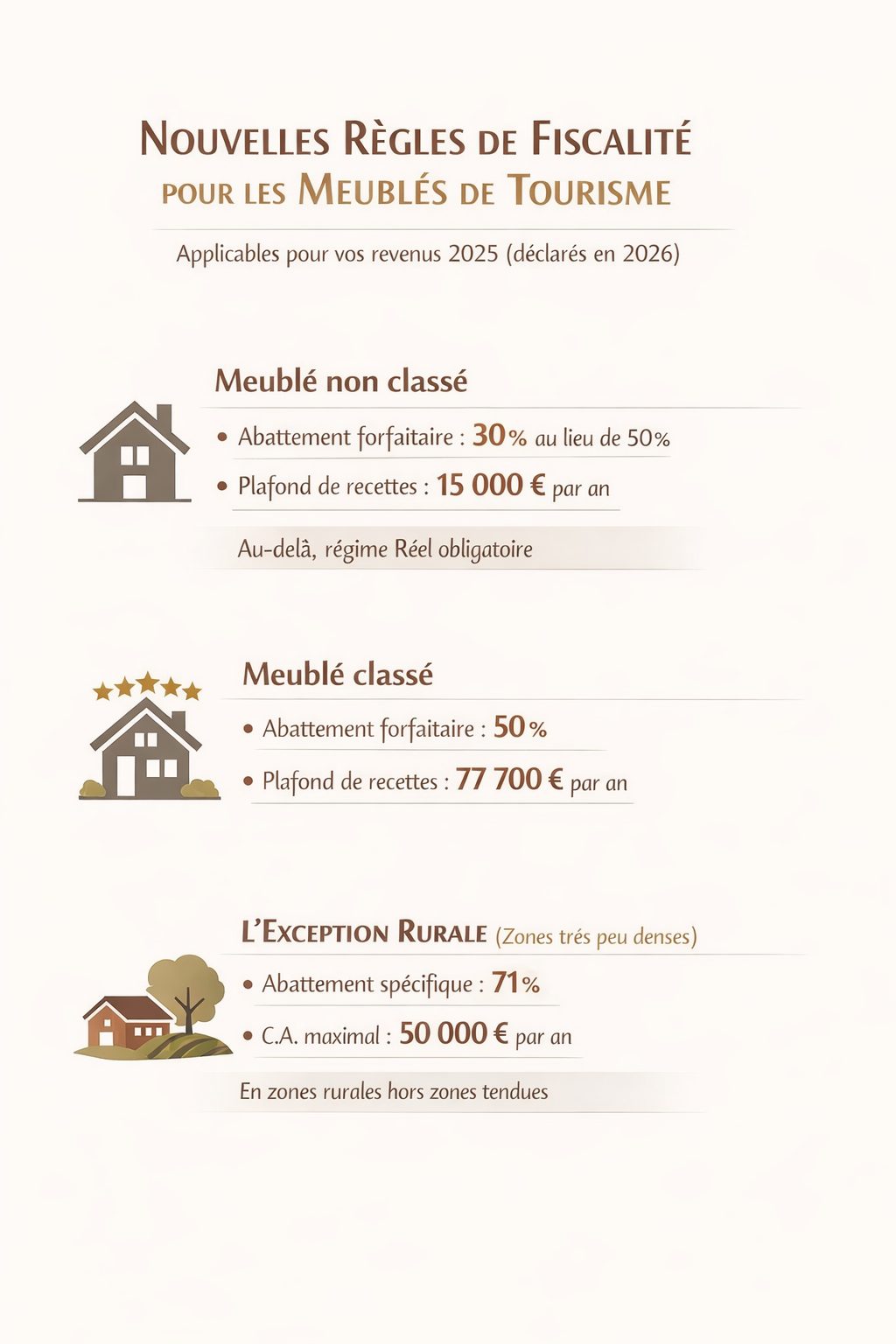
The standard system (unclassified furnished accommodation) : The flat-rate allowance falls to 30 % (previously 50 %). The revenue ceiling is now set at 15 000 € per year (Art. 50-0 of the CGI). Beyond that, you must switch to the Real regime.
Le régime du Meublé de tourisme classé : To encourage the quality of the offer, the official classification (1 to 5 stars) allows you to keep an allowance of 50 % with a revenue ceiling of 77 700 €.
The rural exception (very sparsely populated areas) : Under article 45 of the law, an additional deduction raising the allowance to 71 % is still possible for classified furnished accommodation in non-tension zones, provided that sales do not exceed 50 000 €.
Practical info: What tax system should I choose for my furnished rental? (Impots.gouv.fr).
The end of a capital gains niche: A major reference point for investors: the reform modifies the methods for calculating capital gains by LMNP (Non-Professional Furnished Rental). From now on, depreciation taken during the ownership of the property will be added back to the tax base on resale, thus increasing the tax due on disposal (partial alignment with the professional LMP system).
Energy performance (DPE): Is your home still rentable?
For a long time, seasonal rentals escaped the energy decency constraints imposed on long-term rentals. The Law no. 2024-1039 (art. 12) and the Climate and Resilience Act (Art. L. 173-1-1 du CCH) put an end to this exception to prevent “thermal flats” from flooding the tourism market.
Timetable for the ban
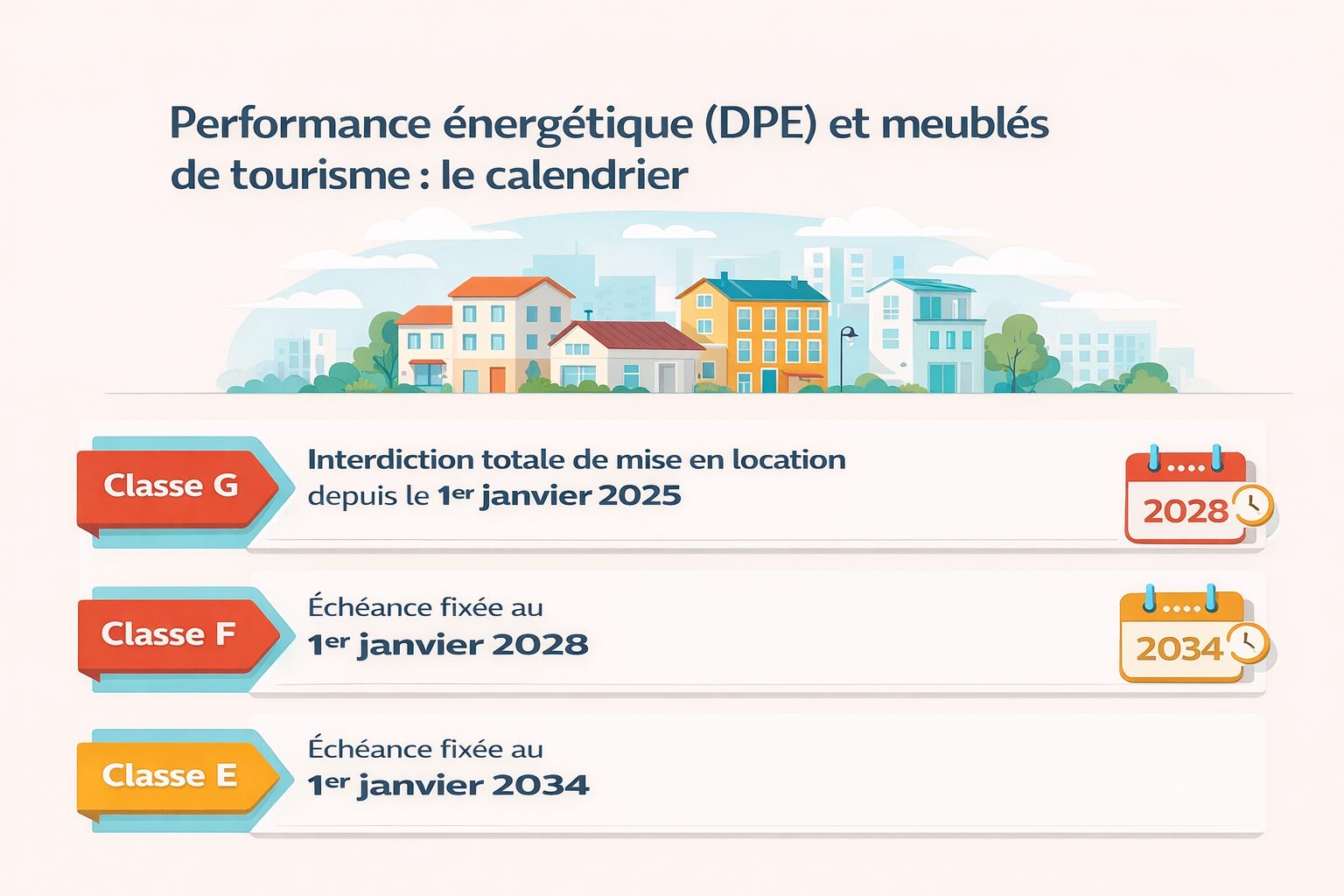
In 2026, the decency criterion has become a barrier to entry. The timetable is now aligned with that for standard residential leases:
G class : A total ban on lettings from January 1, 2025.
Class F : Maturity date: January 1, 2028.
Class E : Maturity date: January 1, 2034.
Case in point: > Pierre owns a small mountain listed G due to non-existent insulation under the roof.
The risk: If he tries to publish his ad in 2026, the platforms (obliged to check the DPE) will technically block the publication of his offer.
The penalty: In the event of an inspection, Pierre is liable to a fine and the obligation to carry out energy renovation work in order to regain the right to rent.
ECD as a condition for “change of use”
In municipalities that have introduced change-of-use regulations (such as Paris, Lyon, Annecy and the Basque Country), the mayor's office now makes authorization conditional on a minimum level of energy performance.
The rule: To convert a property into a furnished tourist accommodation, the local authority may require that the property be classified as a "furnished tourist accommodation". at least E from 2026.
Example: > You are buying former commercial premises in Bordeaux to convert them into Airbnb. To obtain authorization from the town hall, you need to prove, with an ECD, that your renovation achieves a decent level of performance. If the result is F, your rental project is administratively blocked.
Greater control for mayors
The Le Meur law gives mayors the power to suspend registration number.
Procedure: If there is any doubt as to the decency of the property, the mayor's office may require the owner to provide a DPE. If the owner fails to provide it, or if the property is rated G, the registration number is deactivated within 45 days.
The national registration number: How to obtain it before May 2026?
Until recently, the obligation to obtain a registration number was reserved for large metropolitan areas in “tense zones”. The Law no. 2024-1039 (Art. L324-1-1 of the French Tourism Code) has generalized this system to create a single national directory managed by a state digital portal.
A general obligation
From now on, any person who offers for rent a furnished holiday home, Whether it's your primary or secondary residence, you need to make a prior declaration.
Change in 2026: Even if your commune hasn't introduced any specific regulations, you need to obtain this 13-digit number to be able to publish an advert on any website.
The step-by-step procedure
You can obtain it immediately and entirely online:
Login : You log in via FranceConnect on the national furnished accommodation portal.
Statement: Enter the property's details (address, number of rooms, capacity, primary or secondary residence status).
Reception : You'll receive instant confirmation of receipt, with your registration number.
Case in point: Nadine rents a small outbuilding in her garden to Sarlat. She thought she'd be exempt because Sarlat isn't Paris.
In 2026 : Nadine receives an email from her reservation platform (or ad site) asking for her number, under penalty of deactivation. She connects to the national portal, fills in the form in 5 minutes, and gets her number back. She can then update her ads and continue to rent legally.
Sanctions and traceability
The registration number is the main control tool used by the tax authorities and town halls:
Penalty for missing number : Up to 5 000 € civil fine.
Automatic control : In 2026, the API of the national portal will communicate directly with rental sites. If a number is invalid or “duplicated” across several addresses, the advert is automatically reported to the municipal services.
Did you know? Platforms are now legally obliged to remove all ads that do not display this number by May 2026.
Our tips for maintaining your profitability despite the reform
With the reduction in tax allowances (from 50 % to 30 % for non-classified properties), the tax burden increases mechanically. For an owner, 2026 is the year in which it is imperative to optimize his other expenses to avoid seeing his net profit melt away.
Reduce or eliminate commissions: Lever #1
The commission charged by the major platforms (OTA) generally varies between 15 % and 18 %. Over the course of a year, this often represents several thousand euros, far more than your income tax bill.
Strategy: By switching part of your bookings to “Direct” via a site such as cparici.com, you immediately recover this margin.
Case in point: > For 15 000 € of annual sales :
On a classic platform : You pay about 2 250 € expenses.
Live on cparici.com : You pay 0 € commission.
The balance sheet: These savings of €2,250 more than cover the extra taxes generated by the new law. Direct payment becomes your real “tax shield”.
Obtain the “Meublé de Tourisme” classification”
Classification is no longer an option, it's a financial investment. The cost (around €200 for 5 years) is derisory compared to the gain.
Calculation : For €10,000 of income, being classified allows you to be taxed on 5 000 € (allowance of 50 %) instead of 7 000 € (allowance of 30 %).
The board: Classify your property now to benefit from the reduced rate on your next tax return.
Anticipating energy renovation
Instead of being banned from renting, take advantage of renovation grants (MaPrimeRénov’ under certain conditions) to improve your DPE.
The advantage: A well-insulated home (class C or D) rents more cheaply, more easily in winter, and guarantees the continuity of your business beyond 2028 and 2034.
Building loyalty so as not to depend on algorithms
In 2026, the algorithms of the industry's giants are increasingly opaque.
Cparici's advice: Use platforms to acquire new customers, but encourage them to book their next stay directly on your ad. cparici.com. You create a loyal customer base that costs you €0 in acquisition costs.
Conclusion
The Loi Le Meur marks the end of the “all-easy” era in seasonal rental. But for rigorous owners who adapt (classification, DPE, direct booking), it also offers an opportunity to stand out from the less prepared competition. By regaining control over your bookings without commission, you can turn these constraints into a healthier, more sustainable business model.

 Français
  English
  Deutsch