
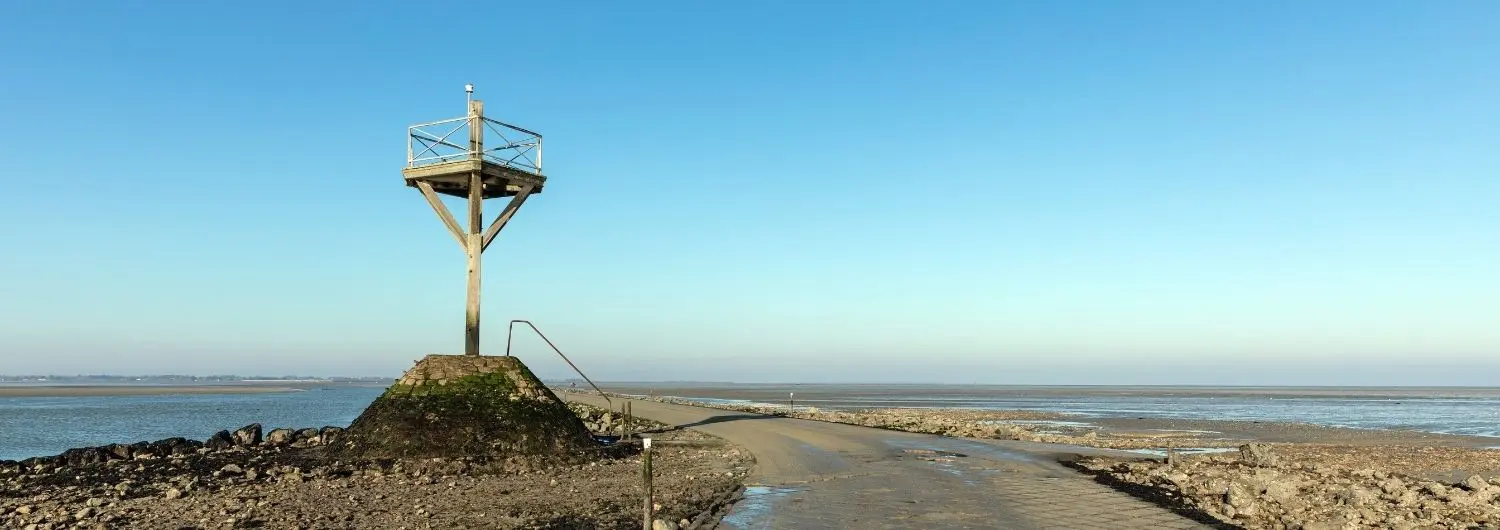
Passage du Gois: between sea and asphalt, a treasure of the Vendée coast
Visit Passage du Gois is a fascinating place: unique, dangerous, magical—and a must-see if you're visiting the French Atlantic coast. This article invites you to discover this legendary site, understand its tides, its dangers, its history—and why it remains one of the region's must-see attractions.
A road under the sea—what is the Passage du Gois?
The Passage du Gois is a flooded roadway from 4.2 km connecting the island of Noirmoutier Island (municipality of Barbâtre) to the mainland (municipality of Beauvoir-sur-Mer), in Bourgneuf Bay (Vendée).
This road is only passable at low tide : at high tide, it is completely submerged, with the water reaching between 1.5 and 3 m, or even more depending on tidal coefficients.
This unique feature—a road that is only accessible for a few hours each day—is what makes the Passage du Gois so charming (and dangerous).
Since 1971, a bridge has also connected Noirmoutier to the mainland, but Le Gois retains its uniqueness and appeal.

When to cross: the dance of the tides
One of the most important aspects of the Passage du Gois is the tide table. It determines when the road is accessible—and, more importantly, when it becomes dangerous again.
-
If the tidal coefficient is low (less than 50), the time to cross is very limited: you must aim to low tide, and cross as close as possible to low tide.
-
For a coefficient between 50 and 70, the passageway widens: you can walk through it. between 30 minutes and 1 hour before and after low tide.
-
If the coefficient exceeds 70, we have a wider range: up to 1.5 hours before and 1.5 hours after low tide.
⚠️ In addition to these landmarks, weather conditions—wind, fog, rain—can make the crossing dangerous or significantly reduce the time available.
Why the Passage du Gois is unique
-
Exceptional length : At 4.2 km, the Passage du Gois is one of the longest «submersible roads» in the world.
-
A spectacular natural phenomenon : watching the sea recede to reveal a road—then return to engulf it—is a striking sight, symbolic of the power of the tides.
-
A rich historical heritage : Le Gois has existed for centuries. Mentioned as early as 1701 on a map, it has been stabilized, paved, and marked over time to improve safety.
-
A lively place : shellfish gathering, driving or cycling, sunset walks, bird watching... Le Gois lives to the rhythm of the tides and its visitors.
History and development of Le Gois
Le Gois has not always been as we know it today. Its existence dates back several centuries:
-
The first cartographic mention dates back to 1701.
-
The first «official» crossing, often attributed to 1766, is actually subject to debate. Older records suggest a crossing as early as the 9th century.
-
Until the 19th century, the Gois was mainly used on foot or on horseback. It was then stabilized, paved, equipped with refuge markers every 500 to 1,000 meters to ensure safety in case of rising tides.
-
Classified as a heritage site, Le Gois now represents a link between history, nature, and tourism.

Visiting Le Gois today: practical tips
Here are some best practices if you want to visit the Passage du Gois:
-
Be sure to consult tide times before any trip. Several websites (and local webcams) provide the exact times of low and high tide.
-
Choose the period around low tide, respecting the margin according to the coefficient.
-
In case of fog, strong wind, or rain, avoid crossing: there is a real risk of getting trapped.
-
If you are walking or cycling, wear suitable shoes — The foreshore can be slippery or muddy.
-
Take advantage of the visit to observe nature, the bay, the birds, or for a fishing when the tide allows (clams, oysters, cockles, etc.).
Le Gois and local entertainment
The Passage du Gois is not just a simple passage—it is also a place of life, events, and traditions:
-
Among the highlights is Les Foulées du Gois, a unique running event that takes place every year on the Gois at high tide. Runners literally battle against the rising sea.
-
For photography or nature enthusiasts, Le Gois offers magnificent panoramas—sea, sky, marshes, island—at any time of day, but especially at sunrise or sunset.
-
For history buffs, the site recounts the evolution of a coastline, a link between land and sea, witness to a past linked to the tides, navigation, and island life.
The dangers to be aware of — and how to avoid them
Le Gois, spectacular as it may be, is not without its risks. Several incidents—some of them tragic—have been recorded there.
Main risks:
-
Be trapped by the rising tide — Rapidly rising water can submerge the roadway in a matter of minutes.
-
Fog or poor visibility — make crossing dangerous, especially for pedestrians or fishermen on foot, who lose all sense of direction.
-
Inaccurate tide forecast — Never rely solely on your GPS; always check the official tide table.
How to protect yourself:
-
Follow strictly the low and high tide times, taking into account the coefficient for the day.
-
Check the weather—wind, fog, rain—before you leave.
-
In case of unforeseen circumstances (rapid rising tide), head towards the refuge markers spread out along the roadway.
Why the Passage du Gois continues to fascinate
The Passage du Gois arouses curiosity for many reasons—even though generations already know about it. Here's why it continues to fascinate:
-
It's a symbol of nature in motion : the sea rising and falling, erasing or revealing the road... a powerful metaphor for time, tides, and unpredictable change.
-
He embodies the land/sea connection, the idea that one moment the road exists—the next moment, it is gone. For a visitor, it is both an adventure and a source of wonder... and respect for the ocean.
-
It offers a unique experience — driving or walking on what you believe to be solid ground, before realizing it was just a temporary crossing... A thrill, a story to tell.
-
And finally, Le Gois combines history, heritage, nature, sports, recreation — a wealth of attractions for all types of visitors.
Frequently Asked Questions about the Passage du Gois
Why is the Gois Passage only accessible at certain times?
The Passage du Gois is submerged at high tide—the road disappears under water. Only at low tide does it become visible, creating a limited window of access.
How long can you safely cross the Gois?
Depending on the tidal coefficient:
-
less than 50 → crossing very close to low tide; ;
-
between 50 and 70 → approximately 30 minutes to 1 hour before and after low tide; ;
-
more than 70 → up to 1.5 hours before and after low tide.
Can you cross on foot or by bike?
Yes—on foot or by bike, Le Gois is experienced differently. It's a great opportunity to enjoy nature, observe the bay, the birds, and the sea. But be careful: slippery pavement, risks associated with the tide, possible vehicles...
Are there any parking lots or access points from the mainland?
Yes—there are parking spaces on both sides of Le Gois, but during tourist season or when the tide is low, it can get crowded.
Is it dangerous? Are accidents common?
Le Gois presents serious risks: rapidly rising tides, fog, unforeseen events, etc. Every year, incidents are reported, including people trapped by rising waters. It is crucial to adhere to schedules and safety markers.
Conclusion
The Passage du Gois is not just a road—it is a bridge between the sea and the land, a living symbol of the power of the tides, history, and nature. For those who know how to respect its rules—the tide schedule, the tidal range, the weather—crossing the Gois is a unique adventure, a moment of wonder, an experience that is both poetic and impressive.
If you plan to visit the Vendée coast or the island of Noirmoutier, don't miss the Passage du Gois: but do it carefully — and open to the whims of the Atlantic.
You will find more information—historical, geographical, and cultural—on the encyclopedia page dedicated to the site.


