
Yurt: Complete Guide 2025
Visit yurtthe ancestral home of the nomadic peoples of Central Asia, has won over visitors with its unique blend of simplicity, ecology and lifestyle. At the crossroads of tradition and modernity, it is inviting itself into the French countryside as an alternative to conventional housing, whether for unusual tourism or permanent residence. Thanks to its circular shape and flexible wooden framework, it offers a warm, environmentally-friendly and surprisingly flexible living space. To better understand this atypical way of life, there's nothing like a detour through our guide. the country to explore the regional and cultural riches that surround it.
Origins and definition of Yurt
Visit yurt finds its origins among the nomadic peoples of Central Asia, especially the Turks and Mongols, and represents a portable circular habitat designed to track livestock movements. The term yurt comes from Russian jurtitself borrowed from the Turkish yurtmeaning "house" or "estate", which underlines the link between the word and the notion of "home". clan, territory and nomadic home.
Visit yurtor ger in Mongolian, is traditionally made up of a wooden framework (a lattice called a "khana"), covered with felt or insulating fabricssometimes supported by a central wooden circle forming a domed vault. It is designed to be easy to assemble, disassemble and transportideal for a nomadic lifestyle on the steppes or in rural areas of Mongolia, Kyrgyzstan, Kazakhstan, Turkey, Uzbekistan, Afghanistan, etc..
According to some studies, the first yurt-like structures emerged among the Scythians between 600 B.C. and 300 A.D.over the millennia into more sophisticated, felt-insulated dwellings, until they became symbolic structures essential to the traditional way of life.. As early as the Middle Ages, travellers such as Guillaume de Rubrouck described these mobile yurtssometimes used by khans as mobile palaces on carts (ger tereg).
In short, the section shows that yurt is much more than just a shelter: it's a cultural icona millennia of nomadic architectureand a reflection of a lifestyle deeply connected to mobility, community and the environment.
Typologies and cultural variants
There are several yurt types in the different regions of Central Asia, each tailored to the weather conditions and cultural traditions of its people. These differences testify to the diversity of uses around the yurtAll of them have a common base: a dismountable, circular, wood-frame dwelling with a conical or domed roof.

Visit Mongolian yurt
Visit Mongolian yurt is much more than just a nomadic dwelling: it's the living emblem of a thousand-year-old culture deeply rooted in the steppes of Central Asia. Used for centuries by the nomadic peoples of Mongolia, the circular house in canvas and wood combines mobility, climate resistance and symbolic harmony.
Traditionally called "ger" in Mongolian, the Mongolian yurt is based on a wooden structure (trellis, poles and central ring) covered with felt and waterproof canvas. This ingenious system ensures rapid assembly and excellent thermal insulationable to withstand the extreme temperatures of the steppe: from -40°C in winter to +40°C in summer.
Every element of the Mongolian yurt has a spiritual significance. The circular roof, open in the middle (the toono), symbolizes the sky and the universe. The central stove represents the heart of the home. The interior layout follows ancestral codes: men on the right, women on the left, sacred objects at the back. This division embodies the social and cosmic balance so dear to Mongolian culture.
Today, the Mongolian yurt has a following far beyond Mongolia's borders. In France and Europe, it is used as a ecological habitat, unusual accommodationor wellness area. Its warm aesthetics, low environmental footprint and flexibility appeal to fans of voluntary simplicity and slow life.
Easily dismantled, durable and adaptable to different uses, the Mongolian yurt is a perfect example of the alliance between tradition and modernity. It is an inspiring response to the contemporary challenges of sustainable, environmentally-friendly living.
Visit Kazakh yurt
Visit Kazakh yurt or kyrgyzis characterized by a structure that is often taller, with a sloping roof and an interior rich in color, embroidery and symbols. In particular, the Kyrgyz version is characterized by a more rounded dome and the use of more decorative materials in the toono's cladding. These variants are designed for slightly wetter or windier climates than the Mongolian steppe, while maintaining portability.
In Afghanistan and Turkmenistan, some versions of the yurt exist, sometimes under other names, such as boz ui or alash. These habitats share the same construction logic, but can incorporate semi-rigid walls or structures for semi-permanent use.
Finally, in the West, manufacturers have adapted the traditional yurt to our climatic and comfort standards, giving birth to modern yurts PVC fabric, treated wood, or even double-glazed windows. These models are often used in glampingThis is the type of light leisure home or ecological studio that is often found in France.
These typologies reveal the ability of the same architectural model to evolve reinventing for different cultureswhile preserving common identity related mobility and theecology.
Yurt rental
Visit yurt rental is an increasingly popular option for discovering new accommodation. unusual, comfortable and original. In France, offers vary according to the type of yurt (traditional, contemporary or luxury), the number of people and the options included, with well-defined price ranges at different levels.

Average rates for a night in a yurt
According to specialist platforms, prices for yurt location often start around 40 € to 60 € per night for simple accommodation, often without private bathroom facilities. Offers at 55 € only are available in certain regions, such as Auvergne or Lot, for two to four people.. Accommodation is also available in 65 € to 80 €/nightincluding additional equipment or a more aesthetic ambience.
Yurt rental, Medium range: comfort and services
Sites like Cabanes de France list yurts with prices ranging from 80 € to 110 € per nightaccording to location (central France, Burgundy, Provence, Brittany, etc.) and services (terrace, bedding, breakfast). . Some structures, such as spacious yurts for 6 to 8 people, offer a comfortable stay from 110 €.
Top-of-the-range stays or more complete comfort
In contemporary or luxury yurtsrates range from 120 and €150 per nightsometimes more, depending on options such as spa, natural swimming pool, private kitchen or stylish decor.. Structures such as Au Bonheur Nomade in Vendée offer yurts up to 50 m² for 4 to 6 people, with natural swimming pool, full kitchenette and relaxation area on a large wooded plot. Prices start at around 80 € per nightbut go up with equipment such as spas and jacuzzis.
Yurt rental near Paris / Île-de-France
For an unusual stay close to the capital, offers such as a yurt for 4 to 6 people in the Île-de-France region are available from 140 €/nightwith private sanitary facilities, kitchenette and wood-burning stove on nature-filled estates, often close to Provins or Disneyland..
Example of specific ads
-
The Templar Yurts (Oise) welcome up to 12 people, with prices starting at 140 €/night for two peopleexpandable according to capacity and options.
-
A yurt accessible via Gîtes de France in the Manche département (Dennehville) offers one night for two, with linen and heating provided, for similar prices..
Why rent a yurt?
Choose a yurt locationA holiday in the heart of nature means an authentic change of scenery, with circular, often eco-friendly, accommodation. These stays offer direct contact with the landscape, a cosy atmosphere and sometimes an optional spa or Nordic bath, perfect for romantic getaways or family vacations.
Tips for the right choice
-
Consult customer reviews to check quality (cleanliness, welcome, comfort).
-
Compare rates by season Summer and long weekends often drive up prices.
-
Check the included services (linen, cleaning, breakfast, pool or spa access).
-
For larger groups, we recommend spacious yurts (6 to 8 people) or groups of accommodations on the same estate.
Visit yurt location in France offers a wide range of possibilities, from low-cost stays as low as 40 €/night to luxurious experiences in over €150We offer a wide range of accommodation options, depending on comfort, size, services and location. Whether you're looking for a low-cost nature getaway or a high-end immersion, the yurt can adapt to all types of unusual stay. Don't hesitate to ask me for suggestions depending on your budget, region or number of people!
Symbolism and ritual aspects
Visit yurt is more than just a functional habitat: it is a sacred symbol in many nomadic cultures, notably Mongolia, Kyrgyzstan and Kazakhstan. Its circular shape, central hearth and interior layout are not the result of chance, but the reflection of a long-established cosmic vision of the worldin which the home becomes the center of the family and spiritual universe.
The circular plan of the yurt represents theinfinite and unity. In Mongolian tradition, the circle is associated with skyto the cycle permanenceand the connection between man and nature. Le toonothe central opening at the top, symbolizes the passage between the terrestrial and celestial worldsthrough which sunlight enters. The focus, or central stoverepresents the heart of the home, around which the social and ritual order is built.
In the traditional yurt, every element has its place, and the interior traffic codes are strictly governed by tradition. The entrance, facing south, opens onto a space divided into two zones: on the right, the masculine space (place of honor, sacred objects and guests); on the left, the feminine space (hearth, kitchen, domestic objects). At the far end, opposite the entrance, is the altar or religious objects. It is no walking on the thresholdto lean on the central pillaror to pass between the two posts supporting the dome.
Visit rites of entry in the yurt vary from people to people, but always retain a sacred aspect. In Mongolia, for example, you enter with your right foot first, and turn clockwise. The respect for customs ensures the blessing of the home and the balance of protective forces within it.
Visit yurtbeyond its architectural appearance, is therefore a sacred place of cultural transmission, where family ceremonies, teachings and rites linked to nomadic life take place. It embodies a spiritual balance and social, a link between ancestors, the living and the natural elements.
Interior design and modern comfort
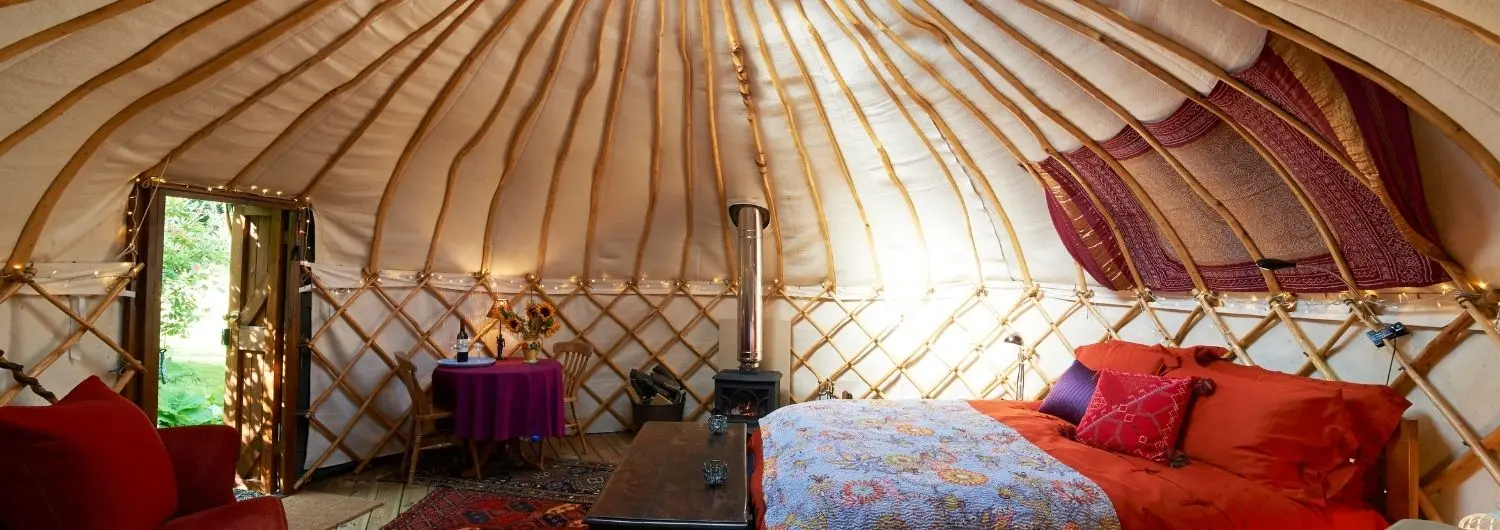
Far from the rustic image sometimes associated with yurthis interior design can now rival that of a conventional home. Thanks to modern techniques and environmentally-friendly materials, the yurt combines functionality, aesthetics and comfort, while retaining its nomadic charm.
Circular layout and modularity
The round shape of the yurt requires a specific layout, often designed in a circular fashion around the central stove. This layout promotes heat circulation and gives the impression of an open space. open volume much appreciated. Visit modular partitionscircular shelves, and custom-made furniture allow intelligent space optimization, even for surfaces of 20 to 40 m². Some models feature a mezzanine, integrated under the cupola, to accommodate a bed or desk.
Thermal and acoustic comfort
Visit modern yurts can benefit from effective insulation thanks to eco-friendly materials such as sheep's woolthe hempthe wood fiber or reflective multi-layers. Airtightness, essential in rainy regions, is ensured by breathable tarpaulins and waterproof roofs. Heating is often provided by a wood stovebut some models also include electric heating or pellet stove. Thermal comfort is perfectly controlled in both summer and winter.
Sanitary, kitchen and autonomy
In a habitable yurtThese spaces are often separated by wooden or fabric partitions. These spaces are often separated by wooden or fabric partitions. Energy autonomy is another feature often sought: solar panels, dry toilets, rainwater harvesting and solar hot water tanks enable comfortable, sustainable living, even off-grid. Manyeco-friendly or permaculture in France are adopting the yurt as main ecological habitat.
Yurt prices
Visit yurt price varies greatly according to size, type (traditional or contemporary), materials, options and construction method. Whether you're looking for a standalone unita main habitator a unusual accommodationIt's essential to understand price ranges in order to prepare your project properly.
1. Traditional yurts for small budgets
Visit traditional yurts Mongolian type, which can be purchased in kit form, are often available from 2,950 excl. VAT for 15 m² of floor space (≈ €3,540 INCL. VAT) . For larger sizes: 20 m² = €3,600 excl. tax (≈ €4,320 inc. VAT), 27 m² = €4,300 excl. tax, up to 50 m² at over €9,125 excl. tax (≈ €10,950 inc. VAT).. In low-tech self-build, some very light models can be assembled for a budget of between 600 and €2,200without glazing or insulated floors, often do-it-yourself using recycled or local materials.
2. Customized contemporary yurt: comfort & standards
Visit contemporary yurt is based on a solid wood structureoften in Douglas fir or maritime pine, combined with a high-performance acrylic or PVC exterior canvas. It is equipped with a skydome (single- to triple-skinned), double-glazed joinery and a insulated floor mounted on stilts or adjustable feet. These elements guarantee thermal and acoustic insulation and excellent durability..
Some brands go so far as to use RE2020-certified structures, wood cladding and more than 10 cm of insulation in cellulose wadding, wool or recycled polyester - ensuring all-season comfort and regulatory compatibility for permanent housing or ERP.
Manufacturers of contemporary yurts offer turnkey models including insulation, flooring, watertight dome, glass doors and meticulous finishing. Prices often start at around 270 €/m² excl. tax for ERP-compliant models, excluding delivery and assembly. For example, a 50 m² yurt costs around 13,500 EXCL. TAX according to this price list. Other manufacturers, such as I Love Yourte, offer models from 6 m (≈ 30 m²) à 15,380 EXCLUDING VAT, 7 m (40 m²) approx. €21,500, up to 10.8 m (88 m²) for €44,950 plus VAT, without assembly. Participatory or professional assembly adds between €3,600 and €12,000, depending on size and options.
The "Elegance" bespoke models include reinforced insulation, floor, skydome, windows and mezzanine, with a base price of €25,000 for 38 m², €28,000 for 49 m² and around €32,000 for 63 m². .
3. Modern kit or self-build models
Kits such as those from Yourteco offer contemporary yurts from 70 m² for €30,000 to €40,000 incl. VATincluding thermal study, permits, support, etc.. That's a price per m² of around €430 to €570 incl. VAT. For complete self-build, a 77 m² model (107 m² floor) would cost around 45,000 INCL. VATThe cost per m² remains around €650, before options such as drainage or solar panels (adding several thousand euros)..
4. Specific examples: actual market rates
-
20 m² yurt, "Flex Yourte" model: 3,900 € INCL. VAT for 10 m² (~390 €/m²), delivered.
-
Yurt 19-20 m² : 5,800 INCL. VATwith wooden structure, insulation, double-glazed door, 75 mm polyester felt .
-
Yurt 28 m² model 6 m : 7,240 € INCL. VATincluding insulation, glazed door, PVC/acrylic walls .
5. Factors influencing the cost of a yurt
-
Surface The larger the yurt, the lower the price per m², but the higher the total cost.
-
Insulation basic versus 4-season option (reinforced insulation ≈ 600 € extra for 5 cm of wadding).
-
Options insulated floor, transparent dome, French windows, mezzanine, electric packages or air-conditioning significantly increase the price.
-
Delivery and assembly regional packages between €600 and €1,000 incl. VAT, or €5,000-12,000 for complete professional assembly.
-
Regulations ERP or residential models requiring permits entail study, permit and thermal adaptation costs.
Summary: standard price range
-
Traditional yurt, small model 15-20 m² self-built : 600 € - 4 000 €
-
Contemporary 30 m² yurt (turnkey) : 15 000 € - 22 000 €
-
Large-format contemporary yurt (≥40 m²) 25,000 - 45,000 depending on options, permissions and autonomy
Visit yurt price depends on many parameters, but is often more affordable than conventional construction. For a made-to-measure project, it's best to compare different quotes from different manufacturers or builders.
Interior design
The decoration of the yurt often reflects an oriental, ethnic or bohemian inspiration. Visit colorful rugs, Mongolian hangingsThe warm, natural ambience of the space is enhanced by the use of soft lighting and raw wood furniture. Some even incorporate stained glassand panoramic windows or portholes to take full advantage of natural light.
Thanks to these improvements, the yurt becomes a complete living spacecomfortable, attractive and perfectly suited to modern, responsible living, without abandoning its nomadic roots.
Ecological and economic benefits
Choosing to live in a yurt or stay is much more than a simple architectural choice. It's a profoundly ecological and economicwhich responds to today's aspirations for sobriety and back to nature and sustainable living.
Low ecological footprint
Visit yurt is a model ofeco-designed housing. Made from natural materials (wood, felt, canvas), it requires few resources for construction and maintenance. Its no foundations and its ability to be dismantled mean that it does not degrade the soil, making it an ideal structure reversible environmentally friendly. What's more, many modern models feature integrated bio-sourced insulationwaterproof but breathable fabrics, and installations for theenergy self-sufficiency.
Thanks to its low heating requirements (thanks to its compact size and insulation), the energy consumption of a yurt is much lower than that of a conventional home. It's an excellent example of passive or semi-passivewith thermal performance adapted to the French climate.
Zero-development habitat
At a time when public policies are seeking to limit the number ofsoil artificialisationthe yurt is the solution of the future. It integrates perfectly intoalternative urbanismof rural third placesorcollective eco-placesThis means it can be installed in rural areas without having a lasting impact on the environment. It can therefore be installed in rural areas without having a lasting impact on the environment.
Affordable cost
On the economic front, the yurt is very competitive. A 20 to 30 m² model can cost between €7,000 and €20,000, depending on the materials and options chosen. Even with interior fittings (sanitary facilities, stove, solar panels), the cost remains well below that of a traditional house or wooden chalet. This makes them an ideal solution for people wishing to settle in quickly, with a minimum of investment. low budget or launch a self-build project.
Maintenance is also reduced: no painting, little heating, minor repairs. The longevity of a well-maintained yurt can exceed 20 years, with covers needing to be replaced every 10 to 15 years, depending on the climate.
Tax and grants
Visit demountable yurts are not subject to property taxIn some cases, local subsidies may be granted to cover the cost of the installation, unless it becomes permanent (connections, concrete screed, etc.). In certain cases, local subsidies may be available for green projects or rural insertionThis is particularly true for young farmers and eco-tourism projects.
Constraints and limits of yurt living
Despite its many advantages, living in a yurt is not always straightforward, and it's essential to know the right technical, legal and practical limits that this type of housing implies. This transparency helps to avoid unpleasant surprises, especially for long-term installation projects.
Complex regulations
One of the main obstacles is administrative. In theory, a demountable yurt can be installed without any formalities if it is used for less than 3 months on private land, and has no foundations or connections. In practice, however, many local authorities require a prior declarationor even a planning permission as soon as the yurt becomes a principal residence or exceeds 20 m².
What's more, some PLU (Plans Locaux d'Urbanisme) prohibit light habitats, or restrict their use to certain areas. It is therefore crucial to check legal feasibility before investing. In natural or agricultural zones, authorizations are rare, unless a coherent agricultural or educational project is integrated.
Life in a humid environment: maintenance and wear
Visit French climateoften wetter than the steppes, requires adaptation. Without a good ventilationa high-performance insulation and a well-designed roof, problems with condensation or mildew may appear. Canvas must be regularly maintainedThey may need to be replaced every 10 to 15 years, depending on climatic conditions.
Reduced space
Visit yurt offers reduced living space, especially for families or people who need a lot of storage space. Even if you can go up to 50 m², the lifestyle must remain minimalistwith good management of space and furniture. This requires voluntary reduction of possessionsand rigorous daily organization.
Sound comfort and privacy
Visit flexible walls and thin fabrics provide poor insulation from external and internal noise. Living together in a yurt therefore requires a good level of cohabitation and mutual respect. Some people may also feel a lack of privacy in this open, unpartitioned habitat.
Social acceptance
Finally, there is still a certain social distrust towards alternative habitats. Living in a yurt can lead to misunderstandings and even tensions with neighbors and local authorities. It is therefore essential to preparing your projectto communicate with local residents, and to obtain the support of local elected representatives in a clear, well-documented approach.
Find out more about yurts, it's over here!
