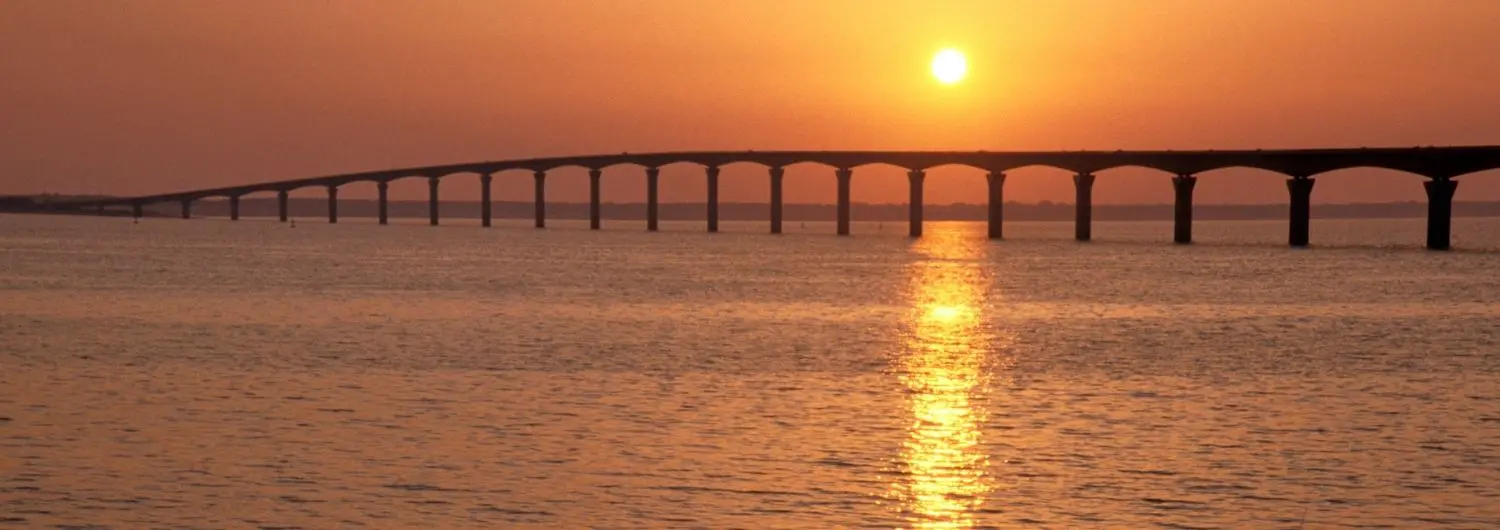
Fascination and history of the Ile de Ré bridge
From idea to realization: the genesis of a major project
The idea of building a fixed link between the island of Ré and the mainland dates back to the late 19th century, with initial proposals for a tunnel. However, it was not until 1974 that the project took shape, with the decision by the Conseil Général de la Charente-MaritimeThis was stimulated by the increase in maritime traffic. The contract was awarded to Bouygues in 1986, bringing the cost of the project to 385 million francs (58.7 million euros), rising to over 600 million with the inclusion of the access roads.
Technical and architectural challenges
At almost 3 kilometers long, the bridge ranks as the second longest in France, surpassed only by that of Saint-Nazaire. Its construction required the use of 46 pre-stressed concrete piers and prefabricated voussoirs, forming a remarkably elegant structure that rises 42 meters above the sea, allowing ships to pass.
Its resilience to thermal expansion, high winds and seismic shocks is ensured by an ingenious skid system, giving the bridge deck freedom of movement.
The bridge in history: milestones and evolution
Inaugurated on May 19, 1988 after four years of construction, the bridge on the Ile de Ré has been the center of significant controversy, pitting those who saw it as a vehicle for development against those concerned about the island's environment and authenticity. It has also been marked by incidents, notably the accident on September 12, 2018 when a truck hit one of the piers, causing the temporary closure of the bridge.
From its opening to the present day, toll rates have evolved, rising from 10 francs (1.52 euros) in 1988 to 16 euros in 2020, reflecting economic and usage changes over the years.
The Pont de Ré today: a vital structure for the island
Bridge description: dimensions, structure and capacities
Since its inauguration in 1988, the Ile de Ré bridge has been an essential link between the island and the mainland. The cable-stayed bridge boasts impressive dimensions: a length of 2926 meters, a width of 15.5 meters and a height of 42 meters above sea level.
Designed to facilitate traffic flow, the bridge offers two lanes in each direction, plus a dedicated path for cyclists and pedestrians. With a maximum load capacity of 13,000 tonnes and a speed limit of 110 km/h, it is the second longest bridge in France, just after Saint-Nazaire.
The importance of the bridge for access and the local economy
The advent of the bridge revolutionized access to the island of Ré, previously dependent on ferry boats. This infrastructure has been a key driver of economic and tourism development, welcoming over 3 million visitors annually. It has also improved the lives of residents, giving them easier access to the mainland for work, study or healthcare.
The bridge represents a vital artery for the island, contributing around 40 % to its gross domestic product.
Safety and traffic management: strategies and innovations
Faced with the challenges of safety and traffic management, especially during the high season when the flow of traffic can reach 30,000 vehicles a day, the Ile de Ré bridge incorporates a range of measures. Equipped with surveillance cameras, speed sensors, variable message signs and emergency bollards, it guarantees a safe experience for all users.
The toll system, adjusted according to season, vehicle type and payment method, plays a crucial role in regulating traffic. Revenues generated are reinvested in bridge maintenance and projects that benefit the island's environment and heritage. In addition, digital tools such as webcams, journey time sensors and traffic alerts improve user information.
Practical information for travellers
Rates and payment options: subscriptions, reduced rates
The Ile de Ré bridge involves a toll, with rates fluctuating according to season, vehicle type and method of payment. A round trip by car costs between 8 euros in off-peak periods and 16 euros in peak periods.
Subscriptions are available for permanent or secondary residents, professionals and businesses, offering low or unlimited rates. Payment options include cash, credit card, cheque and electronic toll collection.
Tips for a smooth and pleasant crossing
For the best possible crossing of the Ile de Ré bridge, it's essential to follow safety and traffic regulations: respect the 110 km/h speed limit, no overtaking, no stopping and no U-turns. Also pay close attention to variable message signs for traffic information, incidents or roadworks.
It's a good idea to avoid busy periods, especially Saturdays in summer, to avoid traffic jams. Checking webcams and online traffic information can help you plan your journey.
Exploring the Ile de Ré: tips and points of interest after the bridge
Once on the Ile de Ré, a multitude of landscapes, villages, beaches, salt marshes and natural sites await you.
Cycling is the most environmentally-friendly way to explore the island. With over 100 km of cycle paths, you can easily reach attractions such as the Baleines lighthouse, the Trousse-Chemise wood, the port of Saint-Martin-de-Ré or the Lilleau des Niges nature reserve.
The island of Ré is also famous for its rich cultural, historical and gastronomic heritage, accessible through its museums, churches, fortifications and markets. It's the perfect destination for relaxation, entertainment and wonder.
Conclusion
From its inauguration in 1988The Ile de Ré bridge is an exceptional feat of engineering, linking the mainland to this much-loved island. Born of considerable ambition, this project overcame major technical and architectural challenges to become an emblematic link between the mainland and the island, a destination of choice for tourists and nature lovers alike.
This structure offers breathtaking views over the ocean and the characteristic landscape of the Ile de Ré. It involves a toll, the rates of which fluctuate according to the time of year, the type of vehicle used and the method of payment chosen.
Equipped with advanced safety and traffic control systems, the bridge guarantees smooth, safe traffic flow for all users. It opens the door to the discovery of the Ile de Ré, an area of varied landscapes, including picturesque villages, magnificent beaches, salt marshes and various exceptional natural sites.
The island also boasts a rich cultural, historical and gastronomic heritage, making the Ile de Ré bridge much more than a simple means of crossing: it's an invitation to adventure.
To plan your visit to the Ile de Ré, we recommend that you consult the practical information presented in this article. And if exploring the Ile de Ré appeals to you, follow our advice and discover the wonders we've highlighted for an unforgettable experience.
You'll discover the unique charm of the Ile de Ré bridge and all that the island has to offer as an exceptional destination.
FAQ
How much does it cost to cross the Ile de Ré bridge?
The cost of crossing the bridge over the Ile de Ré varies according to the season and the type of vehicle. For a car or camper van, it costs €8 in low season (September 12 to June 19) and double to €16 in high season (June 20 to September 11).
How not to pay for the bridge on the Ile de Ré?
To avoid paying for the Ile de Ré bridge, you have several options, depending on your profile:
- As a principal resident, benefit from free passage with an identification card or telebadge.
- Secondary residents can purchase an annual pass via telebadge at €100 for unlimited passages.
- Disabled people with a disability level of at least 80% are eligible for free travel under certain conditions.
- Employees from the island or the mainland can cross for €0.50 per crossing all year round, with proof of identity.
- Visitors can cut costs by avoiding peak times, using electronic toll collection, or take advantage of a low €4 fare in the very low season, from November 15 to March 1ᵉʳ.
How long is the bridge to the Ile de Ré?
The bridge to the Ile de Ré spans 2,926.5 meters, making it the second longest bridge in France, just behind the 3,356-meter Saint-Nazaire bridge.
Do Ile de Ré residents pay for the bridge?
No, residents of Ile de Ré benefit from free passage. This free pass is granted on presentation of an identification card for principal residents, issued by the Département.