
Visit Canal du Midi
Visit Canal du Midi est l’une des merveilles du génie civil français, classé au patrimoine mondial de l’UNESCO depuis 1996. S’étendant sur 240 km, il relie Toulouse to the sea Mediterranean in Sète. Aujourd’hui, il est prisé pour les croisières fluviales, les balades à vélo et les découvertes culturelles.
History of the Canal du Midi
Le projet de relier l’Atlantique à la Méditerranée remonte à l’Antiquité, mais c’est au XVIIe siècle que Pierre-Paul Riquet concrétise cette idée. En 1666, sous l’impulsion de Colbert et de Louis XIV, les travaux débutent. En seulement 15 ans, le canal est achevé en 1681, mobilisant des milliers d’ouvriers. Malheureusement, Riquet décède quelques mois avant l’inauguration officielle.
An ancient dream come true
L’idée de relier l’Atlantique à la Méditerranée par un canal intérieur remonte à l’Antiquité. Cependant, c’est sous le règne de Louis XIV que ce projet ambitieux voit le jour. En 1666, le roi signe l’édit de Saint-Germain, autorisant la construction du canal, confiée à Pierre-Paul Riquet
A colossal construction site
Les travaux débutent en 1667 et s’étendent sur 14 ans. Des milliers d’ouvriers creusent le canal à la pelle et à la pioche, traversant des terrains variés et surmontant de nombreux défis techniques. Riquet conçoit un système ingénieux d’alimentation en eau, captant les eaux de la Montagne Noire pour alimenter le canal au point le plus élevé, le seuil de Naurouze;
A major technical innovation
Le canal comprend 328 ouvrages d’art, dont des écluses, des aqueducs, des ponts et des tunnels. Parmi les plus remarquables figurent les écluses de Fonserannes et le tunnel de Malpas, premier tunnel navigable d’Europe. Ces structures témoignent de l’ingéniosité et de la maîtrise technique de l’époque .
L’héritage de Pierre-Paul Riquet
Malheureusement, Riquet décède en 1680, un an avant l’inauguration officielle du canal en 1681. His work lives on, revolutionizing river transport in France and contributing to the economic development of the south of the country. .
International recognition
En 1996, le Canal du Midi est inscrit au patrimoine mondial de l’UNESCO, en reconnaissance de son importance historique et technique. Aujourd’hui, il est prisé pour le tourisme fluvial, offrant des paysages pittoresques et une plongée dans l’histoire de France .

Architecture and remarkable structures
The Canal du Midi is dotted with impressive structures.
-
Locks These include the Fonserannes locks in Béziers, a set of nine staircase locks.
-
Canal bridges : comme celui de Béziers, permettant au canal de franchir l’Orb.
-
Malpas tunnel : premier tunnel navigable d’Europe, long de 173 mètres.
-
Saint-Ferréol basin : réservoir principal alimentant le canal, une prouesse technique de l’époque.
Locks: essential structures
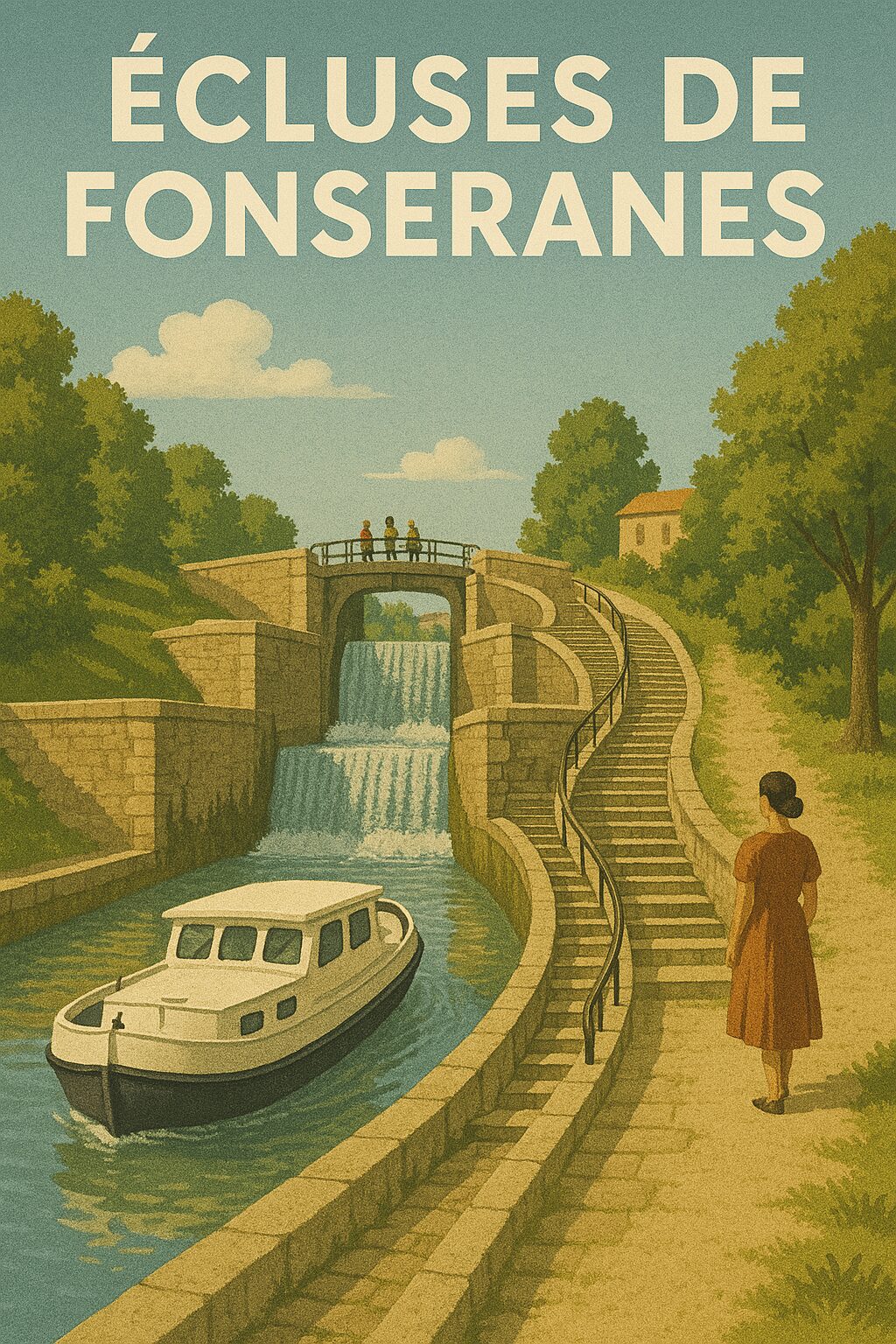
Le canal compte 63 corps d’écluses, totalisant 101 bassins, conçus pour gérer les variations de dénivelé. Les écluses de Fonseranes, situées à Béziers, sont particulièrement impressionnantes : un escalier de huit bassins permettant de franchir un dénivelé de 21,5 mètres sur 300 mètres de long. Leur forme ovoïde, spécifique au canal, offre une meilleure résistance à la pression des terres environnantes.
Visit Fonseranes locks
Visit Fonseranes lockslocated in Béziers in the Hérault department, is one of the most emblematic structures of the Canal du Midi. Designed by Pierre-Paul Riquet, a native of the town, they represent a feat of 17th-century engineering.
An ingenious structure
The ensemble, often referred to as the "Octuple", comprises eight ovoid basins and nine doorswhich allows boats to overcome a height difference of 21.5 meters over a distance of 300 metres . This staircase configuration facilitates navigation between the different altitudes of the canal.
Evolution and modernization
Initially, boats continued towards the Orb via a ninth lock, now disused. In 1858, the construction of a canal bridge altered the layout, rendering some parts of the lock obsolete. . Since then, only six of the eight locks have been operational, with a side exit at the seventh basin.
A major tourist attraction
Listed as a UNESCO World Heritage Site since 1996, the Fonseranes locks attract many visitors every year. The site was redeveloped in 2017 to improve public reception, including the renovation of the maison du coche d'eau, transformed into a tourist office and scenovision area. .
A unique experience
Watching the boats pass through the locks is a fascinating spectacle. The maneuvers, though complex, take place in a peaceful setting, surrounded by gardens and shady paths, offering visitors an immersion in the history and beauty of the Canal du Midi.
Canal bridges: daring passages
The Répudre canal bridge, built between 1676 and 1680, is the oldest navigable canal bridge in the world. It allows the canal to cross the Répudre stream at Paraza. D’autres ouvrages, tels que les ponts-canaux de l’Orbiel à Trèbes ou du Fresquel à Carcassonne, illustrent également cette ingéniosité.
Visit Répudre canal-bridge
Visit Répudre canal-bridge, situé à Paraza dans l’Aude, est un ouvrage emblématique du Canal du Midi. Built between 1676 and 1680, it is regarded as the France's first navigable canal bridge et l’un des plus anciens d’Europe .
A technical feat from the 17th century
Conçu par Pierre-Paul Riquet, maître d’œuvre du canal, et réalisé par l’architecte Emmanuel de l’Estang, le pont-canal de Répudre permet au canal de franchir le ruisseau éponyme, un affluent de l’Aude sujet à des crues soudaines . Long de 90 mètres, il repose sur une arche unique en maçonnerie, conférant à l’ouvrage une apparence monumentale .
History and construction challenges
La construction du pont-canal a été marquée par des difficultés techniques et financières. En 1680, un différend oppose Riquet à de l’Estang concernant des paiements en suspens, conduisant à l’emprisonnement de l’architecte pendant dix mois. Il sera libéré peu avant l’inauguration du canal
Protection and heritage
Listed as a historic monument in 1942, the Répudre canal bridge is recognized for its exceptional heritage value. Wikipédia, l’encyclopédie libre. Il constitue aujourd’hui une étape incontournable pour les visiteurs du Canal du Midi, offrant un témoignage vivant de l’ingéniosité des ingénieurs du XVIIe siècle.
Le pont-canal de Répudre illustre parfaitement la capacité d’adaptation et d’innovation des concepteurs du Canal du Midi face aux défis naturels et techniques de leur époque.
The Malpas tunnel: a feat of underground engineering
Le tunnel de Malpas, long de 165 mètres, est le premier tunnel navigable d’Europe. Carved into a fragile sandstone hill, it was completed despite initial reluctance, thanks to Riquet's determination. This tunnel allows the canal to cross a natural obstacle without detouring.
Visit Malpas tunnellocated in Colombiers in the Hérault region of France, is an emblematic work of the Canal du Midi. Excavated between 1679 and 1680 under the direction of Pierre-Paul Riquet, it is recognized as the premier tunnel navigable d’Europe .
Technical data
-
Length : 173 meters
-
Width : about 6 meters
-
Height : 8.5 metres
-
Vault : supported by 30 archesTowpath : on one side for manual boat towing
The tunnel crosses the Ensérune hill, linking the Aude and Orb valleys.
Historical background
When building the canal, Riquet chose to route it under the Ensérune hill to avoid flooding of the Aude. Cependant, le terrain composé de grès friable posait des risques d’effondrement. Malgré l’interdiction de poursuivre les travaux par Colbert, Riquet fit creuser en secret un tunnel d’essai, convainquant ainsi les autorités de la faisabilité du projet .
A site with a complex geology
Le tunnel est creusé dans une roche tendre, sujette à l’érosion. Consolidation work was necessary between 1695 and 1720 to strengthen the vault. .
A unique underground junction
Under the Malpas tunnel are two other galleries:
-
A railway tunnel on the Bordeaux-Sète line, built in the 19th century.
-
Un aqueduc médiéval du XIIIe siècle, servant à drainer l’étang de Montady.
This triple underpass is unique in Europe
Practical information
-
Access : Via the canal towpath or the D162E3.
-
Visit : Free on foot or by boat.
-
Nearby : Oppidum d’Ensérune, étang de Montady, Maison du Malpas (centre d’information).
Le tunnel de Malpas est une étape incontournable pour les amateurs d’histoire et d’ingénierie.
L’alimentation en eau : un défi maîtrisé
To feed the canal, Riquet designed a complex system of channels and reservoirs. Le barrage de Saint-Ferréol, construit entre 1667 et 1672, était à l’époque le plus grand réservoir artificiel du monde. The Cammazes breakthrough, a 122-meter vaulted tunnel designed by Vauban, channels water from the Montagne Noire to the reservoir.
Visit Les Cammazes breakthrough
Visit Les Cammazes breakthroughalso known as Vauban vault or Cammazes tunnelis a remarkable hydraulic structure located in the commune of Les Cammazes, in the Tarn department. Construite entre 1686 et 1688, cette structure fait partie intégrante du système d’alimentation en eau du Canal du Midia major 17th-century work.
Technical data
-
Length : 122 meters
-
Width : 3 meters
-
Type : Vaulted masonry tunnelFunction : Permettre à la rigole de la Montagne Noire de franchir la crête de la Montagne d’Escammase pour alimenter le réservoir de Saint-Ferréol
Ce tunnel est orné de deux façades symétriques, dont l’une portait autrefois un bas-relief à l’effigie de Louis XIV, détruit lors de la Révolution française.
Historical background
After Pierre-Paul Riquet's death in 1680, the Canal du Midi was showing signs of deterioration, and several structures remained unfinished. En 1685, Vauban, ingénieur du roi, est chargé d’une inspection du canal. Constatant les insuffisances, notamment en matière d’alimentation en eau, il propose un plan de réhabilitation. La percée des Cammazes est alors conçue pour prolonger la rigole de la Montagne Noire et renforcer l’approvisionnement du réservoir de Saint-Ferréol.
The work, directed by Antoine Niquet, Regional Commissioner for Fortifications, began in 1686. Unfortunately, an accident in April 1687 killed six workers and injured three others. Malgré ces difficultés, l’ouvrage est achevé en deux ans.
Landscape integration and heritage
En 1846, des arbres sont plantés au sommet de la voûte pour l’intégrer harmonieusement au paysage. L’année suivante, une maison de garde est construite à l’entrée du sentier de la rigole. Bien que désaffectée aujourd’hui, elle témoigne de l’importance de l’entretien de cet ouvrage.
La percée des Cammazes est inscrite au titre des monuments historiques depuis 1997 et fait partie du patrimoine mondial de l’UNESCO au sein du Canal du Midi depuis 1996.
Visits and access
The tunnel is accessible to visitors on foot. A low, narrow wall runs alongside the gully, allowing an immersive crossing under the vault. After the tunnel, a flat path follows the Montagne Noire gully, offering nature walks and bike rides.
La percée des Cammazes est un témoignage de l’ingéniosité des ingénieurs du XVIIe siècle et constitue une étape incontournable pour les amateurs d’histoire et de patrimoine.
Tourism and activities on the Canal du Midi
Le Canal du Midi offre une multitude d’activités pour tous les goûts :
River cruises
Navigating the canal is a unique experience. A number of companies offer barge rentals, with or without a license, so you can discover the countryside at your own pace.
Cycling and hiking
The banks of the canal are equipped for cyclists and hikers. The towpath offers a shady trail ideal for family outings.
Cultural discoveries
The canal passes through towns rich in heritage.
-
Carcassonne famous for its fortified medieval town.
-
Castelnaudary the birthplace of cassoulet.
-
Narbonne : avec son canal de la Robine, classé à l’UNESCO.
The Canal du Midi by boat
Navigate the Canal du Midi by boat is an unforgettable experience, offering total immersion in the heritage, nature and gentle way of life of southern France. Listed as a UNESCO World Heritage Site since 1996, this historic canal links Toulouse to Sète over some 240 km, passing through varied landscapes and picturesque villages.
A cruise accessible to all
One of the great assets of the Canal du Midi is the possibility of renting a boat without a license. Companies such as Locaboat, The Boat, Nicols or The Canalous offer houseboats for 2 to 12 people, ideal for holidays with family or friends. A short introduction is all it takes to learn how to manoeuvre and pass through locks in complete safety. .
A variety of routes
Depending on the length of your cruise, there are several itineraries to choose from:
-
Weekend or mini-week : Start from Bram to Carcassonne to discover its famous medieval city.
-
One week : Explore the stretch between Homps and Agdealternating typical villages and natural landscapes.
-
Two weeks : Choose a one-way ticket from Toulouse à Sètecrossing emblematic sites such as Castelnaudary, Carcassonne, Le Somail and Béziers .
Canal du Midi by boat: engineering structures and heritage not to be missed
The canal is dotted with remarkable structures:
-
The 9 locks at Fonseranes in Béziers : an impressive water staircase.
-
The Malpas tunnel : Europe's first navigable tunnel.
-
The Répudre canal bridge : one of France's oldest canal bridges.
These works bear witness to the genius of Pierre-Paul Riquet and the ingenuity of the 17th century.
Gourmet and cultural stopovers
Numerous stops along the way allow you to discover the cultural and gastronomic wealth of the region:
-
Castelnaudary : cradle of cassoulet.
-
Le Somail : charming village with its antique bookshop.
-
Trèbes : friendly little town with good restaurants.
Take the opportunity to taste local wines and regional specialities.
Comfort and service
The boats are equipped to offer every comfort: cabins, kitchen, bathroom, and sometimes even a terrace. Optional services such as bicycle rental or gourmet basket delivery are also available.
Practical advice
-
Ideal period From March to October, with a preference for spring and autumn to avoid the heat.
-
Navigation speed Speed limit: 8 km/h, allowing safe, unhurried progress.
-
Reservation Booking in advance is recommended, especially in high season.
To embark on the Canal du Midi is to choose a peaceful adventure, rich in discovery and emotion. Whether you're a lover of history, nature or gastronomy, this river cruise will meet all your expectations.
Accommodation and gastronomy
Le long du canal, une variété d’hébergements est disponible :
-
Gîtes et chambres d’hôtes : souvent situés dans d’anciennes maisons éclusières rénovées.
-
Charming hotels : with breathtaking canal views.
-
Hotel barges : pour une expérience immersive sur l’eau.
The region's gastronomic specialties include cassoulet, Languedoc wines and fresh seafood.
Practical advice
-
Best period : from May to September to take advantage of the pleasant climate.
-
Access : Toulouse and Sète are well served by rail and road.
-
Rental : companies offer bike and boat hire along the canal.
-
Regulations : respect the 8 km/h speed limit for boats and follow lock instructions.
List of departments and towns crossed by the Canal du Midi
Visit Canal du Midi, inscrit au patrimoine mondial de l’UNESCO depuis 1996, traverse la région Occitanie en reliant Toulouse à Marseillan sur environ 240 km. Il parcourt principalement trois départements : la Haute-Garonne, l’Aude et l’Hérault. De plus, le département du Tarn est impliqué dans son système d’alimentation en eau via la rigole de la Montagne Noire
Departments crossed
-
Haute-Garonne (31)
-
The canal starts in Toulouse and passes through several communes in the Lauragais region.
-
-
Aude (11)
-
The route continues through agricultural plains and historic sites.
-
-
Hérault (34)
-
Le canal termine son trajet en rejoignant l’étang de Thau à Marseillan.
-
-
Tarn (81)
-
Although the main canal does not cross the department, the Tarn contributes to its water supply via the Montagne Noire channel. .
-
Communes crossed
Here is a selection of towns crossed by the canal in each département:
Haute-Garonne
-
Toulouse : Starting point of the canal.
-
Ramonville-Saint-Agne : Suburban town with a marina.
-
Castanet-Tolosan : Residential town along the canal.
-
Montgiscard : Picturesque village with a bridge over the canal.
-
Avignonet-Lauragais : Historic town with windmills.
Aude
-
Castelnaudary : Famous for its large pool and cassoulet.
-
Bram : Circular town typical of the Lauragais region.
-
Carcassonne : Close to the famous medieval city.
-
Trèbes : Commune with a lively port.
-
Homps : Wine-growing village with marina.
-
Le Somail : Charming hamlet with antique bookshop.
-
Narbonne : Crossed by the Canal de la Robine, a branch of the Canal du Midi.
Hérault
-
Capestang : Village with medieval bridge over the canal.
-
Béziers : Known for the Fonseranes locks.
-
Agde : Historic town with a unique round lock.
-
Marseillan : Terminus du canal, donnant accès à l’étang de Thau.
Tarn
-
Sorèze : Starting point of the Montagne Noire channel.
-
Revel : Town near Lac de Saint-Ferréol, reservoir feeding the canal.
FAQ Canal du Midi
How long is the Canal du Midi?
The canal is 240 km long, linking Toulouse to Sète.
Do I need a permit to navigate the canal?
No, many houseboats are available for rental without a license.
Can we camp along the canal?
Unauthorized camping is prohibited, but serviced areas are available nearby.
What are the must-see sites?
The Fonserannes locks, the Malpas tunnel, Carcassonne and the port of Sète are major milestones.
Useful links
Visit Canal du Midi is an invitation to discovery, combining history, nature and culture. Whether by boat, bike or on foot, there's something for everyone. Plan your getaway and let yourself be charmed by this jewel in the South of France.