
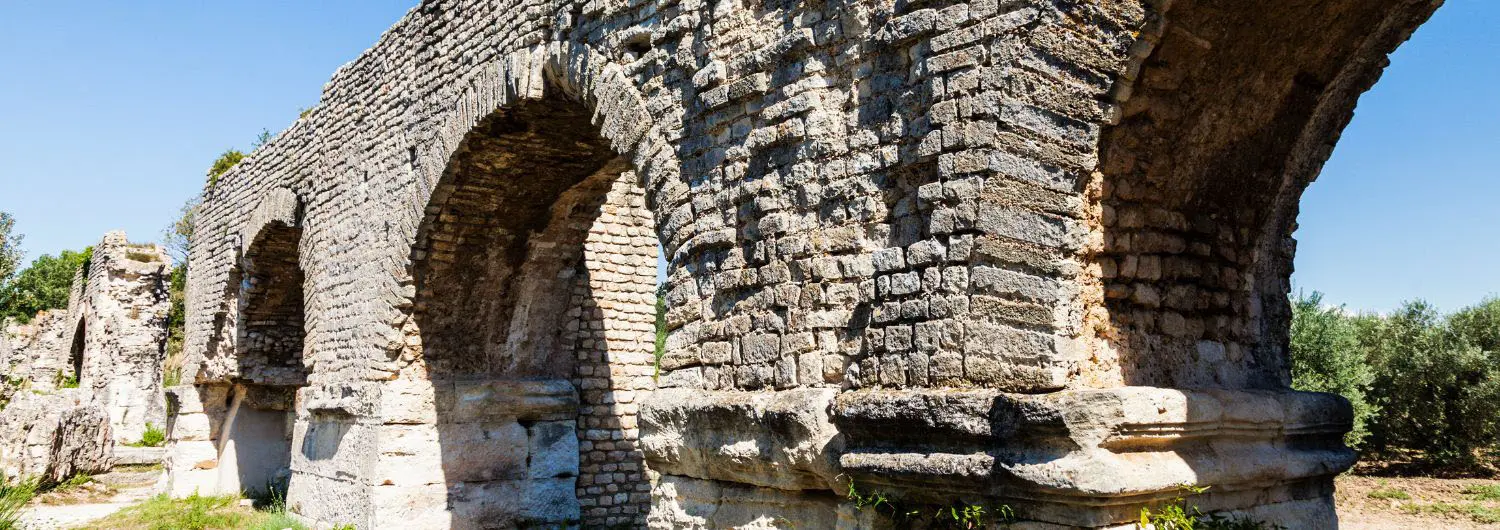
Aqueducts in France - History, Sites and Visits
France is home to many aqueducts Romanstrue jewels of the heritage archaeological country. These monuments, witnesses to a past civilization, attract thousands of visitors every year. From the famous Pont du Gard to lesser-known but equally fascinating structures, the aqueducts in France offer a journey through time, and bear witness to the ingenuity of the Romans. Studying them not only helps us to better understand the history of our regions, but also to marvel at these technical feats.
Definition and Description of Aqueducts
What is an aqueduct?
An aqueduct is a structure built to carry water from a distant source to a town or city. region. This ingenious system, widely used by the Romans, often consists of a canal supported by a series of arches or bridges to maintain a constant flow of water over long distances. Aqueducts can be underground or overhead, depending on the terrain they cross.
How do aqueducts transport water?
The operation of an aqueduct relies on a gentle, continuous slope, allowing water to flow by gravity. Ancient engineers had to carefully calculate this slope to ensure a constant flow without excessive velocity, which could damage the canals.
Different types of aqueduct
There are two main types of aqueduct: underground aqueducts, which often follow galleries dug into the ground, and aerial aqueducts, built on majestic arches. These aerial structures have become emblematic, as much for their architectural beauty as for their functional importance.
Historical background to the construction of aqueducts in France
Aqueducts in Antiquity: the Roman legacy
France's most famous aqueducts date back to Roman times, when these structures were essential for supplying water to the city. major citiesthe thermal bathsand public fountains. These structures testify to the ingenuity of Roman engineers and their ability to overcome complex geographical challenges.
The importance of aqueducts for urban development
Beyond their primary function of transporting water, aqueducts have played a crucial role in urban development. Access to abundant, clean water has enabled cities to expand, populations to grow and sanitary conditions to improve.
The evolution of aqueduct construction techniques over time
Aqueduct construction techniques have evolved over the centuries, from simple stone canals to more elaborate structures using mortar, bricks and finally concrete. This evolution reflects technological progress and the growing need to supply water to populations.
France's most famous aqueducts
The Pont du Gard: A Roman masterpiece
The Pont du Gard is undoubtedly the most famous aqueduct in France. Located in the south of the country, this majestic structure, listed on the UNESCO World Heritage Siteis an outstanding example of Roman engineering. Built in the 1st century A.D., it was used to transport water over 50 kilometers to the city of Nîmes.
Find out more about the Pont du Gard, read our detailed article here.
L'aqueduc de Maintenon: An Unfinished but Magnificent Project
The aqueduct at Maintenon, in the Eure-et-Loir region of France, is another fascinating, if unfinished, structure. Designed during the reign of Louis XIV to carry water to the gardens of VersaillesThis ambitious project was abandoned due to financial and technical difficulties. Nevertheless, its imposing ruins continue to attract visitors.
The Gier aqueduct: France's longest
The Gier aqueduct, built to supply the town of LyonAt 86 kilometers, it is the longest in France. This monument, although largely underground, still reveals a number of remarkable remains, particularly in the Saint-Chamond area.
The Roquefavour aqueduct: The monumental work of Provence
The Roquefavour aqueduct, close toAix-en-Provenceis one of the largest aqueducts built in the 19th century. Stretching over 400 metres, it is a true masterpiece of the engineering of its time, inspired by Roman techniques.
Museums and Aqueduct Conservation Sites in France
Musée du Pont du Gard: A testament to Roman genius
The Musée du Pont du Gard, located close to the eponymous aqueduct, offers an immersive insight into the history of this structure and Roman construction techniques. Visitors can discover models, videos and archaeological objects that illustrate the importance of this site.
Musée de l'Aqueduc de Lyon: Explore the remains of the Aqueduc du Gier
The Musée de l'Aqueduc de Lyon is dedicated to the history of the Roman aqueducts that supplied the city with water. It includes preserved sections of the Gier aqueduct, as well as exhibits detailing water supply systems in Roman Gaul.
Archaeological sites of the Nîmes aqueduct
The archaeological sites of the Nîmes aqueduct, of which the Pont du Gard is the centerpiece, offer visitors the opportunity to explore the remains of this complex system. Visitors can follow the route of the aqueduct and understand its role in supplying water to the city.
Visit Aqueducts in France: Activities and Discoveries
Hikes along ancient aqueducts
France's aqueducts are often located in splendid natural settings, offering opportunities to hiking and walks. Signposted footpaths allow you to follow the route of certain aqueducts, such as the one at Nîmes, and discover the surrounding countryside.
Guided tours and historical events
Many aqueducts offer guided tours of the monuments. from a historical perspective and technology. Special events, such as historical re-enactments and educational workshops, are also organized throughout the year.
Educational activities for children and schools
The aqueducts are also places of learning for young people. Educational activities are offered on a regular basis, including model-building workshops, interactive tours and school programs.
Preservation and Importance of Aqueducts Today
The challenges of preserving aqueducts
The preservation of aqueducts is essential to protect this unique historical heritage. The structures, often fragile due to their age, require constant care to prevent deterioration and to enable future generations to admire them.
Aqueduct protection initiatives in France
Various initiatives have been put in place to protect aqueducts in France. These include restoration projects, awareness campaigns and the creation of protected areas around the most vulnerable sites.
How aqueducts inspire modern architecture
Aqueducts continue to influence contemporary architecture, both in terms of their aesthetics and their construction principles. Modern engineers often draw inspiration from these ancient structures to design sustainable, environmentally-friendly structures.
FAQ about Aqueducts in France
What's the difference between an aqueduct and a bridge?
An aqueduct is a structure specifically designed to carry water, while a bridge is intended to allow the passage of people or vehicles. However, some aqueducts, such as the Pont du Gard, also function as bridges.
How many aqueducts are still in service in France?
Today, most of the Roman aqueducts are no longer in service as water supply systems, but some segments are still in use, notably for agricultural irrigation.
Can you visit the inside of an aqueduct?
In some cases, it's possible to visit the inside of the aqueducts, notably on guided tours or special events organized by museums or archaeological sites.
When is the best time to visit the aqueducts?
Spring and summer are the ideal seasons to visit aqueducts, as weather conditions are generally favorable. However, some structures, such as the Pont du Gard, are magnificent in any season.
How were aqueducts maintained in Roman times?
In Roman times, aqueducts were maintained by dedicated teams called curatores aquarumwho regularly inspected the canals and made the necessary repairs to ensure a constant flow of water.
Are there aqueducts in other European countries?
Yes, aqueducts can be found in many European countries, including Spain, Italy and Portugal, where the Romans left a rich legacy of hydraulic engineering.
Aqueducts in France - Conclusion
France's aqueducts not only bear witness to the distant past, but also to the present. monuments of great importance and architectural heritage. Exploring them gives us a better understanding of the ingenuity of ancient civilizations, and an appreciation of the effort to preserve them for future generations.
