
How does a channel manager work?
Channel managers are at the heart of digital accommodation management. It acts as an intelligent intermediary between the various reservation platforms and an establishment's internal system. Understanding how this tool works is the key to understanding why it has become indispensable in online distribution.
The principle of real-time synchronization
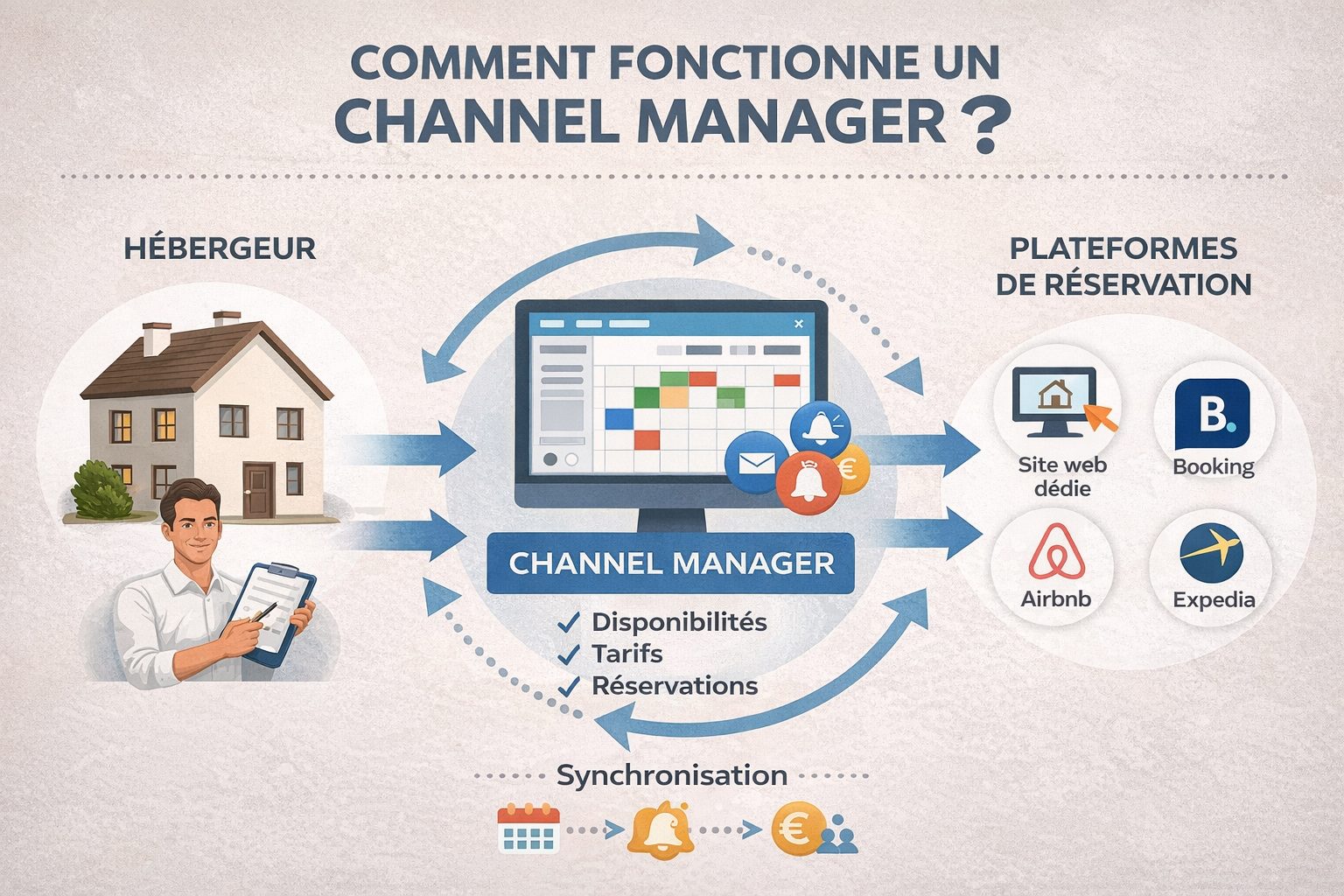
Visit Channel manager is based on a key mechanism: the automatic synchronization of data in real time. When a reservation is made on one platform, the system immediately updates availability on all other channels.
In concrete terms, if a room is booked on Booking.com, the software instantly reduces the number of rooms available on Airbnb or Expedia, Holidu or the official website. This process avoids human error and, above all, overbooking.
This synchronization is made possible by API connections between the different platforms, enabling almost instantaneous updates.
Connection with OTAs and platforms
A channel manager connects to numerous platforms known as OTAs (Online Travel Agencies), such as Abritel, Booking.com, Airbnb or Expedia. These platforms now account for a major share of online bookings.
The role of this distribution tool is to centralize these connections and distribute information to each channel. Instead of managing each extranet separately, the user controls everything from a single interface.
This considerably simplifies day-to-day management and reduces the risk of errors.
Find out more about plateformes en ligne (otas), c’est par ici!
Interaction with PMS and booking engine
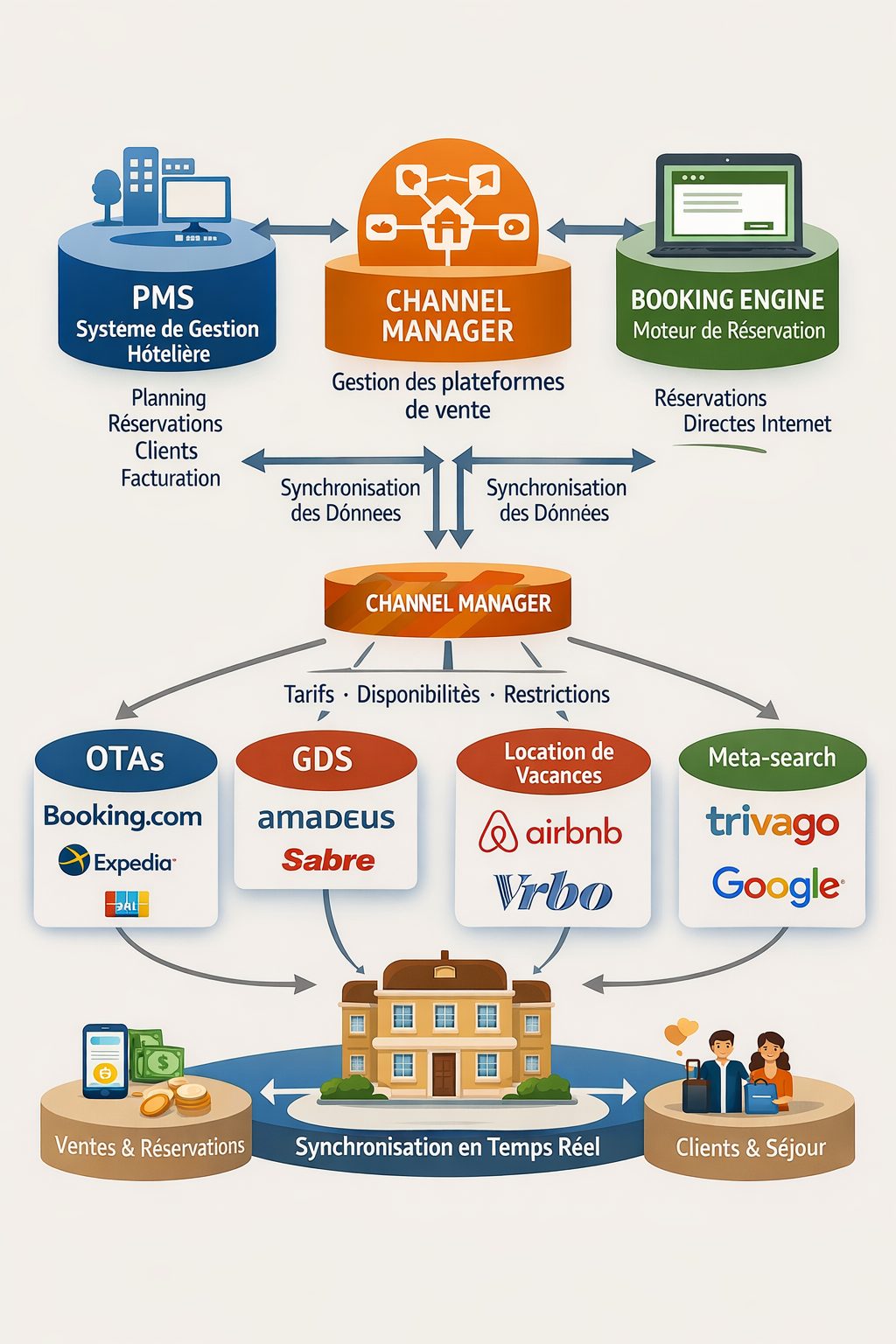
Visit Channel manager does not stand alone. It is integrated into a software ecosystem that includes the PMS (Property Management System) and the booking engine.
The PMS manages internal operations (check-in, billing, scheduling), while this tool handles external distribution. The booking engine enables direct reservations on the website.
According to Mews :
«The channel manager works in synergy with the PMS to guarantee smooth management of reservations and availability.»
This interaction enables complete automation of the booking cycle, from online visibility to customer management.
Interaction with other platforms
Visit Channel manager can also link to various third-party sites (such as your personal website), Amivac, pap vacation, lvp direct, cparici.com) grâce à une API ou grâce au ICAL.
Cette interaction permet une automatisation complète ou une semi-automatisation du cycle de réservation, depuis la visibilité en ligne jusqu’à la gestion client.
Why use a channel manager?
Visit channel manager is today an essential lever for optimizing the management and performance of tourism establishments. In an environment dominated by online bookings, this tool helps to increase efficiency, avoid errors and boost profitability.
Avoid double bookings
One of the main advantages of channel manager is the prevention of double bookings, also known as overbooking. Without this tool, managers have to manually update availability on each platform, which greatly increases the risk of errors.
Thanks to this synchronization solution, every booking is automatically reflected on all channels in real time. This ensures that the availability displayed is always accurate.
This tool has become indispensable for protecting an establishment's reputation and avoiding conflicts with customers.
Save time and automate
Visit channel manager also saves considerable time by automating repetitive tasks. Without this tool, managing rates and availability across multiple platforms can become extremely time-consuming.
With distribution software, all modifications are made from a single interface, then automatically distributed to all connected channels.
This automation enables professionals to concentrate on higher value-added tasks, such as customer experience or sales strategy.
Increase revenues and occupancy
A Channel manager contributes directly to increased sales by improving online visibility and optimizing occupancy rates.
By being present on several platforms simultaneously, an establishment multiplies its chances of booking. This tool also makes it possible to adjust rates quickly in line with demand, which is essential in a revenue management strategy.
According to HotelTechReport :
«Hotels using a channel manager often see a significant increase in occupancy rates and revenues».»
So this solution is not just a technical tool, but a real growth driver.
Advantages and disadvantages of the channel manager
Visit Channel manager is a powerful tool, but like any technology, it has both major benefits and certain limitations. Understanding its advantages and disadvantages enables you to make an informed choice and optimize its use.
Key benefits
Visit channel manager offers a number of advantages that explain its massive adoption in the hotel and vacation rental sectors.
First and foremost, this tool enables automatic synchronization availability, rates and reservations. This automation considerably reduces human error and ensures perfect consistency between the different channels.
Then, it improves productivity. Repetitive tasks are eliminated, saving managers valuable time on a daily basis.
According to Cloudbeds :
«Channel managers enable hoteliers to manage their distribution more efficiently while reducing their workload.»
Another key benefit is the increased online visibility. By having a presence on several platforms, an establishment can reach a wider audience and increase its bookings.
Last but not least, this software facilitates the implementation of a revenue management, by enabling prices to be quickly adjusted to demand.
Limits and drawbacks
Despite its many assets, the channel manager also has certain limitations that it's important to be aware of.
The first drawback is its cost. Depending on the solution, prices may vary according to the number of rooms, connected channels or features.
Secondly, the use of this solution implies a certain technological dependence. In the event of a breakdown or misconfiguration, this can have an impact on room distribution.
As the HotelTechReport :
«Choosing a channel manager means paying particular attention to system integration and reliability».»
Finally, the technical complexity may be an obstacle for some users. Initial configuration may require some assistance, particularly to connect all channels correctly.
Channel manager vs PMS vs CRS: what are the differences?
Visit channel manager is often confused with other hotel industry tools such as PMS or CRS. However, these solutions have very distinct roles, particularly in the management of OTA (Online Travel Agencies). Understanding the differences between these systems is essential for effectively structuring your digital ecosystem and optimizing your online distribution.
Channel manager vs. PMS
Visit channel manager and PMS (Property Management System) are complementary, but perform different functions.
PMS is an in-house management software package. It is used to manage the day-to-day operations of an establishment: check-in, check-out, billing, room scheduling and guest management.
Conversely, this tool is dedicated to external distribution, in particular to platforms such as Booking.com, Airbnb or Expedia. It automatically broadcasts availability and rates to these channels.
According to Mews :
«The PMS manages internal operations, while the channel manager handles room distribution on external channels.»
These solutions work together to ensure seamless management of reservations from online platforms.
Channel manager vs CRS
Visit channel manager is also often compared to the CRS (Central Reservation System). Both solutions help to manage distribution channels, but their roles differ.
CRS is a central reservation system that consolidates availability and manages bookings from different channels, including direct sales.
This software acts as a connector between the establishment and reservation platforms. It sends data (rates, availability) to the channels and retrieves reservations.
As the SiteMinder :
«The channel manager focuses on distribution to the channels, while the CRS centralizes reservations.»
The two tools can be used together to optimize reservations management.
Channel manager vs booking engine
Visit channel manager should not be confused with the booking engine.
The booking engine enables customers to book directly on the establishment's website, without going through intermediaries.
This tool is used to manage distribution across different channels and synchronize data between these platforms.
According to Cloudbeds :
«The booking engine facilitates direct bookings, while the channel manager manages distribution on third-party channels.»
These tools are complementary: the booking engine promotes direct sales, while this solution optimizes multi-channel presence.
Channel manager for hotels or vacation rentals
Visit Channel manager is used in both the traditional hotel and vacation rental sectors. However, its use varies according to the type of establishment. Understanding these differences will enable you to fully exploit the potential of this tool, depending on your activity.
Hotel use
In the hotel sector, the channel manager has become an indispensable tool for managing room distribution across multiple platforms.
Hotels, whether independent or chain-owned, need to be present on multiple channels to maximize their visibility. This tool makes it possible to simultaneously connect platforms such as Booking.com, Expedia or Agoda, while ensuring perfect data synchronization.
According to SiteMinder :
«Hotels use a channel manager to distribute their rooms across multiple channels while maintaining centralized control».»
In this context, it plays a key role in :
- dynamic tariff management
- optimizing occupancy rates
- multi-channel distribution strategy
It is usually integrated with a PMS to automate all operations.
Seasonal rental use
In short-term rental, the channel manager is just as essential, especially for owners managing several properties.
Platforms such as Airbnb, Abritel and Vrbo account for a significant proportion of bookings. This solution enables us to synchronize calendars between these platforms and avoid booking conflicts.
As the Lodgify :
«A channel manager helps rental managers synchronize their listings across multiple platforms and avoid double bookings.»
In this sector, this tool is particularly useful for :
- manage several homes simultaneously
- automate availability
- centralize reservations
It often replaces inefficient manual methods and significantly reduces errors.
Key differences between the two uses
Visit channel manager adapts to the specific needs of each sector, but some differences are important.
In the hotel sector, it is often used in conjunction with a complete ecosystem (PMS, RMS, CRS), whereas in the vacation rental sector, it is sometimes used on its own or with simpler tools.
What's more, hotels generally work with a large number of channels, while vacation rentals concentrate on a few major platforms.
According to Cloudbeds :
«Distribution needs vary according to the type of hosting, but the channel manager remains central in all cases».»
This makes the solution a flexible tool for both hotels and short-term rentals.
How do you choose a channel manager?
Choose a channel manager is a crucial step in optimizing an establishment's online distribution. Given the diversity of solutions available, it's important to understand the essential criteria for selecting the tool best suited to your needs.
Essential criteria
The choice of a channel manager is based on several fundamental criteria that directly influence performance and profitability.
The first criterion is the number of channels connected. A good tool needs to connect to a wide range of booking platforms to increase visibility.
Next, the integration quality is essential. This solution must be able to connect easily to a PMS, a booking engine or other tools used by the facility.
According to HotelTechReport :
«Choosing a channel manager must take into account integrations and ease of use to guarantee rapid adoption»
Finally, the price is a determining factor. Rates vary according to features, number of rooms and channels connected.
Indispensable features
A channel manager must offer key functionalities to ensure efficient management.
Key features include real-time synchronization availability and rates. This function is essential to avoid errors and double bookings.
L'user interface is also an important factor. An intuitive tool is quick to learn, and minimizes errors.
As the Cloudbeds :
«A simple interface and real-time updates are essential for effective channel management.»
Finally, the customer support must be responsive and accessible, as technical problems can have a direct impact on bookings.
Mistakes to avoid
Choose a channel manager can be fraught with pitfalls that it's important to avoid.
The first mistake is to choose solely on the basis of price. A less expensive solution may lack essential functionality or offer limited integrations.
Another common mistake is to neglect the technical integrations. A tool that is poorly connected to the PMS or platforms can lead to malfunctions.
Finally, it's important to test the tool before adopting it. Many solutions offer demonstrations or free trials.
According to SiteMinder :
«Testing a channel manager before deployment helps avoid operational problems».»
Top des meilleurs channel managers
Visit channel manager is a key tool, the choice of which depends on the specific needs of each establishment. There are many solutions on the market today, each with its own features, integrations and pricing. Comparing these tools will help you identify the one best suited to your business.
Tableau des solutions
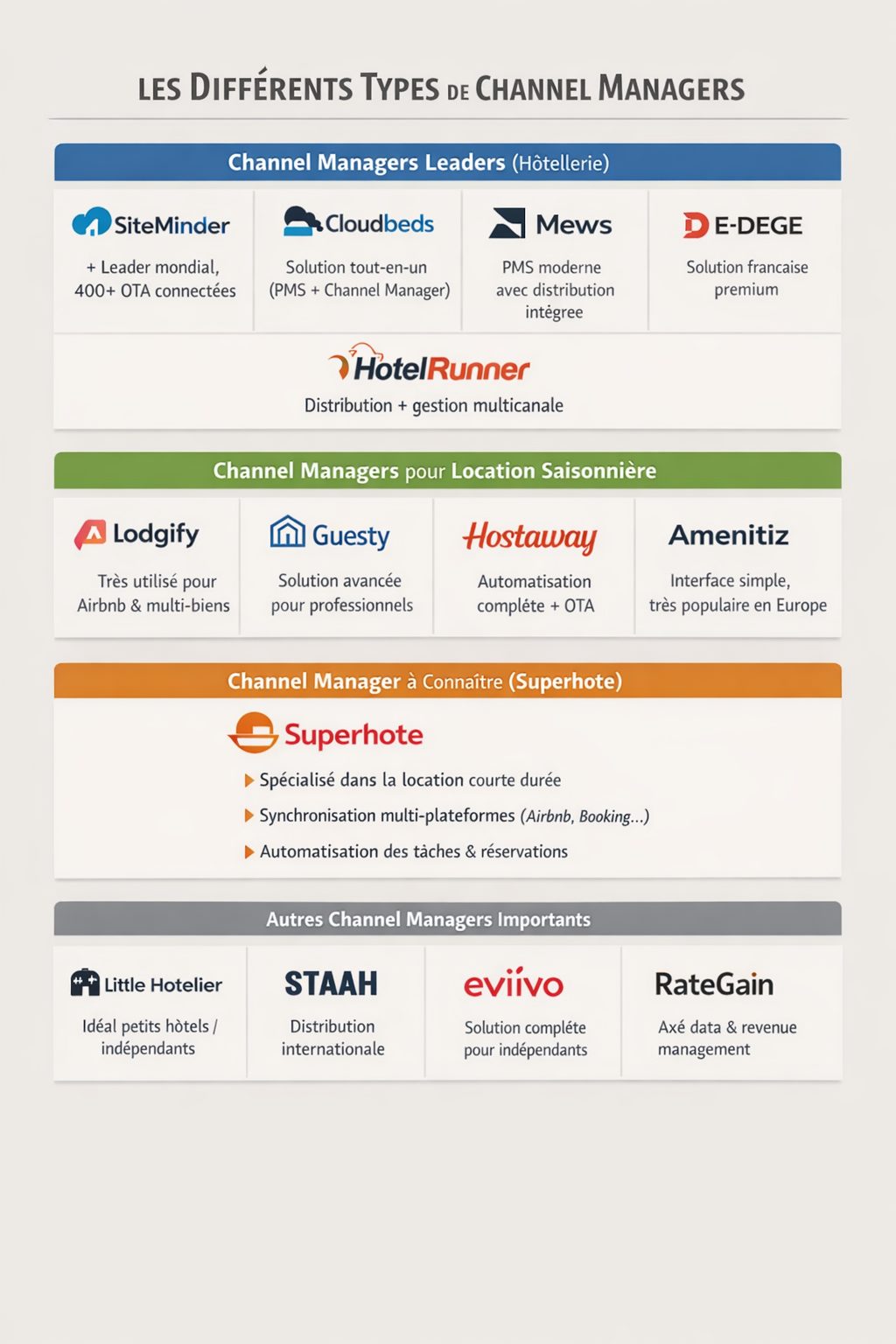
Here's an overview of the main solutions used in the hotel and holiday rental industries:
| Solution | Type | Connected channels | Ideal for | Highlights |
|---|---|---|---|---|
| SiteMinder | Hotel | 400+ | Hotels | Broad connectivity |
| Cloudbeds | Hotel | 300+ | Hôtels & groupes | All-in-one solution |
| Lodgify | Rental | 50+ | Seasonal rentals | Ease of use |
| Amenitiz | Mixed | 100+ | Independent | Intuitive interface |
This table provides a quick overview of the differences between each solution, so you can make the right choice for your needs.
Analysis of market leaders
The solution proposed by SiteMinder is one of the most widely used in the world. It stands out for its extensive connectivity with reservation platforms and its robustness.
On his side, Cloudbeds offers a tool integrated into a complete suite including PMS and booking engine. This makes it particularly well-suited to establishments wishing to centralize their management.
For seasonal rentals, Lodgify offers a simple and effective tool, ideal for owners or managers of several properties.
Finally, Amenitiz is positioned as an accessible solution with an intuitive interface, adapted to smaller structures.
According to HotelTechReport :
«The best channel managers are those who offer extensive connectivity, reliable synchronization and an easy-to-use interface.»
How to choose between these solutions
Visit channel manager ideal is not necessarily the most popular, but the one that best suits your needs.
A hotel with many rooms will prefer a robust solution with numerous integrations, while a vacation rental manager will be looking for a tool that's simple and quick to configure.
It is also advisable to test several solutions before making a final choice. Most suppliers offer demonstrations or free trials.
Comparing the different tools enables you to find a solution perfectly suited to your distribution strategy.
Case study: the impact of a channel manager
Visit channel manager is more than just a theory: its impact is measurable in real-life situations. This case study provides a concrete understanding of how this tool can transform a plant's management and performance.
Real-life case of an independent hotel
Let's take the example of a 25-room independent hotel located in a tourist area. Before using a channel manager, This establishment managed its reservations manually on several platforms.
Each availability or price update had to be carried out on each site individually. This method resulted in :
- frequent errors
- double reservations
- a major waste of time
The lack of synchronization also limited the company's visibility on certain channels.
According to SiteMinder :
«Hotels that manually manage their channels risk errors and lost revenue»
Faced with these difficulties, the hotel decided to implement a distribution solution to automate its management.
Setting up a channel manager
The company chooses a channel manager connected to its PMS and several reservation platforms.
The installation is carried out in several stages:
- connection to platforms
- calendar synchronization
- price configuration
Once the tool is up and running, all data is automatically updated across all channels.
As the Cloudbeds :
«Automation via a channel manager enables efficient, centralized management of availability».»
This transition eliminates manual tasks and improves the reliability of information.
Results
After a few months of use, the results are significant thanks to the channel manager.
The main benefits observed :
- +25 % occupancy rate
- -60 % of time spent managing reservations
- increase in sales
These results can be explained by improved visibility on the platforms and optimized rate management.
According to HotelTechReport :
«Establishments using a channel manager report improved performance and operational efficiency».»
This tool not only saves time, but also increases revenues.
How to set up a channel manager (practical guide)
Set up a channel manager is an essential step towards automating reservations management and improving online distribution. This practical guide explains how to deploy this tool effectively, even without technical expertise.
Installation steps
The installation of a channel manager usually involves several simple but structured steps.
1. Choose the right solution
The first step is to select a tool based on your needs: number of rooms, platforms used, budget and expected functionalities.
2. Connect booking platforms
Once the solution has been chosen, it needs to be connected to the various platforms (Booking.com, Airbnb, Expedia). This step centralizes availability management.
3. Synchronize data
The channel manager must then be configured to synchronize schedules, rates and inventories.
According to SiteMinder :
«The initial configuration of a channel manager is essential to ensure correct synchronization between channels».»
4. Test the system
Before making the system operational, we recommend that you test the synchronizations to ensure that all data is correctly updated.
Best practices
To make the most of a channel manager, certain best practices must be applied.
First of all, it's important to check synchronizations regularly to avoid any inconsistencies.
Secondly, it is advisable to optimize rates according to demand. This tool makes it possible to adjust prices quickly, which is a major asset for revenue management.
As the Cloudbeds :
«Effective use of a channel manager requires continuous monitoring of data and performance».»
Finally, we recommend that you train your teams to use the solution, to avoid errors and optimize its use.
Installation mistakes to avoid
Setting up a channel manager may contain some common errors.
The first is poor initial configuration. Incorrect settings can lead to inconsistencies between platforms.
Another mistake is not testing the system sufficiently before launching it. This can lead to synchronization problems.
Finally, it's important not to neglect updates. This tool needs to be checked regularly to ensure that it is working properly.
According to HotelTechReport :
«Incorrect configuration of a channel manager can lead to lost revenue and booking errors».»
Channel manager and digital distribution strategy
Visit channel manager plays a central role in the digital distribution strategy of tourism establishments. It's not just a technical tool, but a strategic lever for optimizing visibility, sales and profitability.
Multichannel and visibility
Visit channel manager enables offers to be distributed via several distribution channels simultaneously. This approach, known as multi-channel distribution, Today, it's essential to attract as many customers as possible.
By being present on various platforms such as Booking.com, Airbnb or Expedia, an establishment considerably increases its chances of being visible to travelers from all over the world.
According to SiteMinder :
«A multi-channel strategy enables hotels to increase their visibility and bookings».»
This tool facilitates this strategy by centralizing the management of the various channels.
Revenue management and price optimization
Visit channel manager is also a key tool in the implementation of an effective revenue management.
Thanks to real-time synchronization, rates can be adjusted according to demand, seasonality or competition.
For example, an establishment can increase its prices during periods of high demand, and reduce them during off-peak periods. This solution enables these changes to be applied instantly across all channels.
As the Cloudbeds :
«Dynamic price adjustment is key to maximizing hotel revenues».»
This ability to adapt helps optimize occupancy rates and sales.
Performance analysis
A channel manager can also be used to analyze the performance of different distribution channels.
It is possible to identify :
- the most profitable platforms
- periods of high demand
- top-performing channels
This data can be used to adjust strategy and focus efforts on the most effective channels.
According to HotelTechReport :
«Performance analysis is essential for optimizing distribution and maximizing revenues».»
In this way, the tool becomes a real decision-making aid.
Frequently asked questions about the channel manager
What is a hotel channel manager?
A channel manager is a software package that automatically manages the distribution of rooms across multiple online booking platforms. It synchronizes availability, rates and reservations in real time to avoid errors and double bookings.
According to SiteMinder :
«A channel manager enables hotels to manage their distribution on several channels simultaneously.»
Why use a channel manager?
Use a channel manager automates reservation management, saving time and human error. It also enhances online visibility by distributing offers across multiple platforms.
This solution also helps increase occupancy and sales thanks to better channel management.
What's the difference between PMS and channel manager?
Visit channel manager manages external distribution on reservation platforms, while the PMS handles internal operations such as check-in, billing and customer management.
These two tools are complementary and often work together to automate the management of a facility.
Is a channel manager compulsory?
Visit channel manager is not compulsory, but is strongly recommended for establishments present on several platforms.
Without this tool, manual management quickly becomes complex and increases the risk of errors, particularly double bookings.
How much does a channel manager cost?
The price of a channel manager varies according to several factors: number of rooms, features, number of connected channels and supplier.
In general, rates can range from a few dozen to several hundred euros per month.
Who's the best channel manager?
There's no single best channel manager, But there are several solutions to suit different needs.
Important selection criteria include :
- number of channels connected
- ease of use
- integrations
- customer support
Solutions like Cloudbeds or Lodgify are often cited among the best performers.
Can I use a channel manager with Airbnb?
Yes, a channel manager can be connected to Airbnb as well as to other platforms such as Booking.com or Expedia.
This automatically synchronizes calendars and avoids booking conflicts between different platforms.
Does it work in real time?
Yes, this tool generally works in real time, thanks to API connections with reservation platforms.
This ensures instant availability and price updates across all channels.
Wikipedia
👉 https://en.wikipedia.org/wiki/Channel_manager
Useful links
Channel managers leaders (hotels)
- SiteMinder
👉 https://www.siteminder.com
➤ World leader, +400 connected OTAs - Cloudbeds
👉 https://www.cloudbeds.com
➤ All-in-one solution (PMS + channel manager) - Mews
👉 https://www.mews.com
➤ Modern PMS with integrated distribution - D-EDGE
👉 https://www.d-edge.com
➤ Premium French solution - HotelRunner
👉 https://hotelrunner.com
➤ Distribution + multi-channel management
Channel managers for seasonal rentals
- Lodgify
👉 https://www.lodgify.com
➤ Widely used for Airbnb and multi-property - Guesty
👉 https://www.guesty.com
➤ Advanced solution for professionals - Hostaway
👉 https://www.hostaway.com
➤ Complete automation + OTA - Amenitiz
👉 https://amenitiz.com
➤ Simple interface, very popular in Europe
Channel manager to know (Superhote)
- Superhote
👉 https://www.superhote.com
➤ Specialized in short-term rentals
➤ Multi-platform synchronization (Airbnb, Booking...)
➤ Task automation (messages, reservations, etc.)
Other key channel managers
- Little Hotelier
👉 https://www.littlehotelier.com
➤ Ideal for small hotels / independents - STAAH
👉 https://www.staah.com
➤ Highly successful in international distribution - eviivo
👉 https://eviivo.com
➤ Complete solution for freelancers - RateGain
👉 https://rategain.com
➤ Axé data + revenue management


