
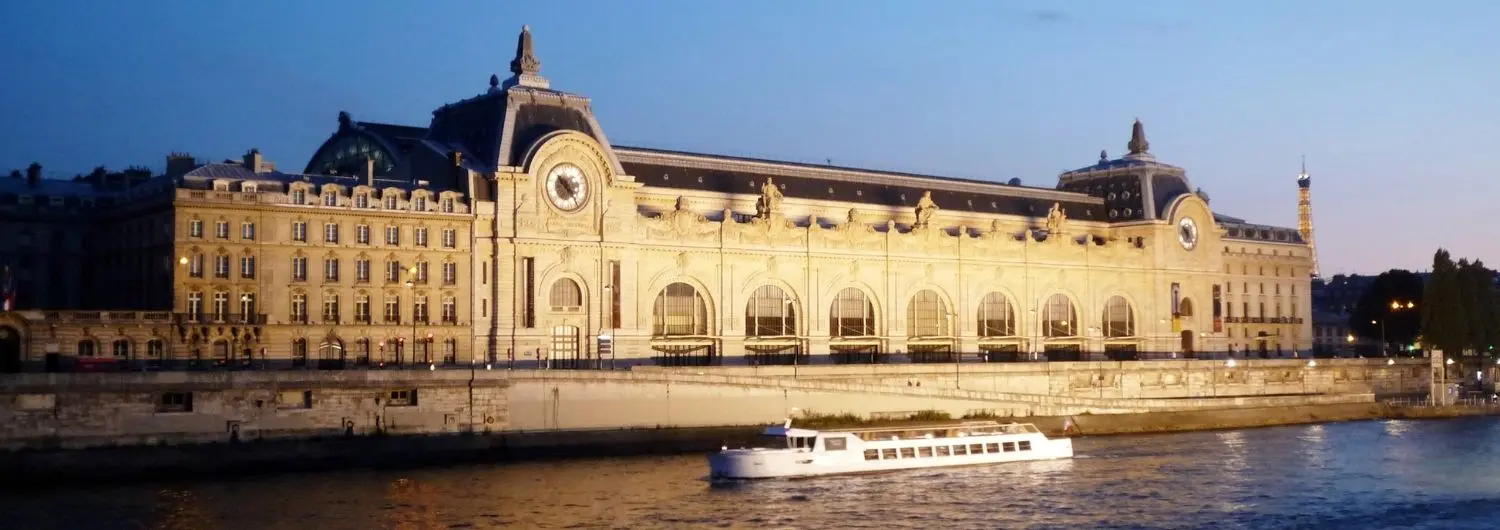
Musée d'Orsay
Among the most visited museums in ParisThe Musée d'Orsay is a true cultural gem. Housed in a former XIXᵉ century railway station, this museum is world-renowned for its exceptional collection of Impressionist and Post-Impressionist paintings. It's a must-see for any visiting art lover. the countrywith an immersion in a pivotal artistic period from 1848 to 1914.
The Musée d'Orsay doesn't just showcase iconic works; it embodies a fusion of architectural heritage and modern art. Whether you're fascinated by the masterpieces of Van GoghWhether you're an art lover, a connoisseur of Monet or Manet, or simply want to discover an extraordinary museum, a visit is a must. This comprehensive guide will tell you all about its fascinating history, major works, practical information and future plans.
An architectural masterpiece: the transformed station
The Musée d'Orsay finds its uniqueness in the building that houses it: a former railway station. Built between 1898 and 1900 by the architect Victor Lalouxthe Orsay station was used to accommodate trains from south-west France. Its style Fine artswith its stone facades, monumental glass roof and decorative wrought-iron elements, still impresses visitors today.

From the 1930s onwards, the station lost its importance as trains became longer and could no longer be accommodated there. After serving as a reception center for prisoners and deportees returning from Germany in 1945, it gradually fell into disuse. The idea of transforming the station into a museum emerged in the 1970s, and it was under the impetus of the president Valéry Giscard d'Estaing that it was officially converted. Work lasted until the inauguration in December 1986.
The Musée d'Orsay building alone is a work of art. Classified as a historic monument in 1978, it combines the architectural elegance of the late XIXᵉ century with modern museographic facilities. The contrast between the industrial skeleton of a former railway station and the delicacy of Impressionist paintings contributes to a unique visual experienceThis is a place that lovers of architecture and history will appreciate just as much as art enthusiasts.
The emblematic collections of the Musée d'Orsay
The Musée d'Orsay houses one of the world's most prestigious art collections, covering the period from 1848 à 1914. This pivotal period marked the transition from academic classicism to the modern avant-garde, a time when Europe, and France in particular, was teeming with artistic innovation. The Musée d'Orsay is unique in that it concentrates in a single location major works from this period, in all disciplines: paint, sculpture, decorative arts, photography and architecture.
The golden age of Impressionism
The heart of the Musée d'Orsay is its impressionist and post-impressionist collectionsthe richest in the world. This collection includes emblematic works by great masters such as Claude Monet, Édouard Manet, Pierre-Auguste Renoir, Edgar Degas, Camille Pissarro, Alfred Sisley, Paul Cézanne, Berthe Morisotand of course Vincent van Gogh. These artists revolutionized painting by breaking with classical codes, preferring to paint on the motif, capturing changing light and focusing on scenes from modern life.
The rooms dedicated to Impressionism, located on the upper floor of the museum under the glass roof, offer a natural luminosity that enhances the vivacity of colors and textures. In this way, the Musée d'Orsay total immersion in the impressionist movementof which he has become the greatest ambassador.
Major works not to be missed
-
Édouard Manet : Lunch on the Grass (1863) and Olympia (1865) marked a break with academic conventions and provoked fierce controversy in their day.
-
Claude Monet the museum exhibits a number of emblematic canvases, including views of the Rouen Cathedrallandscapes of Giverny, or even Saint-Lazare station.
-
Pierre-Auguste Renoir : Galette Mill Ball (1876) is one of our most famous works, illustrating the festive Parisian life of Montmartre.
-
Vincent van Gogh his powerful, colorful canvases like Starry Night on the Rhône, Self-portrait or Bedroom in Arles express his unique, tormented genius.
-
Paul Gauguin Polynesian works such as Arearea or La Orana Maria testify to his quest for exoticism and spirituality.
-
Edgar Degas recognized for its sculptures and pastels of dancers, he is also represented by his backstage series at the Opéra.

Other collections: sculpture, photography and decorative arts
Visit Musée d'Orsay is not limited to painting. It also offers a remarkable panorama of late XIXᵉ century sculpture. Artists such as Jean-Baptiste Carpeaux, Auguste Rodin or Camille Claudel are widely represented. We discover expressive works that follow the evolution of taste, from Romanticism to Symbolism.
Visit decorative artsThe once under-appreciated, new collection also features Art Nouveau furniture, glass objects by Galléas well as creations by Hector Guimardthe designer of the famous Parisian subway entrances. This is fundamental to understanding the lifestyle and aesthetic ideals of the period.
Finally, the photography offers a unique look at the history of the medium, from its beginnings to its integration into the visual arts, with images by Nadar, Le Gray or Atget.
Practical info: access, opening hours, prices
Visit the Musée d'Orsay is both a cultural and logistical experience. To take full advantage of this exceptional site, it's essential to prepare your visit carefully, taking into account the following points opening hoursthe ratesthe means of access and tips for avoiding queues. Here's everything you need to know to organize your discovery of the Musée d'Orsay.
Address and access
Visit Musée d'Orsay is located in the heart of Paris, on the left bank of the Seine, at 1 rue de la Légion d'Honneur, in the 7ᵉ arrondissement. It faces the Tuileries Gardens and Louvre Museumwith which it is linked by the Léopold-Sédar-Senghor footbridge.
Several means of transport are available to get there:
-
RER C Musée d'Orsay" station, just opposite the building.
-
Metro line 12 Solférino" station a 5-minute walk away.
-
Bus lines 63, 68, 69, 73, 83, 84, 87 and 94.
-
Vélib' Several stations are located in the immediate vicinity.
-
PMR access The museum is fully accessible to people with reduced mobility.
Opening hours
Visit Musée d'Orsay is open Tuesday to Sunday, 9:30 a.m. to 6 p.m.. On Thursdays, it offers a nocturne until 9:45 pmThis is an excellent option for enjoying the museum in a quieter atmosphere. The museum is closed every Mondayand the May 1st and the December 25.
Ticket offices close at 5pm (9pm on Thursdays), and evacuation begins 30 minutes before official closing time.
Prices and tickets
Visit full fare is currently 16 €. A reduced rate of 13 € applies to visitors meeting certain conditions (teachers, Paris Musées card holders, etc.). Admission is free of charge :
-
For under 18,
-
For European Union nationals aged 18 to 25,
-
Visit first Sunday of each month,
-
For disabled people and their carers.
Visit tickets can be purchased onlineThis is highly recommended to avoid long queues. With a time-stamped ticket, you can enter through the file Cdedicated to ticketed visitors.
Tips for an optimal visit
-
Choose off-peak hours morning as soon as it opens, or in the late afternoon, especially on Thursday evenings.
-
Allow at least 2h30 to 3h for a full tour.
-
From audio guides are available at the entrance.
-
The museum also offers a free mobile application with themed trails.
-
From free changing rooms are available, but avoid bulky luggage, which is prohibited.
Visit Musée d'Orsay welcomes nearly 3.5 million visitors. Good preparation guarantees a smooth, pleasant experience.
Temporary exhibitions and future projects
Visit Musée d'Orsay is not limited to its permanent collections: it also offers a rich program oftemporary exhibitions which renew public interest and delve deeper into the artistic themes of the 1848-1914 period. These events are often eagerly awaited, and benefit from a meticulously-designed scenography and expert editorial support.
Current and upcoming exhibitions
Each year, the Musée d'Orsay organizes a number of internationally renowned temporary exhibitions. In 2025, announced exhibitions include:
-
"Christian Krohg - Painting modern lifeA new exhibition on this often overlooked Norwegian painter, active in the realist movement.
-
"Sargent in Francededicated to the American portrait painter John Singer Sargentfamous for his pictorial elegance and his stays in Paris.
-
"I photograph therefore I ama reflection on identity and self-representation through photography from the XIXᵉ century to the present day.
These exhibitions enable visitors to discover artists who are less well known to the general public, to place masterpieces in context or to compare them with other art forms. They contribute to musée d'orsay and contribute to its international reputation.
Orsay Grand Ouvert: an ambitious extension project
Officially launched in 2024, the Orsay Grand Ouvert represents a turning point for the future of Musée d'Orsay. This vast project, financed in part by a private donation of over 20 million euros, aims to expand exhibition space by converting former administrative premises.
Projects include
-
Visit creation of an additional 1,300 m² of floor space to present contemporary works from the collection, with a particular focus on thesymbolist art, l'Art nouveauand european decorative arts.
-
The introduction of the Étienne Moreau-Nélaton Resource Centera veritable library and study center dedicated to the history of art in the XIXᵉ century.
-
A museographic reflection to adapt the tours to new audiences, including more interactivity and digital mediation.
Full delivery is scheduled by 2027with intermediate phases allowing progressive access to the new spaces from 2026. This project will strengthen Musée d'Orsay to welcome more visitors while improving the presentation of its collections.
Regional and eco-responsible commitment
As part of our cultural democratizationthe Musée d'Orsay is also committed outside its own walls. By 2025, it will be lending more than 100 works à 31 French regional museumsas part of a project on the theme of "Art and Climate. This initiative is part of a drive to cultural decentralization and heritage enhancement throughout the region.
Visit Musée d'Orsay is also stepping up its efforts to adopt a more proactive approach. eco-friendlyby integrating sustainable criteria into its exhibitions (LED lighting, reuse of scenographic materials, limiting the transportation of works of art...).
Why visit the Musée d'Orsay?
Visit Musée d'Orsay is much more than just a museum: it's an immersive experience that perfectly combines architecture, history and art. It regularly features among the 10 most visited museums in the worldAnd that's no coincidence. Whether you're a fan of Impressionism, a lover of architecture or simply curious, a visit to the Musée d'Orsay is an essential part of any stay in Paris.
A collection unique in the world
The wealth of works on display at Musée d'Orsay is unrivalled. No other institution brings together so many Impressionist and Post-Impressionist masterpieces. This museum allows us to see in one place the great names of modern painting, often studied in books or reproduced in school textbooks, but here visible in their own right. original sizewith their details, textures and vibrant colors.
This artistic density creates a real visual shock The rooms follow a chronological itinerary that highlights the stylistic evolutions, cross-influences and innovations of each artistic movement.
A spectacular architectural setting
Housed in a listed former railway station, the Musée d'Orsay offers a monumental setting worthy of its collections. The large central nave, with its spectacular glass roof, bathes the works in a natural light that sublimates the colors. It's a majestic yet soothing place to stroll around and observe the original architectural details: monumental clocks, cast-iron columns, sculpted cornices...
This unique setting makes Musée d'Orsay one of the most photogenic places in Paris, popular with photographers and Instagram fans.
An accessible and varied experience
Unlike some major museums, the Musée d'Orsay is on a human scale It can be visited in half a day without feeling overwhelmed. Its clear museography, plenty of benches to sit on, multilingual audio guides and digital devices make it an ideal place to visit. welcoming for allfrom families to art enthusiasts.
The museum also hosts a variety of events:
-
Nocturnes on Thursdays until 9:45pm, often accompanied by concerts or readings.
-
Thematic guided toursto explore art history from a specific angle.
-
Virtual reality experiencesThis is the perfect place to relive the atmosphere of a 19th-century painter's studio.
A bridge between tradition and modernity
Finally, the Musée d'Orsay is a model of dialogue between past and present. It welcomes contemporary artists in residence, offers podcasts, organizes meetings and provides numerous online resources. The "Une œuvre, un regard" series, for example, gives the floor to artists, philosophers and scientists who freely interpret an exhibited work.
This desire toopenness to modernity makes the Musée d'Orsay resolutely alive and in tune with current issues, while paying tribute to the great masters of the XIXᵉ century.
Frequently asked questions (FAQ)
What is the most beautiful work at the Musée d'Orsay?
It's impossible to choose just one work, such is the richness of the collection. Galette Mill Ball by Renoir, Lunch on the Grass by Manet, and Van Gogh's self-portraits are among the must-sees of the museum. Musée d'Orsay.
What are the Musée d'Orsay opening times?
Visit Musée d'Orsay is open Tuesday to Sunday, 9.30am to 6pm. On Thursdays, a nocturne allows visitors to visit until 9:45pm. The museum is closed on Mondays.
Can I buy tickets online?
Yes, we strongly recommend that you buy your tickets in advance on the official Musée d'Orsay. This avoids long queues and gives you priority access.
How much does it cost to enter the Musée d'Orsay?
Full price is €16. Reduced admission is €13. Admission is free for under-18s, EU citizens aged 18-25, disabled persons and on the first Sunday of the month.
Is the Musée d'Orsay wheelchair-accessible?
Yes, the Musée d'Orsay is fully accessible to people with reduced mobility. Elevators and ramps are available, and admission is free for disabled visitors and their companions.
How long is the ideal time to visit the Musée d'Orsay?
Allow between 2h30 and 4h for a complete visit. You can also target certain wings (Impressionism, sculpture...) for a shorter, more focused visit.
Can I visit the Musée d'Orsay with an audioguide?
Yes, multilingual audio guides are available at reception. There's also a free mobile application with themed tours and enriched content.
Does the Musée d'Orsay offer guided tours?
Yes, guided tours are offered by accredited lecturers. Themed tours are also organized according to exhibitions and periods.
Can we take photos inside the museum?
Photography is permitted without flash for the permanent collections. For temporary exhibitions, rules may vary.
Is there a café or restaurant on site?
Yes, the Musée d'Orsay features several dining areas, including the famous restaurant in the former dining room of the Hôtel de la Gare, decorated in Belle Époque style.
Conclusion
Visit musée d'orsay is much more than a museum: it's a gripping plunge into the history of 19thᵉ century art, carried by an exceptional collection and a unique architectural setting. Whether you're a Monet fan, a Van Gogh enthusiast, or simply curious to discover the masterpieces that turned artistic canons on their head, this place is a must-see on any cultural trip to Paris.
Its richness is not limited to its works: between its ambitious temporary exhibitions, its renovation projects, its accessibility to all audiences and its many digital initiatives, the musée d'orsay embodies a living, constantly evolving institution.
All you have to do is prepare for your visit... and let yourself be amazed.
Find out more about the Musée d'Orsay, it's over here!

