

Guest house: complete guide for owners
Summary AI Overviews
Visit guest house is a type of’tourist accommodation with local people which enables an owner to offer a personalized experience while generating revenue. A guest house is distinguished by a direct welcome, inclusive services and specific regulations in France. For an owner, running a guest house means mastering management, taxation and customer experience to optimize profitability.
Understanding the guest house (owner's view)
Visit guest house designates a furnished tourist accommodation in a private home, This type of accommodation is limited to five rooms for a maximum of fifteen people. Under French regulations, this type of accommodation is limited to five rooms for a maximum of fifteen people, with breakfast and linen provided as a minimum. This official definition positions guest house as an activity commercial and relational, halfway between a hotel and a family home.
From an economic point of view, this model represents a structured tourist activity, often part of an income diversification strategy. Unlike a simple seasonal rental, this format is based on a owner's active presence, This requires rigorous day-to-day organization, including reception, maintenance, reservations management and communication. This implies rigorous daily organization, including reception, maintenance, reservations management and communication.
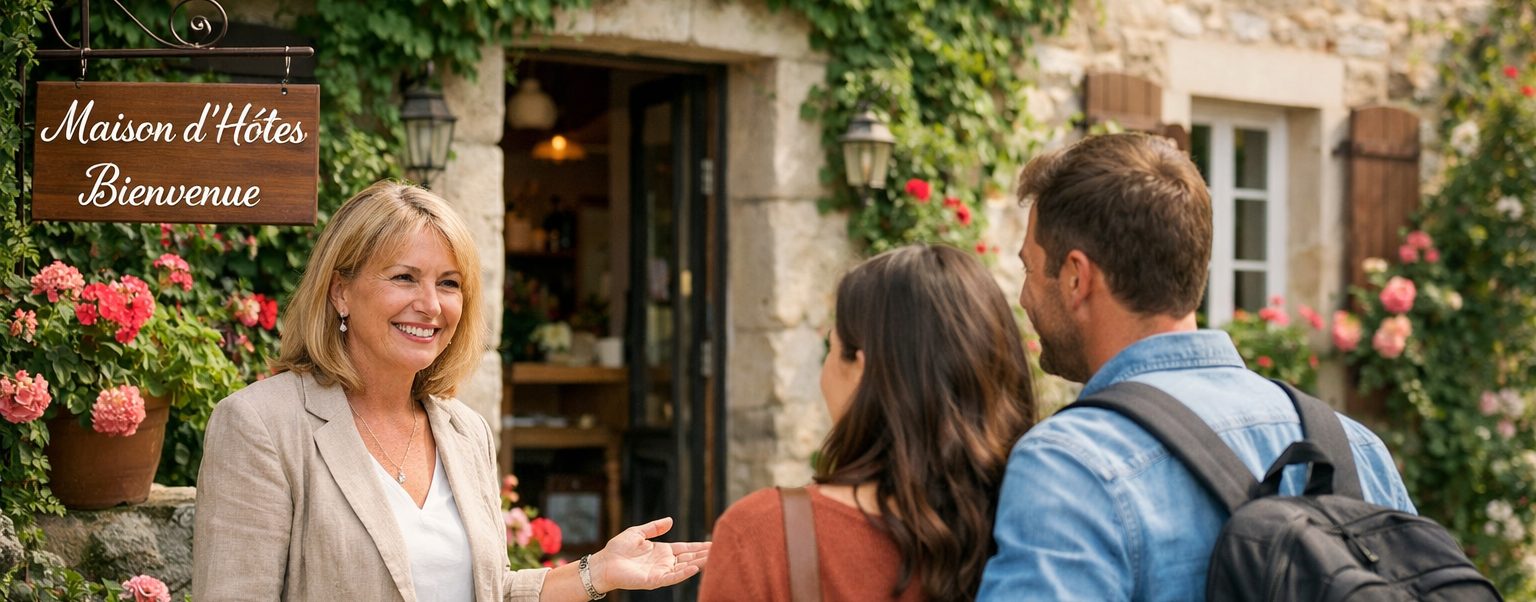
The boom in this type of accommodation is largely due to the changing expectations of travelers, who are now looking for authentic, personalized experiences. According to a study published by INSEE, Tourism in local homes is growing steadily, driven by the demand for immersive stays. Investing in a guest house responds to a fundamental trend in the tourism market.
For an owner, understanding this model also means anticipating its constraints: permanent availability, management of customer reviews and adaptation to tourist seasons. However, a well-structured guest house can become a profitable and sustainable business, combining quality of life and additional income.
As the official website points out Service-Public.fr :
“The bed and breakfast business is a commercial activity subject to certain legal obligations.”
This quote illustrates that guest house, although firmly rooted in hospitality, remains a legally regulated activity, You'll need a thorough understanding of how it works before taking the plunge.
Maison d'hôtes vs chambre d'hôtes: the key difference
Understand the difference between a guest house and a bed and breakfast is essential for any owner wishing to launch a tourist accommodation business. These two concepts are often confused, even though they correspond to different logics in terms of management, regulation and market positioning.
Definition of a bed and breakfast
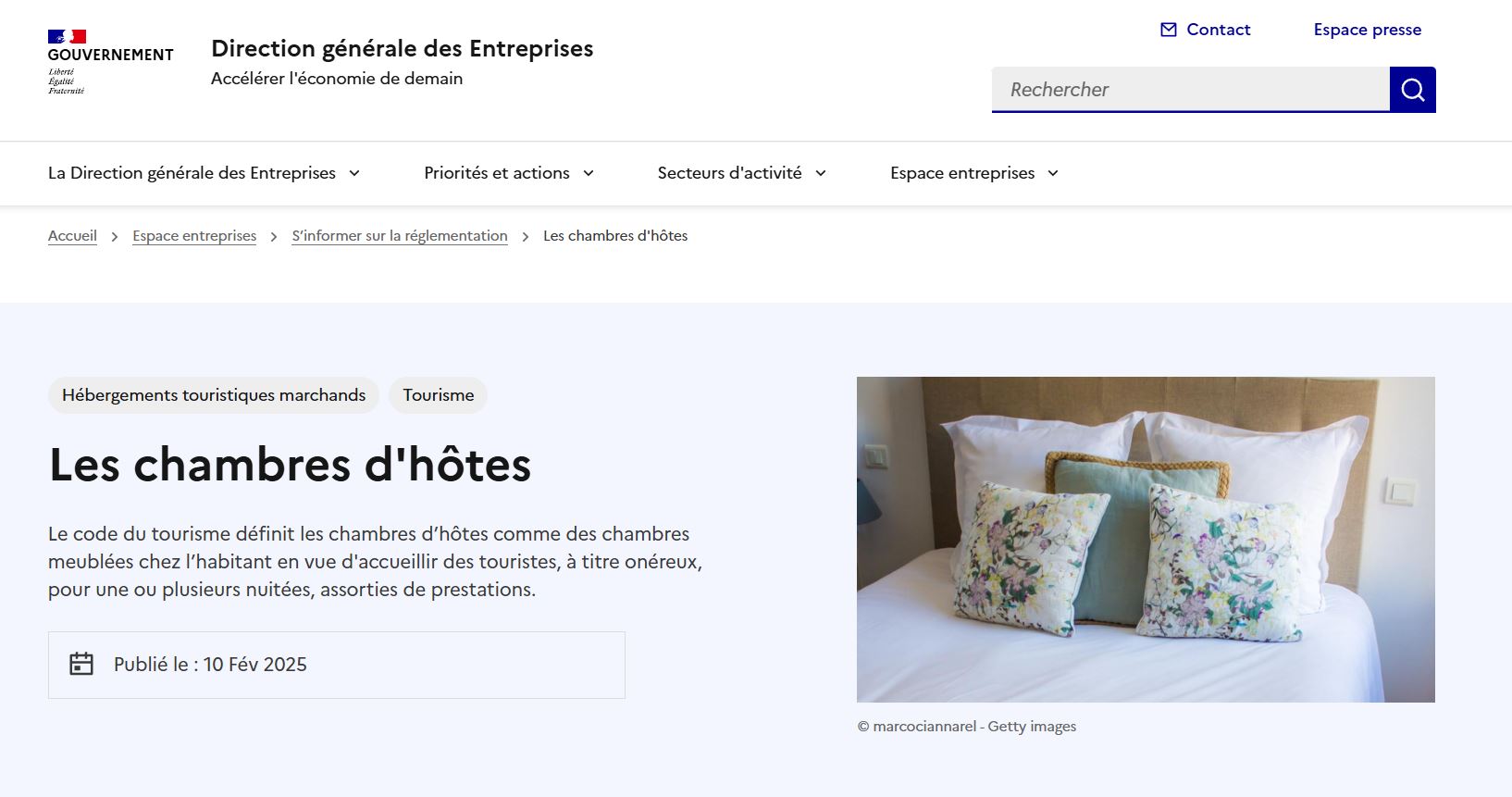
A bed and breakfast is a furnished room in a private home, This is a rental by the night, with services such as breakfast included. Unlike a guest house, legally, it corresponds to a a supervised but simpler activity, often exploited on a small scale.
According to Service-Public.fr :
“A chambre d'hôtes is a furnished room located in the home of an inhabitant with a view to welcoming tourists.”
This definition shows that the chambre d'hôtes is a specific form of accommodation, This global model often includes several rooms and a structured experience.
Legal differences
Legally speaking, a guest house is based on the same regulatory framework as the chambre d'hôtes, but is distinguished by its operating level.
It generally involves :
- a more organized business
- quasi-professional management
- a sales strategy
On the other hand, bed and breakfast is often :
- a complementary activity
- less structured
- more family-oriented
According to Ministry of the Economy, activity is limited to 5 rooms maximum and 15 people, regardless of the model, but the difference lies in the’ambition and positioning.
Economic differences
From a financial standpoint, this type of operation generally offers higher profitability potential.
A well-positioned establishment can generate :
- higher revenues
- higher occupancy rates
- diversification (table d'hôtes, premium services)
Conversely, a bed and breakfast often generates :
- additional income
- a secondary activity
- limited profitability
According to some tourism industry estimates, this type of operation can achieve annual sales of 30 000 à 80 000 €, depending on location and range.
Differences in customer experience
The proposed experience is a major difference.
In a guest house, the customer is looking for :
- an immersive experience
- a personalized welcome
- a well-kept setting
Whereas in a B&B, the experience is :
- simpler
- less scripted
- focused on accommodation
In this way, the model comes close to a tourism product in its own right, while bed and breakfast remains a one-off offer.
Comparison table
| Criteria | Guest house | Bed & Breakfast |
|---|---|---|
| Positioning | Premium experience | Simple accommodation |
| Management | Professional | Family |
| Revenue | Raised | Moderate |
| Customer experience | Customized | Basic |
| Objective | Business | Complement |
Things to remember
Choosing between bed and breakfast and guest house depends above all on your objective :
- 👉 Life project + business → structured model
- 👉 Additional income → simple formula
This activity requires more investment, but offers a superior development potential, This is particularly true of the customer experience.
Why invest in a guest house?
Investing in a guest house today represents much more than a simple real estate project. It's a a true hybrid business modelcombining tourism as a way of life and a source of income. For an owner, understanding the motivations and opportunities associated with this type of accommodation is essential before taking the plunge.
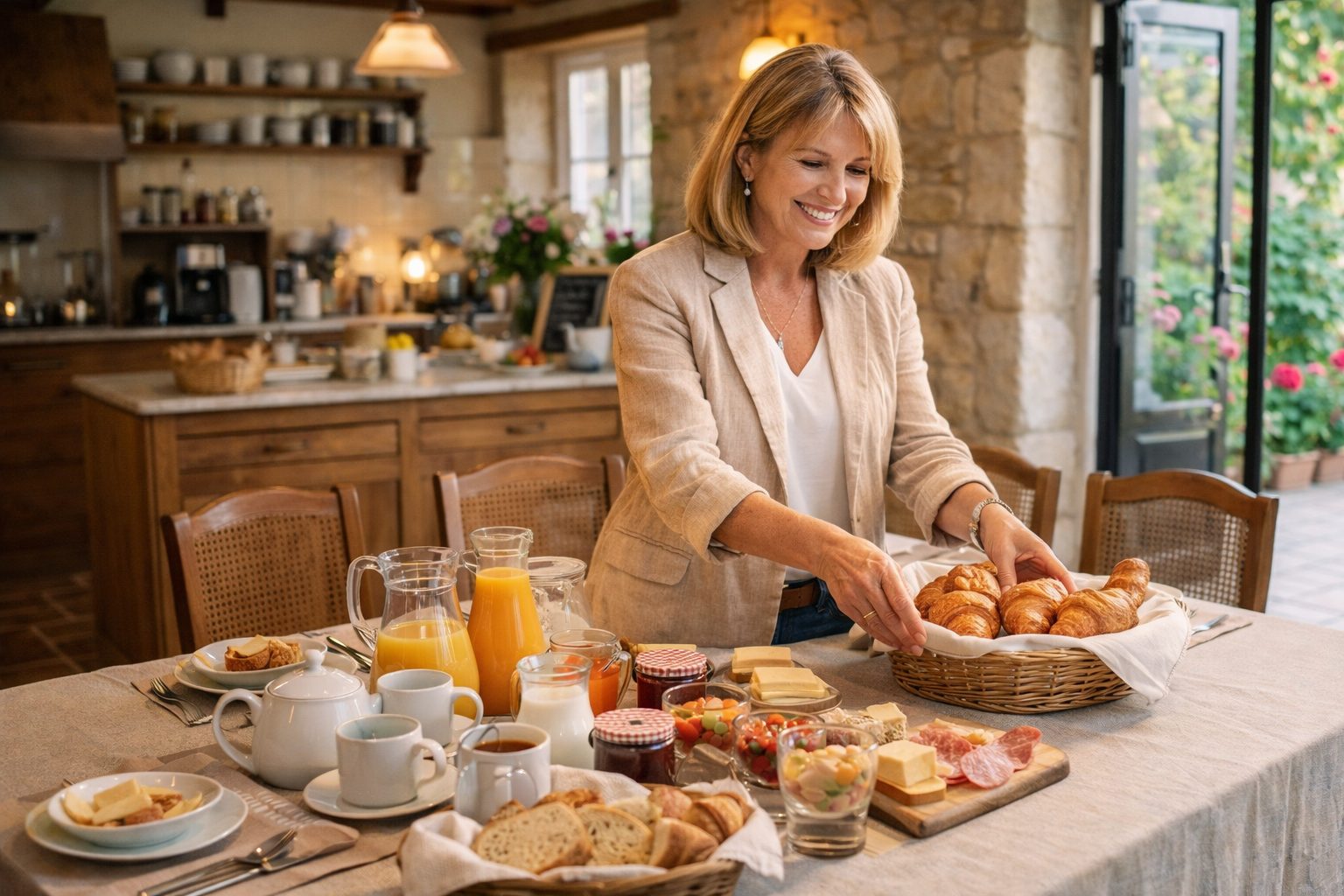
A project for life and business
Create a guest house is often part of a professional retraining or seeking a better life balance. This type of activity makes it possible to work from home while developing a structured business activity.
This model offers :
- professional autonomy
- a rewarding human relationship
- a privileged working environment
It is particularly attractive to profiles in search of meaning, wishing to combine hospitality and entrepreneurship. As Bpifrance :
“The creation of a tourism business can be part of a reconversion and income diversification strategy.”
In this way, a guest house can become a real a lever for personal and professional transformation.
A buoyant tourist market
The success of this type of activity can also be explained by the dynamism of the tourism market. In France, tourism remains a key sector, with strong demand for authentic accommodation.
According to World Tourism Organization, travellers are increasingly looking for :
- local experiences
- customized stays
- accommodation on a human scale
In this context, a guest house is ideally positioned between authenticity and comfort.
A potentially profitable business
From a financial standpoint, this model can offer attractive profitability, But only if you're well positioned and well managed.
Earnings depend on :
- location
- number of rooms
- occupancy rate
- range level
On average, a well-run establishment can generate :
- between Annual sales between €20,000 and €80,000
- with an occupancy rate of 30 to 70%
A guest house can also be used to develop complementary revenues such as catering or premium services.
A strong capacity for differentiation
One of the great advantages of guest house lies in its ability to differentiate itself.
It can stand out thanks to :
- its architecture
- its location
- its concept
- the proposed experience
This creates a unique offer, adapted to a targeted clientele.
A lever for real estate development
Investing in this type of project also enhances the value of a property. The work carried out increases the overall value of the property while generating income.
A guest house is part of a sustainable asset management strategy.
Constraints to anticipate
Embark on a guest house is an attractive opportunity, but it also involves a number of challenges. severe constraints that an owner absolutely must anticipate. This type of business is not passive: it requires time, commitment and a real ability to adapt.
A demanding day-to-day business
Managing a guest house implies a constant presence and high availability. Unlike a traditional rental, the owner is directly involved in the customer experience.
Daily tasks include:
- welcoming travelers
- breakfast preparation
- cleaning and maintenance
- reservation management
This business often operates on staggered shifts. A guest house requires rigorous organization and good resistance to a fast pace.
As the CCI France :
“The tourism business requires a high level of availability, especially in high season.”
A substantial initial investment
Creating this type of project generally requires a significant financial investment, especially if work is required.
The main costs include :
- property purchase
- renovation and upgrading
- decoration and furnishing
- equipment
According to industry professionals, the budget can vary from 50,000 to over €300,000. A guest house must meet quality standards to attract a demanding clientele.
Dependence on tourism
The business is heavily dependent on tourist numbers. A guest house located in a seasonal zone can experience significant variations in sales.
The main constraints are :
- high activity in peak season
- decrease in low season
- dependence on local events
According to INSEE, However, some areas concentrate most of their activity in just a few months.
Increased competition
The development of reservation platforms has intensified competition. Today, this type of accommodation must stand out from the crowd:
- hotels
- Airbnb rentals
- cottages
To remain competitive, a guest house must invest in customer experience and visibility.
Administrative management
Operate a guest house also implies compliance with several obligations:
- declaration at the town hall
- safety standards
- tax obligations
These steps are essential if you are to operate legally.
Guest house regulations
Visit guest house is a strictly regulated tourist activity in France. For an owner, understanding the regulations is essential to avoid penalties and ensure compliant operation. This activity is based on a precise legal framework that defines obligations, limits and responsibilities.
The official legal framework
In France, the guest house comes under the Bed & Breakfast regime defined by the French Tourism Code. It must comply with several fundamental rules:
- be located in the home
- offer furnished rooms
- include breakfast
- limit capacity to 5 rooms
- accommodate a maximum of 15 people
According to Service-Public.fr :
“The bed and breakfast activity is limited to 5 rooms for a maximum capacity of 15 people.”
These regulations apply to all operators.
Administrative obligations
Before opening this type of business, the owner must take several steps:
- declaration at the town hall
- registration if necessary
- price display
- compliance with safety rules
A guest house must also keep a customer register, especially for foreign visitors.
Tax and legal status
Taxation depends on the status you choose. In most cases, the activity is subject to BIC.
There are two main systems:
- micro-BIC
- actual system
According to impots.gouv, under the micro-BIC scheme, you can claim an allowance of up to 71% revenues, which makes it an attractive business.
Safety standards
A guest house must comply with minimum standards to guarantee customer safety:
- smoke detectors
- compliant installations
- secure access
The owner remains responsible for safety.
Labels and certifications
To improve visibility, a guest house can obtain labels such as :
These certifications reinforce credibility.
Things to remember
The regulations require :
- capacity limits
- administrative obligations
- a precise tax framework
A guest house compliant allows you to secure your business.
Real-life case study: launching a guest house
To get a concrete idea of how a guest house, Nothing is more relevant than a real-life case study. This approach makes it possible to analyze the investments, results and success factors of a tourism project operated in a real-life context.
Project presentation
This case concerns a couple who have decided to set up a new business. guest house in a tourist region of southwest France. Their aim was to develop a profitable business while changing their lifestyle.
The project was based on :
- a 4-bedroom property
- mid-range positioning
- a varied customer base
From the outset, the business was conceived as a structured business, with a clear marketing strategy.
Initial investment
The launch required a total investment of :
| Position | Amount |
|---|---|
| Property purchase | 220 000 € |
| Work | 80 000 € |
| Furniture & decoration | 25 000 € |
| Total | 325 000 € |
According to Bpifrance, Tourism projects often require substantial capital to guarantee the quality of the offer.
Results after 1 year
After a year of operation, the guest house achieved the following results:
- SALES : 52 000 €
- occupancy rate : 55%
- average basket : 85 € / night
This performance shows that a well-structured project can rapidly generate income.
Analysis of success factors
Several factors contributed to this success:
- presence on several platforms
- quality of customer reviews
- meticulous decoration
- personalized welcome
According to World Tourism Organization, Customer experience is a determining factor in the choice of accommodation.
Difficulties encountered
Despite these results, the owners had to deal with :
- heavy workload
- off-peak management
- price adjustment
A guest house requires constant adaptation.
Lessons learned
The study highlights several key points:
- define a clear positioning
- anticipating investments
- work on your visibility
- optimize the customer experience
A guest house is based on a solid strategy.
Choosing the right location
The choice of location is a determining factor in the success of a guest house. A well-located project benefits from better visibility, a higher occupancy rate and optimized profitability. For an owner, selecting the right location means aligning tourism potential, accessibility and local appeal.
The most profitable areas
Some locations offer greater potential, thanks in particular to their tourist appeal.
The best-performing zones are :
- the coastline
- tourist regions
- the mountain
- sites close to landmarks
A guest house located in a popular destination enjoys a constant flow of visitors.
According to INSEE, In France, tourist regions account for a large proportion of overnight stays.
Accessibility
Accessibility is an essential criterion for attracting customers.
Key points:
- close to transport links
- easy road access
- good signage
A guest house can limit its appeal.
Local appeal
The environment plays a major role in travelers' choices.
What we're looking for :
- heritage
- activities
- gastronomy
- events
According to Atout France, The overall experience has a strong influence on the choice of accommodation.
Adapt your positioning
Each zone requires a different strategy:
- countryside → nature
- seaside → seasonal tourism
- city → short breaks
A guest house must adapt its offer to its environment.
Analyze the competition
Before taking the plunge, it's essential to study :
- the existing offer
- prices
- Reviews
A guest house can stand out from the crowd thanks to clear positioning.
Things to remember
Site selection is based on :
- attractiveness
- accessibility
- consistency
A guest house increases its chances of success.
FAQ guest house
What's the difference between a guest house and a bed and breakfast?
Visit guest house corresponds to structured accommodation with several rooms and a complete experience, while the chambre d'hôtes is a simpler formula.
How much can this business earn?
Earnings can vary between 20,000 and €80,000 per year, depending on location and service level.
What budget do you need to get started?
The budget is generally between 50,000 and €300,000, according to the project.
What are the regulations?
A guest house is limited to 5 rooms and 15 people maximum and must be registered with the town hall.
Is it profitable?
Yes, with good management and positioning.
Do I need a diploma?
No, but management skills are useful.
How many rooms?
Up to 5 rooms maximum.
Can you make a living from it?
Yes, with a good occupancy rate.
Visit guest house today represents a attractive opportunity for owners wishing to develop a profitable tourism business while improving their quality of life. As we've seen, the success of this type of project rests on several pillars: a good location, rigorous management, a carefully thought-out customer experience and a strategy adapted to the market.
This model is attracting more and more project developers, thanks in particular to the rise of experiential tourism and the search for authenticity. A guest house can become a sustainable, scalable business capable of generating income over the long term.
However, it is essential to anticipate constraints, particularly in terms of time, investment and regulations. A guest house requires a truly entrepreneurial approach to be profitable.
If you want to go further and discover the country's best destinations, check out this complete guide 👉 https://cparici.com/fr/visiter-la-france-guide-des-regions-et-sites-touristiques
To learn more about this type of tourist accommodation, check out this reliable resource:
👉 https://fr.wikipedia.org/wiki/Chambre_d%27h%C3%B4tes

