
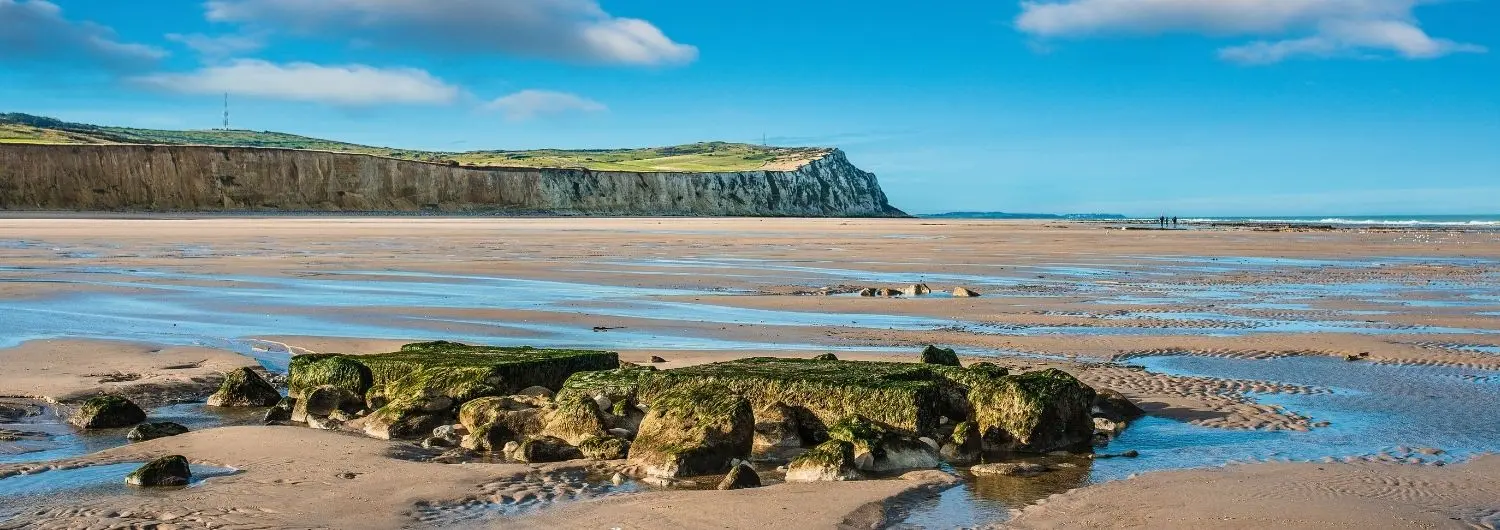

The Two Capes
Between Calais and Boulogne-sur-Mer, Cap Blanc-Nez and Cap Gris-Nez form the Grand Site de France des Deux Caps. It is the most visited part of the coast.
Cap Blanc-Nez
In the commune of Escalles, this chalk cliff rises to about 134 metres. On a clear day, you can see the white cliffs of Dover. From the car park, the top is a few minutes’ walk away.

Cap Gris-Nez
In Audinghen, this is the point on the French coast closest to England, about 34 km away. Its sandstone and clay cliffs are darker than the chalk of Blanc-Nez. The present lighthouse was rebuilt after the Second World War.

Between the two capes, the bay of Wissant is a top spot for kitesurfing and sand yachting.
Seaside resorts and villages
- Le Touquet-Paris-Plage: a resort founded at the end of the 19th century, with a long beach, villas in the forest and a covered market.
- Wimereux: Belle Époque villas and a seafront promenade.
- Wissant: a village between the two capes, on a wide sandy bay.
- Audresselles: a fishing village where you can still see flobarts, the traditional boats hauled up on the shore.
- Ambleteuse: Fort Mahon, built by Vauban at the end of the 17th century, guards the mouth of the Slack.
- Berck-sur-Mer: a huge beach and an international kite festival in spring.

Where to eat
- La Sirène, at the foot of Cap Gris-Nez, in Audinghen: fish and seafood facing the sea.
- La Liégeoise, the restaurant of the Hôtel Atlantic, on the seafront in Wimereux.
- Le Green Bistrot, in Wissant.
- Pérard, rue de Metz, in Le Touquet: fish and seafood.
- Le Pavillon, the restaurant of the Hôtel Westminster, in Le Touquet.
Boulogne-sur-Mer and Nausicaá
Boulogne-sur-Mer is France’s leading fishing port. Its upper town is surrounded by 13th-century ramparts. Nausicaá, the Centre national de la mer, is one of the largest aquariums in Europe.
Nature and wildlife
- The Slack dunes, between Wimereux and Ambleteuse.
- The bay of Canche, near Le Touquet, a nature reserve for migratory birds.
- The bay of Authie, south of Berck, where you can watch harbour seals and grey seals, preferably at low tide and from a good distance.
- The Parc naturel régional des Caps et Marais d’Opale, which covers much of the hinterland.
Before heading out on the foreshore, check the tide times on the SHOM website.
Frequently asked questions
How many days do you need to visit the Opal Coast?
Three or four days let you see the Two Capes, Boulogne-sur-Mer, Wimereux and Le Touquet.
Where can you see seals?
In the bay of Authie, south of Berck-sur-Mer.
Can you visit the Opal Coast without a car?
Partly. TER trains serve Calais, Boulogne-sur-Mer, Étaples-Le Touquet and Rang-du-Fliers, the station for Berck. For the capes and the villages, a car or a bike is more practical.
What is the best viewpoint?
Cap Blanc-Nez, for the view over the Channel and the English coast.
What can you do when it rains?
Nausicaá in Boulogne-sur-Mer, Boulogne’s upper town, or the Château d’Hardelot in Condette, devoted to the Entente Cordiale.
