

Joan of Arc, the Maid of Orleans
Joan of Arc, nicknamed "La Pucelle d'Orléans" (The Maid of Orleans)is one of the figures the most famoushistory of France. Born around 1412 in Domrémy, a town in the Duchy of Bar (now in the Vosges region of Lorraine), she became a national heroine and a saint recognized by the Catholic Church.
Her story is punctuated by remarkable events and heroic deeds that significantly shaped the course of the Hundred Years' War, breathing new hope into the Kingdom of France. Her capture and sentencing to be burned at the stake in Rouen The events of 1431 brought her life to a tragic end, but her legacy lives on. This article aims to trace her life, highlight the French historical sites associated with her, and underscore the influence she had on French history and culture.
Biography of Joan of Arc
The first years at Domrémy
Joan of Arc, born around 1412 in Domrémy, a village in the Duchy of Bar—now in the Vosges region of Lorraine—grew up in a modest peasant family. Her parents, Jacques d’Arc and Isabelle Romée, raised her alongside her four brothers and sisters during a time marked by the Hundred Years’ War between the France and England. Jeanne received an education centered on Christian values and prayer.
From an early age, Jeanne began to hear voices that she identified as those of saints and angels, including the archangel Saint Michael, who entrusted her with the mission of saving France.
The meeting with Charles VII and the rise to power
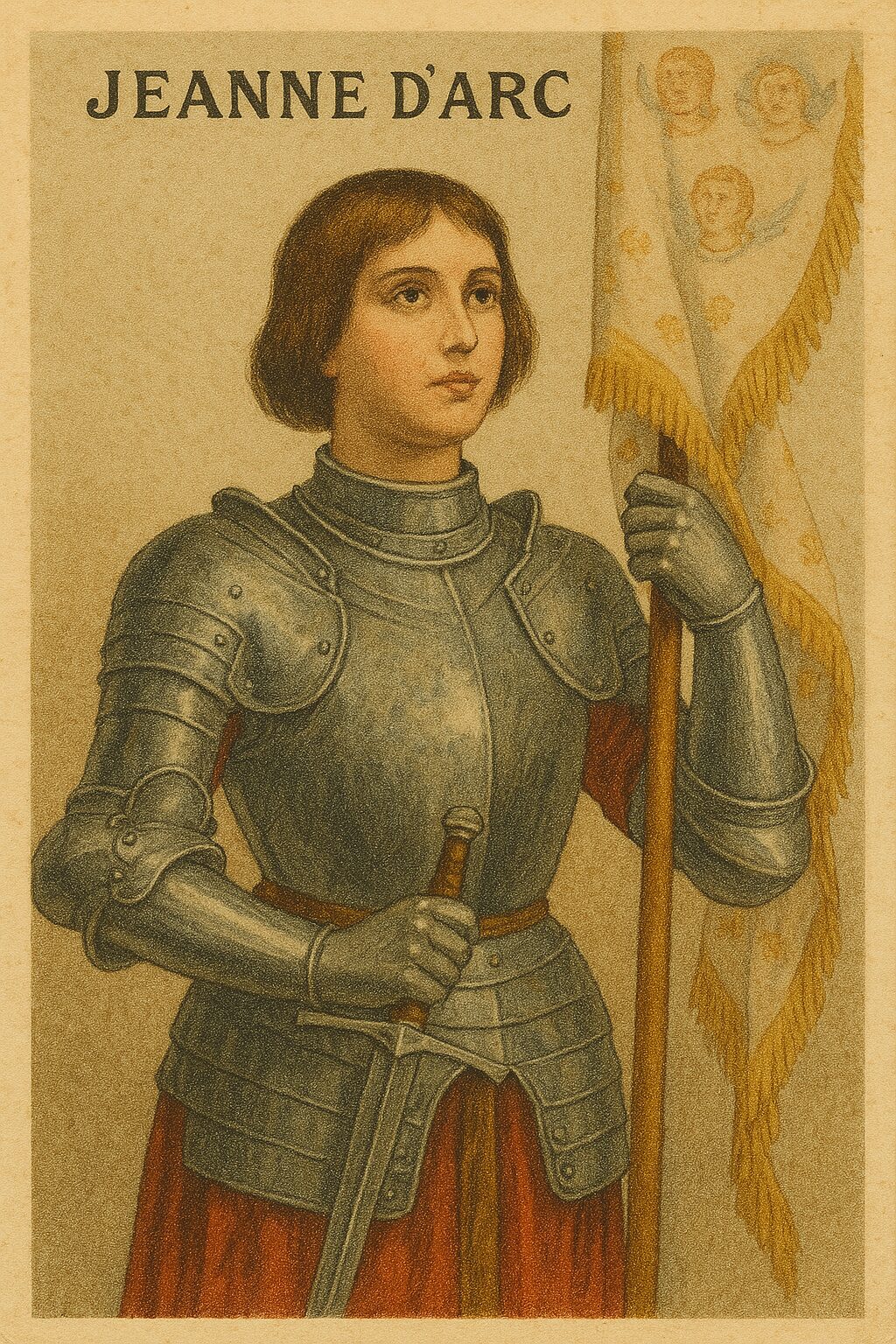
In 1429, determined, Joan traveled to Vaucouleurs to seek the help of Robert de Baudricourt, the town’s captain, in order to meet King Charles VII in Chinon. Despite several initial refusals, she managed to convince him to let her go. Introduced to Charles VII, she secured his support after the king had the truth of her divine mission verified. Joan then became a key figure in the French army, leading the troops to’important victories, including the siege of Orleans raised in May 1429, earning her the nickname "The Maid of Orleans" and national recognition.
Emblematic victories and capture
Under the auspices of the king, Jeanne successfully led several military campaigns, notably the Battle of Patay and the liberation of key towns such as Jargeau and Beaugency. She also played an important role during the coronation of Charles VII in Reims in July 1429. However, in May 1430, during an attempt to liberate Compiègne, she was captured by the forces of the Duke of BurgundyShe was sold to the English, who handed her over to the clergy to be tried for heresy and witchcraft.
The trial and execution in Rouen
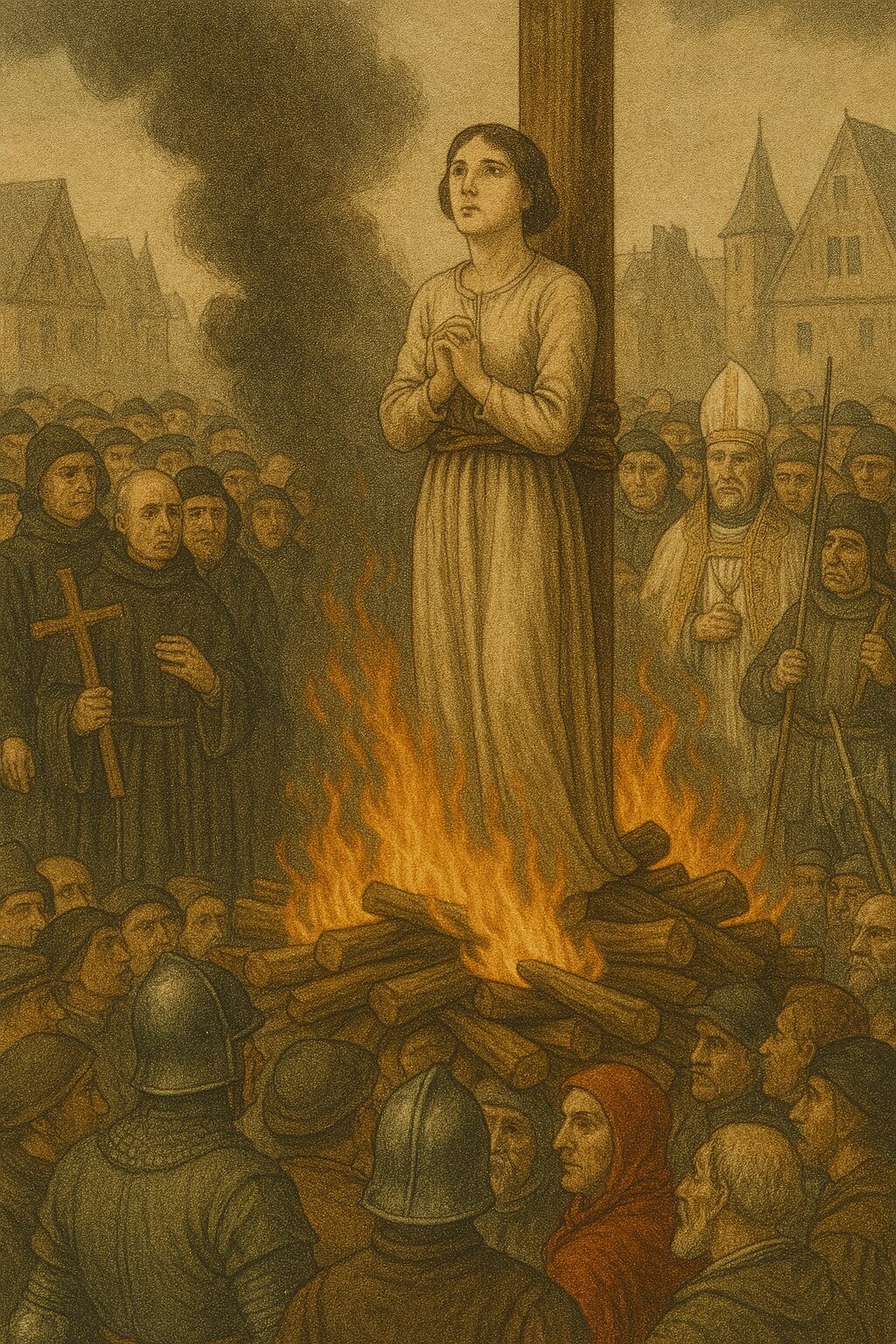
The trial of Joan of Arc took place in Rouen in Normandy, orchestrated by Bishop Pierre Cauchon, a fervent supporter of the English. Despite a trial marred by irregularities and pressure, Joan was sentenced to death. On May 30, 1431, she was burned at the stake in the Place du Vieux-Marché in Rouen. Twenty-five years later, in 1456, a rehabilitation trial authorized by Pope Callixtus III overturned her conviction. In 1920, Joan of Arc was canonized by the Catholic Church.
Historic sites linked to Joan of Arc in France
Domrémy-la-Pucelle: The birthplace
Domrémy-la-Pucelle, nestled in the Vosges, is famous as the birthplace and childhood home of Joan of Arc. Her birthplace is now open to visitors and offers a glimpse into her family life and early years.
Chinon: The castle where she met the king
Visit Chinon castlelocated in Indre-et-Loire, is historically significant for having been the site of the first meeting between Joan of Arc and King Charles VII in 1429. This medieval stronghold, with its imposing towers and ramparts, played a key role in Joan’s story, marking the beginning of her royal support and her military campaigns. Today, the castle is a major tourist attraction.
Orléans: The scene of its greatest victories
Orléans, in the Loiret, is the site of one of Joan of Arc’s most famous victories, where she lifted the English siege in May 1429. The House of Joan of Arc and the statue of Joan of Arc on Martroi Square are major points of interest. Annual celebrations are held there in her honor.
Rouen: The place of his trial and execution
Rouen, located in Seine-Maritime, is infamous for having been the site of Joan of Arc’s trial and execution in 1431. The Place du Vieux-Marché, where she was executed, is now a memorial site featuring a statue and a church in her memory. The Historial Jeanne d’Arc chronicles these events.
The impact and legacy of Joan of Arc
Canonization and transformation into a national symbol
On May 16, 1920, Joan of Arc was canonized by Pope Benedict XV, following her beatification in 1909. Her canonization was a pivotal moment, cementing her status as a saint and a French national symbol.
Already celebrated as a national heroine—particularly in Orléans, where an annual festival had been held in her honor since the 15th century—her role in French culture and history has grown even more prominent.
She became an emblem of resistance and freedom, her image serving to boost national morale, particularly during the First World War.
Representations of Joan of Arc in art and culture
Joan of Arc has been a source of inspiration for many artistic and cultural creations over the centuries. Her story has left its mark on literature, painting, music and cinema.
As early as the 15th century, authors such as Christine de Pizan paid tribute to her in their poems, and theatrical works such as the The Mystery of the Siege of Orléans celebrate her achievements. In the 19th century, she inspired hundreds of works of art, and in the 20th century, she captivated the popular imagination through film, literature, and theater.
Joan of Arc in film: an inexhaustible source of inspiration
Joan of Arcthe famous French heroine, has always fascinated film world. Her extraordinary life story—that of a young peasant girl who became a war leader, was captured, and then burned alive at the age of 19—makes her a dramatic figure perfect for the big screen. Since the early 20th century, many filmmakers have adapted its story.
The latest Joan of Arc films
«Jeanne» (2019) – Bruno Dumont
This film is the sequel to *Jeannette: The Childhood of Joan of Arc* (2017), also directed by Bruno Dumont. The actress Lise Leplat Prudhomme10 years old, plays a very young Jeanne, in stark contrast to the usual representations. This film was presented at Cannes in the Un Certain Regard section.
«Jeanne Captive» (2011) – Philippe Ramos
Less well known, this feature film explores Jeanne's last days after her capture. Performed by Clémence Poésy, Joan is portrayed there as a mystical and introspective figure, far removed from the usual image of a warrior.
List of major Joan of Arc films
Here is a selection of the most notable films on Joan of Arcsorted by release date:
1. «The Passion of Joan of Arc» (1928) – Carl Theodor Dreyer
A masterpiece of silent cinema. The actress Maria Falconetti delivers a deeply moving performance, with a very close-up camera that captures every emotion. This film is often cited as one of the greatest in the history of cinema.
2. «Joan of Arc» (1948) – Victor Fleming
Performed by Ingrid Bergman, this Hollywood adaptation chronicles Jeanne's life. It is known for its lavish art direction.
3. «The Trial of Joan of Arc» (1962) – Robert Bresson
The film focuses on Joan's trial, featuring a very minimalist style and dialogue taken directly from historical documents.
4. «Jeanne la Pucelle» (1994) – Jacques Rivette
A two-part mural: «The Battles» and «The Prisons,» featuring Sandrine Bonnaire in the title role. This film takes a realistic approach, rooted in everyday medieval life.
5. «The Messenger: The Story of Joan of Arc» (1999) – Luc Besson
With Milla Jovovich With [name] in the lead role, this film takes on a spectacular tone. While it takes considerable liberties with historical accuracy, it remains one of the best-known versions internationally.
Joan of Arc and international cinema
Joan of Arc inspired many foreign directors. She is often depicted as a a symbol of faith, courage and rebellion. Each culture projects its own values: religious, nationalist or feminist.
Jeanne d’Arc School
Why so many Joan of Arc schools?
The name Joan of Arc is often used for private Catholic schools, in reference to the Christian values that the saint embodies. There are Jeanne d’Arc elementary schools, middle schools, and high schools in most regions of France.
The Historial Jeanne d'Arc: an immersive site in the heart of Rouen
Located in Rouenin the old archdiocese, l'Historial Jeanne d'Arc is an immersive museum entirely dedicated to the life, legend, and legacy of the famous French heroine. Opened in 2015, this museum traces the life story of Joan of Arc, from his visions to his trial and rehabilitation.
This venue was set up in a location steeped in history: the archbishop’s palace, where part of the rehabilitation trial took place in 1456. The exhibition, designed as a narrative journeyuses modern technologies (videos, mapping, 3D reconstructions) to immerse visitors in the context of the 15th century.
A significant portion of the exhibition is also devoted to her legacy throughout the centuries, showing how Joan of Arc was co-opted by the Church, the Republic, and even propaganda. It is a must-see for anyone wishing to explore Rouen and learn more about this major historical figure. the country.
Jeanne d’Arc Street: An Iconic thoroughfare in the heart of the city
Visit rue Jeanne d'Arc is one of the most iconic streets in several French cities, including Rouen, Orleans or even Paris. Its name pays homage to the famous French heroine.
In Rouen, for example, Rue Jeanne d’Arc connects the SNCF train station to downtown and runs past the courthouse. It is a strategic transportation corridor and a hub of commercial activity. In Orléans, it leads directly to Sainte-Croix Cathedral and is decorated every year in honor of Joan of Arc during the Fêtes Johaniques.
Conclusion
Joan of Arc, nicknamed the Maid of Orleans, remains an icon in French history, embodying courage, faith, and resilience. His life, marked by military successes and ending in a tragic death, continues to inspire generations. The 1456 rehabilitation trial cleared his name.
To this day, her cultural and historical legacy remains a source of inspiration. By visiting the historic sites associated with her life, you’ll discover the story of this heroine.
Joan of Arc - FAQ
Who was Joan of Arc's husband?
Joan of Arc remained single throughout her life. She was nicknamed "Jeanne la Pucelle" or "the Maid", emphasizing her virginity.
Who decided to burn Joan of Arc?
The ecclesiastical court of Rouen, influenced by the political authorities of the time—including the Duke of Bedford and Bishop Pierre Cauchon—sentenced Joan of Arc to be burned at the stake. Her sentence was carried out on May 30, 1431.
What's the story of Joan of Arc?
Born around 1412 in Domrémy, Joan of Arc is an iconic figure in French history. She claimed to be guided by divine voices to support Charles VII and liberate France from English occupation during the Hundred Years’ War. Her most famous feat was the liberation of Orléans in 1429. After being captured by the Burgundians, she was sold to the English, tried for heresy, and executed in Rouen in 1431. Rehabilitated in 1456, Joan of Arc was beatified in 1909 and canonized in 1920.
What is the true story of Joan of Arc?
Joan of Arc, born around 1412 in Domrémy, is a French national heroine and a saint of the Catholic Church. Inspired by voices she believed to be those of saints, she played a decisive role in the Hundred Years’ War by helping Charles VII reclaim the throne of France. Her major contributions were the lifting of the siege of Orléans and the coronation of Charles VII in Reims. Captured and sold by the Burgundians to the English, she was executed in Rouen in 1431. Rehabilitated after her death, she was beatified and later canonized.
