

Tourism and disability
Visit tourism and disability is a major challenge in ensuring that everyone, regardless of their abilities, can travel and discover the country’s wonders. The «Tourisme & Handicap» certification guarantees accessibility for people with various types of disabilities at tourist sites. This certification is essential for promoting inclusive tourism. To learn more about the country’s different regions and their tourist attractions, check out our guide to the country's regions and tourist attractions.
Find out more about labels For vacation rentals, click here!
What is the label? Tourism & Handicap ?
The label Tourism & Handicap was created in 2001 to ensure that tourist sites are accessible to people with disabilities. This certification is awarded to establishments that meet specific criteria regarding hospitality and accessibility for people with mobility, visual, hearing, and intellectual disabilities. It allows people with disabilities to plan their vacations with confidence, knowing that the facilities are adapted to their needs.
To discover other tourism labels, read our detailed article here.
History and purpose of the label
The idea of creating this certification arose from the need to make tourism accessible to people with disabilities. The 2005 French law on «equal rights and opportunities» reinforced this approach by establishing accessibility as a fundamental right. The «Tourisme & Handicap» certification is awarded to establishments that meet strict standards to ensure easy access to tourist facilities and activities.
Criteria for obtaining the label Tourism & Handicap
To earn this certification, facilities must meet accessibility criteria for four types of disabilities:
- Motor disabilities : modifications to circulation areas, access ramps, and accessible elevators.
- Visual disability : audible beacons, visual contrasts, Braille signage.
- Hearing impairment magnetic loop systems, subtitling, sound amplification devices.
- Mental disability simplified signage, easy-to-understand information, specific support.
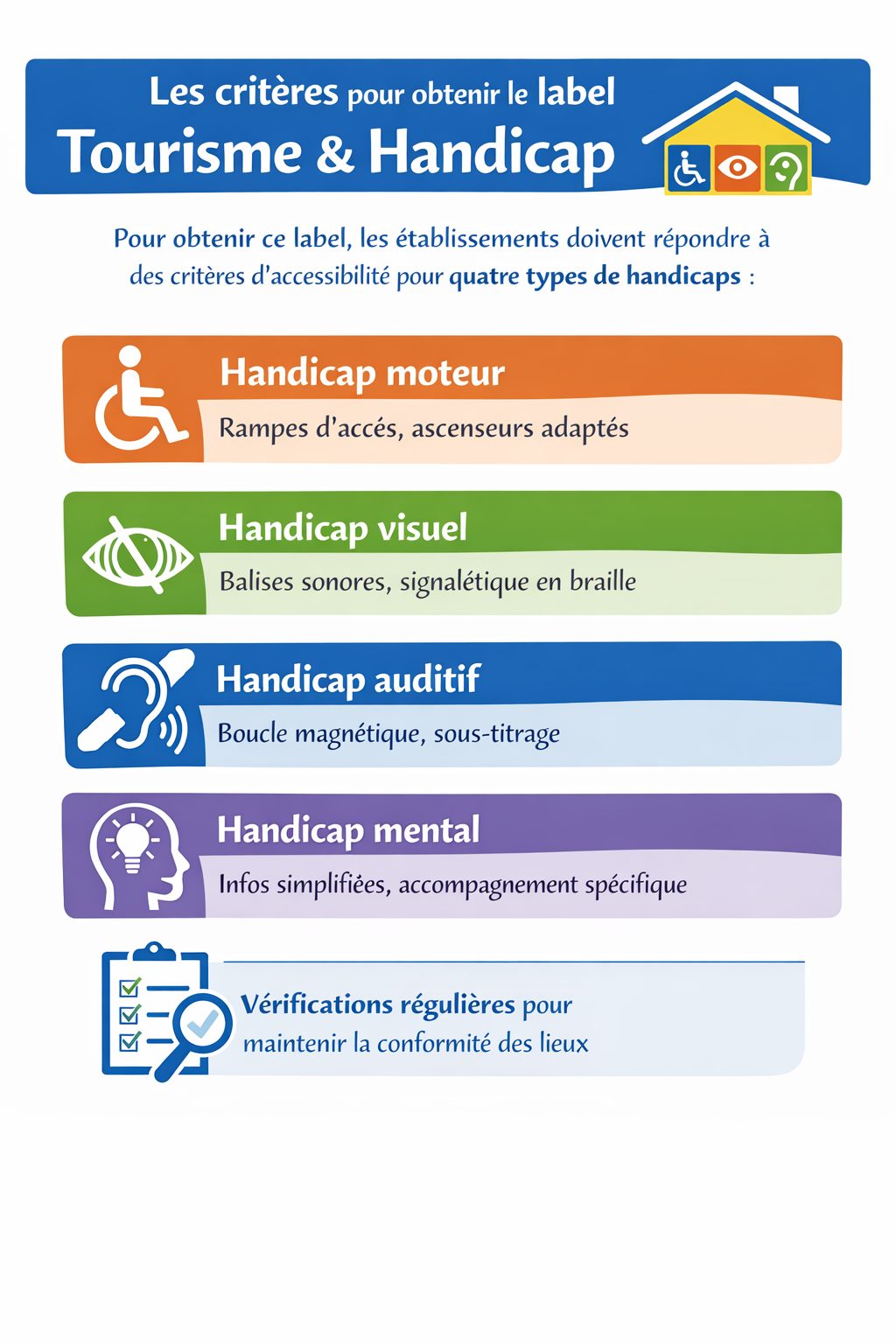
The criteria are reviewed regularly to ensure that the facilities continue to meet accessibility requirements.
Label cities Tourism & Handicap by region
France has many cities and tourist attractions that have earned the «Tourisme & Handicap» certification. Here is a selection of cities by region:
- Île-de-France : Paris, Versailles, Fontainebleau
- Provence-Alpes-Côte d'Azur Marseille, Nice, Cannes
- Nouvelle-Aquitaine Bordeaux, La Rochelle, Poitiers
- Occitanie Toulouse, Montpellier, Carcassonne
- Brittany Rennes, Saint-Malo, Quimper
- Pays de la Loire : NantesAngers, Le Mans
- Great East Strasbourg, Metz, Nancy
These towns offer adapted infrastructures and accessible activities for all types of disability.
Famous towns awarded the label Tourism & Handicap
Some of the most-visited cities in France are also known for their commitment to accessibility. Here are a few of the best-known ones:
- Paris : With a multitude of accessible museums, monuments and public spaces, Paris is a model city for accessible tourism.
- Marseille The city of Marseille offers easy access to beaches, museums and the famous Notre-Dame de la Garde basilica.
- Nice Between sea and mountains, Nice offers accessible walks, as well as museums such as the Matisse Museum.
- Bordeaux The town center and Garonne quays are wheelchair accessible.
- Toulouse Museums, public squares and historic sites in the Pink City are accessible to visitors with disabilities.
Accessible tourist sites and activities
Here are just a few examples:
- Museums and monuments : Many museums, such as the Louvre Museum in Paris, have adapted their exhibition spaces. Other monuments, such as the Palace of Versaillesoffer adapted guided tours.
- Natural parks Spaces like the Parc national des Calanques near Marseille or the Pyrenees National Park in Occitanie have trails equipped for people with reduced mobility.
- Beaches Adapted beaches like La Grande Motte or Nice offer Tiralos wheelchairs to make it easier to get to the beach.
- Guided tours Some cities, like Strasbourg and BordeauxThese include guided tours in sign language and brochures in Braille.
Other tourism labels in France
In addition to the «Tourisme & Handicap» certification, France offers other tourism certifications that guarantee the quality of facilities and services:
- Towns and Villages in Bloom : This label rewards towns that invest in beautifying their green spaces.
- Station Verte : Intended for small rural communities that promote nature-based and environmentally friendly tourism.
- Blue Flag A label awarded to beaches and marinas that meet strict environmental criteria.
- Most Beautiful Villages in France : This label recognizes small towns with a remarkable architectural heritage.
Are you familiar with the « »City of Art and History"? A lesser-known label: the ‘Small Towns of Character’ designation.
These certifications are a guarantee of quality for tourists seeking unique and authentic experiences in France.
Frequently asked questions
What is the label? Tourism & Handicap ?
The «Tourisme & Handicap» certification ensures that tourist sites are accessible to people with disabilities, whether they have mobility, visual, hearing, or intellectual disabilities.
How to obtain the label Tourism & Handicap ?
A facility must meet specific accessibility criteria for the four types of disabilities. These criteria are reviewed on a regular basis.
How many towns in France have the label Tourism & Handicap ?
Hundreds of cities and establishments in France have earned this certification, offering numerous options for tourists with disabilities in every region.
What activities are on offer in approved towns? Tourism & Handicap ?
Certified cities offer a variety of accessible activities, such as museum visits, walks in nature parks, and days at the beach.
Which are France's most accessible cities for disabled tourists?
Paris, Marseille, Nice, Bordeaux and Toulouse are among the most accessible cities for people with disabilities.
What other tourism labels exist in France?
There are several other tourism certifications, such as «Villes et Villages Fleuris,» «Pavillon Bleu,» and «Plus Beaux Villages de France,» which highlight other aspects of tourism, such as the environment or architecture.
Conclusion
Visit tourism and disability in France is constantly evolving, with many towns and sites striving to adapt their infrastructures to meet the needs of people with disabilities. Thanks to labels such as Tourism & HandicapIn France, travelers can enjoy inclusive, accessible vacations all over the country. Plan your stay in France now and discover approved destinations that will welcome you in the best possible conditions.
To learn more about the history and criteria of the label, visit the dedicated Wikipedia page.


