
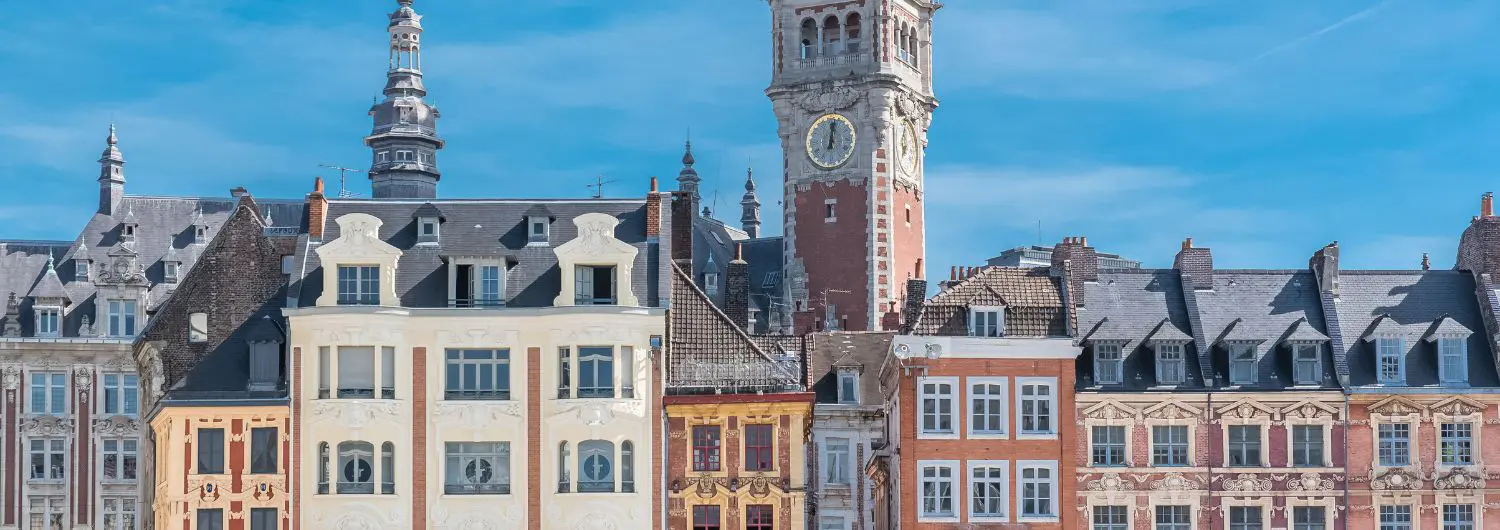
Lille Visit guide
Lillelocated in the department northern Franceis a city a dynamic, culturally rich and storied city. It attracts visitors thanks to its exceptional architectural heritage, its renowned higher education institutions and the diversity of its museums. Lille is also renowned for its warm atmosphere and its ability to celebrate with enthusiasm.
In this article
This guide takes you on a tour of Lille's charms, highlighting its prestigious universities and captivating museums.
Immerse yourself in Lille's unique history and charm
Lille, a city with a diverse past influenced by multiple cultures, stands out for its unique identity and beauty. Occupying a strategic position at the junction of France, Belgium, the Netherlands and England, Lille has capitalized on its location to foster its development and open up to Europe.
It has also succeeded in preserving and enhancing its architectural heritage, a reflection of its rich and tumultuous history.
A city at the heart of Europe
Lille's history is intimately linked to that of the Deûle, a river that connects it to the major cities of Flanders and the fairs of Champagne, making it a vital port for trade and commerce. Since the Middle Ages, Lille has been an integral part of the County of Flanders, under French suzerainty.
In 1369, Lille came under the rule of the House of Burgundy, then the Habsburg family in 1477. It became Spanish in 1598 under Philip II, and was conquered by Louis XIV in 1668, becoming part of France.
After being occupied by the Austrians, the English and the Germans, Lille has regained its freedom and today asserts itself as the capital of the Hauts-de-FranceFrance's third-largest metropolis in terms of population, and a European crossroads hosting numerous cultural institutions and events.
Lille, captivating architecture

Lille captivates visitors with the diversity and richness of its architecture, covering every style from the Middle Ages to the present day.
Its Gothic heritage is remarkable, including the churches of Saint-Maurice and Sainte-Catherine, as well as the Vieille Bourse, a pearl of Flemish Mannerism. The city also has a classical side, with Vauban's citadel and the churches of Saint-Étienne and Saint-André.
The city also stands out for its modern look, embodied by Philippe le Bon's Palais Rihour, the belfry of the town hall, an emblem of the region's art deco style, and the Euralille district, where contemporary towers designed by renowned architects stand tall.
Picturesque alleyways and historic squares
The city invites you to discover its charming alleyways and squares steeped in history. The beating heart of the city is Vieux-Lille, a district that has preserved its character with arched houses, colorful facades and inner courtyards. It's also a lively district, rich in shops, restaurants and bars.
Don't miss the Place du Général-de-Gaulle, or Grand'Place, famous for its statue of the goddess, symbol of Lille's resistance in 1792. Also discover Place du Théâtre, home to the opera house and the Chamber of Commerce, two neoclassical gems. Finally, the Place aux Oignons will enchant you with the Hospice Comtesse, founded in 1237 by Jeanne de Flandre.
Discovering Lille's universities
Lille, a dynamic and welcoming city, is a magnet for students from all over France and the world. The city is home to nine public universities, offering a wide range of disciplines, from law and health to science, humanities, languages, social sciences and sport.
The University of Lille stands out for its academic excellence, vibrant student community and openness to the world.
Université de Lille: a center of educational excellence
Resulting from the 2018 merger of Lille 1
- Sciences and technologies, Lille 2
- Law and Health, and Lille 3
- Charles-de-Gaulle, Université Lilloise is home to some 80,000 students, including 10,000 international students from 150 different countries, making it one of the largest French-speaking universities.
It offers a rich and diversified range of courses, covering more than 300 programs, from DUT to PhD, in six major fields of study. The university also boasts 66 research laboratories, pushing back the frontiers of knowledge and innovation in key areas such as health, the environment, materials, artificial intelligence and the human and social sciences.
Recognized for its excellence, the city's university has been awarded the Initiative d'excellence (IDEX) label, providing additional funding for the development of its strategic projects.
Student life in Lille
The University of Lille offers an environment conducive to the success and well-being of its students. With five main campuses in the Lille area and several regional branches, it provides a full range of high-quality services and facilities, including libraries, computer rooms, collaborative work spaces, university restaurants, residences, sports facilities and health centers.
It also promotes a dynamic community, cultural and civic life, by supporting student projects and organizing various events throughout the year, such as the Festival des sciences, the Forum des métiers and the Nuit des arts et des idées.
International university initiatives
As part of its commitment to international openness, the Université de Lille deploys a wide range of initiatives designed to increase its influence and cooperation on a global scale. It welcomes and supports international students with tailored training courses, French language courses, financial aid and cultural activities. It strongly encourages the international mobility of its students, offering them the opportunity to study or do an internship abroad thanks to exchange or double degree programs with more than 800 partner universities around the world.
Last but not least, the University of Lille participates in major international networks and projects, such as the Utrecht network, which brings together 50 European universities, and the CIVIS project, which aims to create a European university with eight partners.
Lille's museums: a rich cultural heritage
The city, with its myriad of museums, is a showcase of history, diversity and creativity. Whether your passion is art, nature or heritage, there's a museum in Lille that will captivate your interest.
Explore iconic sites such as the Palais des Beaux-Arts, Piscine de Roubaix, Musée d'Histoire Naturelle and Musée de l'Hospice Comtesse, each offering a unique experience.
Palais des Beaux-Arts: a collection of European art not to be missed
The Palais des Beaux-Arts, Lille's largest museum and one of the most renowned in France, presents a collection of European art from the Middle Ages to the 20th century. Discover paintings, sculptures, drawings, ceramics, reliefs and coins.
Works by Goya, Donatello, Veronese, Rubens, Delacroix, Courbet, Rodin and Picasso are on display. The museum also enriches your visit with temporary exhibitions, guided tours, workshops, lectures and events for all.
La Piscine de Roubaix, Museum of Art and Industry
La Piscine de Roubaix, a former art deco swimming pool transformed into a museum, offers an enchanting setting where water, light and color intermingle. Art and industry collections reflect Roubaix's rich textile past, with paintings, sculptures, textiles, ceramics, jewelry and furniture.
Temporary exhibitions, concerts, shows and educational activities are organized on a regular basis.
The Natural History Museum and the Hospice Comtesse Museum
The Natural History Museum, the city's oldest, founded in 1822, offers a journey through the diversity and evolution of the living world, with its zoological, botanical, geological and ethnographic collections.
Admire naturalized animals, skeletons, fossils, minerals, shells and ethnic objects. The museum also enlivens your visit with temporary exhibitions, events, lectures and scientific workshops.
The Musée de l'Hospice Comtesse plunges you into the daily life of the people of Lille in the past, with its collections of furniture, paintings, earthenware, sculptures and silverware, housed in a former 13th-century hospital. Visit the chapel, wards, kitchen and pharmacy, and enjoy temporary exhibitions, concerts, themed tours and cultural events.
Visit LOSC Lille
Visit LOSC Lilleor Lille Olympique Sporting Club, is an iconic French soccer club, founded in 1944 following the merger of Olympique Lillois and SC Fives. Based in Lille, in the north of France, the club competes in Ligue 1 and plays its home games at Stade Pierre-Mauroy, a modern stadium with a capacity of over 50,000. .
A Rich Prize List
Since its creation, the LOSC Lille has won several major titles:
4 French championship titles (1945-46, 1953-54, 2010-11, 2020-21)
6 French Cups
1 Champions Trophy
1 Intertoto Cup in 2004
The club is also renowned for its regular participation in European competitions, notably the Champions League, where it has reached the Round of 16 on several occasions. .
A Competitive Team
Under the guidance of coach Bruno Génésio, the LOSC Lille continues to position itself as a serious contender in Ligue 1. The current team includes talented players such as Jonathan David, a prolific Canadian striker, and Edon Zhegrova, a creative Kosovar winger. The duo has been instrumental in the club's recent performances, particularly in the Champions League. .
Other key players include Angel Gomes, an up-and-coming English midfielder, and Lucas Chevalier, a promising young French goalkeeper. .
Quality Training
Visit LOSC Lille is also renowned for its training center, which has produced talents such as Eden Hazard and Benjamin Pavard. The club continues to invest in the development of young players, ensuring a constant succession for the first team.
A European presence
In addition to its national successes, the LOSC Lille marked its presence on the European scene. The club has taken part in several editions of the Champions League and Europa League, competing against prestigious clubs and reinforcing its international reputation. .
In short, the LOSC Lille is a historic club in French soccer, combining tradition and modernity, with a constant ambition to shine on both the national and international scenes.
Weather in Lille Forecast and climate
Visit weather in Lille is influenced by a temperate oceanic climate, characterized by cool winters, mild summers and regular rainfall throughout the year. Located in the north of France, close to the Belgian border, Lille's geographical position moderates climatic extremes, offering relatively stable weather conditions.

 18°C | °F
Weather in Lille: Average temperatures
In Lille, temperatures vary moderately with the seasons. In winter, minimum temperatures rarely fall below 0°C, with averages around 2°C in January. Summers are generally mild, with average maximum temperatures around 24°C in July and August. This thermal moderation is typical of oceanic climates, where temperature variations between seasons are less pronounced.
Precipitation
Rainfall in Lille is fairly evenly distributed throughout the year. The city records an average annual rainfall of around 763 mm. Autumn and winter months tend to be slightly wetter, with average monthly rainfall reaching up to 74 mm in November. However, even the driest months, such as March, receive around 54 mm of rain, underlining the region's consistency in terms of precipitation.

Sunshine
The city is one of the least sunny regions in France, with an annual average of around 1,628 hours of sunshine. The summer months, especially June and July, offer the longest, sunniest days, while winter is marked by shorter days and less sunshine.
Wind and humidity
Lille's climate is also characterized by frequent winds, particularly during the winter months, which can accentuate the feeling of cold. Relative humidity remains high throughout the year, contributing to a persistent feeling of coolness, even during the hottest periods.
In short, the weather in Lille is marked by a temperate oceanic climate, with moderate temperatures, regular rainfall and relatively little sunshine. These climatic conditions offer a degree of stability, although locals and visitors alike need to be prepared for frequent weather variations, particularly with regard to rain and wind.
Sogo Lille
Sogo Lille is the official collaborative messaging platform of the Académie de Lille, designed to facilitate communication between teachers, administrative staff and students. Accessible via webmail.ac-lille.fr/SOGoIt offers an intuitive, secure interface, compatible with standard protocols such as IMAP, CalDAV and CardDAV.
Sogo Lille connection
To connect to Sogo LilleAll you need to do is use the login details provided by the education authority, generally consisting of the user's first name and surname, followed by the initial password, often based on the NUMEN. If you forget, recovery options are available directly on the login page.
Features include e-mail management, shared calendars, address books and tasks. This open-source solution promotes collaborative working by enabling document sharing and co-editing in real time, while guaranteeing data security thanks to SSL/TLS encryption and two-factor authentication.
In a nutshell, Sogo is an essential tool for the educational community of the Académie de Lille, offering reliable messaging and collaborative services tailored to academic needs.

Eduline Lille
Eduline Lille is the official digital portal of theregional academydesigned to centralize all the services and tools for national education staff. Accessible via eduline.ac-lille.frThis platform offers a secure interface enabling teachers, school heads and administrative staff to manage their professional activities efficiently.
Main features
SOGo professional messaging : allows you to exchange e-mails, manage a calendar and an address book.
Personal workspace : document storage via Electronic Document Management (EDM) with 4 GB capacity.
Pedagogical applications : access to tools such as Escola for managing schedules and assessments.
Continuing education : integration of the M@gistère platform for teacher professional development.
Administrative services : consultation of pay slips, career management via i-Prof, and access to various administrative procedures.
Access and safety
Access to Edulin requires an academic identifier (usually in the form prenom.nom@ac-lille.fr) and a password. For added security, authentication can include a single-use code (OTP). If you lose your login or password, recovery procedures are available directly on the login page.
Benefits for users
By centralizing essential tools, Eduline Lille simplifies the day-to-day management of professional tasks, encourages collaboration between colleagues and improves work organization. The platform is accessible 24/7, from any Internet-connected device, offering users optimum flexibility.
For any questions or assistance, users can consult the help section available on the portal or contact the academy's technical support.
Conclusion
Lille, with its rich past, distinctive identity and singular beauty, promises an unforgettable experience to those who visit it. Strolling through its lively streets, historic squares and imposing monuments, you can fully appreciate what this city has to offer.
This metropolis is not content to rest on its laurels; it is resolutely looking to the future, driven by dynamism, a quest for excellence and a remarkable openness, particularly in the academic and cultural spheres. The city of Lille invites you to discover it, ready to welcome you with open arms and fill you with wonder. Don't miss the opportunity to discover it: Lille will not disappoint!
FAQ
How to visit Lille in 2 days?
To discover the city in 2 days, here's a recommended itinerary: Start with the city center on foot on the first day. Start with the Grand Place, Lille's vibrant historic heart. Admire the impressive Flemish facades and the statue of the Goddess. Then head to Vieux Lille, the city's most picturesque district, characterized by cobbled streets and colorful houses.
Don't miss a visit to Notre-Dame de la Treille Cathedral, a neo-Gothic gem with a modern marble facade. For a breathtaking view of Lille and its surroundings, climb up to the Hôtel de Ville belfry, the highest in northern France. Conclude the day at the Hospice Comtesse museum, once a medieval hospital, now home to art and history collections.
On the second day, rent a bike and explore Lille's surroundings. Take a trip to Parc de la Citadelle, considered the city's green lung, where you can stroll along the ramparts and canal. Then visit the Villa Cavrois, an Art Deco masterpiece designed by Robert Mallet-Stevens.
Finish off with a visit to Roubaix, an industrial town converted into a cultural center. Don't miss La Piscine, an art museum housed in a former municipal swimming pool, offering varied collections in a unique setting.
Why is Lille such a beautiful city?
The city is renowned for its rich historical and cultural heritage, reflecting a diverse past and varied influences. It's a lively, welcoming city, offering a multitude of activities, leisure and gastronomic options, all in a warm, festive atmosphere.
How is life in Lille?
Life in the city is dynamic and rich in diversity. Located in northern France, Lille boasts a rich history, splendid architecture and a vibrant cultural scene. The city boasts an affordable cost of living, an efficient public transport network and a wide range of entertainment and events, particularly popular with students.
Is Lille a big city?
Yes, Lille is a great city. It ranks as France's tenth most populous commune and is the fourth-largest metropolitan area in the country. Lille is also the capital of French Flanders and plays a central role in the history of the Nord-Pas-de-Calais region.
