

Why was this law passed?
Si la réglementation s’est durcie, c’est avant tout pour répondre à la crise du logement qui frappe les zones les plus attractives du territoire. Voici les trois piliers qui ont poussé le législateur à agir :
Rebalancing the rental market: In many cities (Bordeaux, Biarritz, Annecy or Paris), la multiplication des meublés de tourisme a réduit l’offre de logements disponibles pour les résidents permanents et les travailleurs locaux. L’objectif est de remettre des biens sur le marché de la location longue durée.
La fin d’une « niche fiscale » : Le gouvernement a jugé que l’abattement de 71% ou 50% du régime Micro-BIC créait une distorsion de concurrence injustifiée par rapport à la location vide, taxée beaucoup plus lourdement.
Municipal sovereignty: The law gives mayors back the power to regulate their territory. It's no longer just metropolitan areas that are concerned, but potentially every commune in France facing real estate tension.
Law no. 2024-1039 of November 19, 2024 aimed at strengthening the tools for regulating meublés de tourisme. (Légifrance).
Le nouveau calendrier fiscal : 30%, 50% ou 71% d’abattement ?
The tax reform resulting from the Law no. 2024-1039 (codifiée en partie dans le Code Général des Impôts) a radicalement modifié les seuils du régime Micro-BIC. L’objectif affiché par le législateur est d’aligner la fiscalité du meublé sur celle de la location nue.
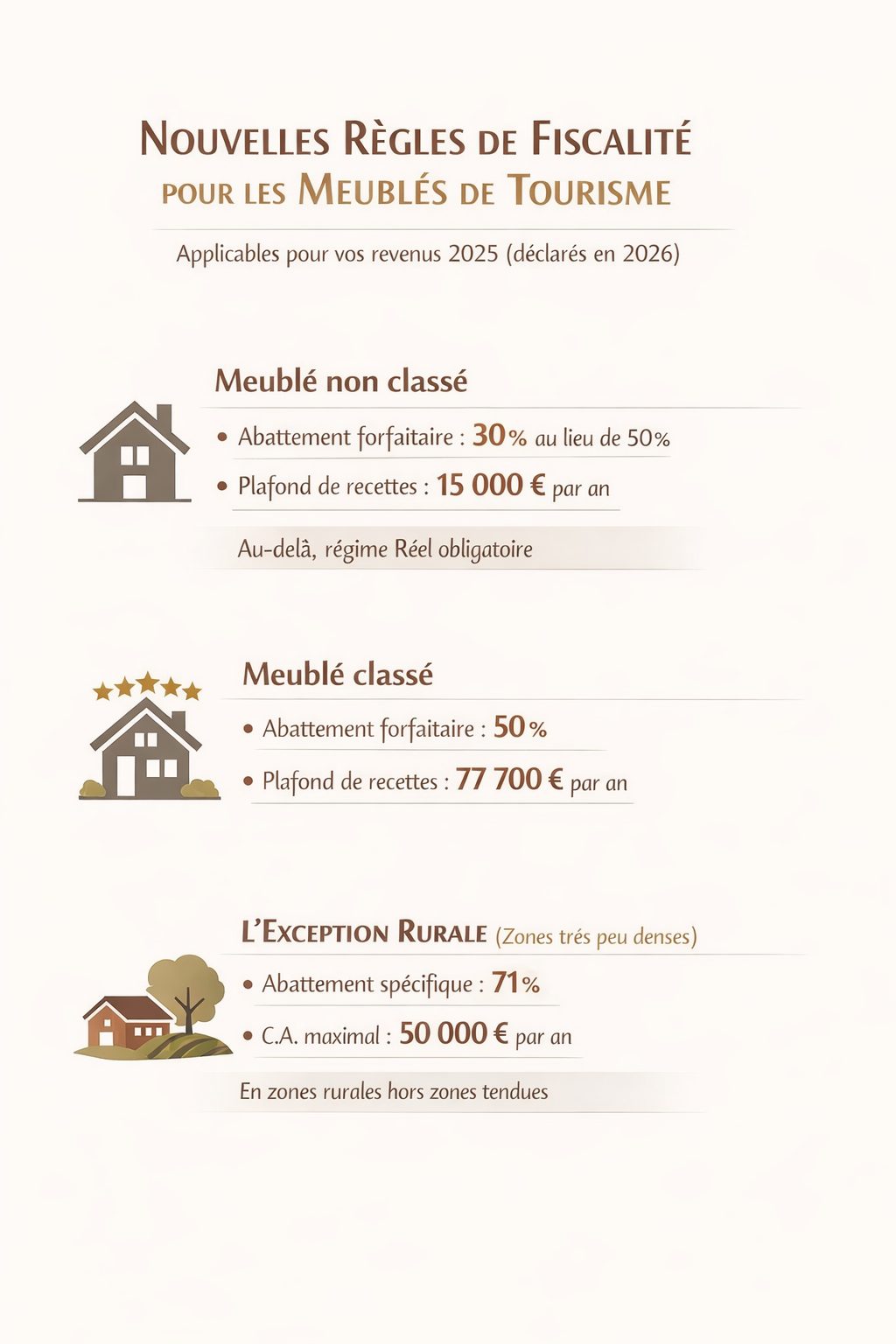
Here are the new rules applicable to your 2025 income (declared in 2026):
The standard system (unclassified furnished accommodation) : L’abattement forfaitaire chute à 30 % (previously 50 %). The revenue ceiling is now set at 15 000 € per year (Art. 50-0 of the CGI). Beyond that, you must switch to the Real regime.
The Meublé de tourisme classification system : Pour encourager la qualité de l’offre, le classement officiel (1 à 5 étoiles) permet de conserver un abattement de 50 % with a revenue ceiling of 77 700 €.
L’exception rurale (Zones très peu denses) : Selon l’article 45 de la loi, une déduction supplémentaire portant l’abattement à 71 % reste possible pour les meublés classés situés hors zones tendues, à condition que le chiffre d’affaires n’excède pas 50 000 €.
Practical info: What tax system should I choose for my furnished rental? (Impots.gouv.fr).
La fin d’une niche sur la plus-value : A major reference point for investors: the reform modifies the methods for calculating capital gains by LMNP (Non-Professional Furnished Rental). Désormais, les amortissements pratiqués durant la détention du bien sont réintégrés dans la base imposable lors de la revente, augmentant ainsi l’impôt dû lors de la cession (alignement partiel sur le régime professionnel LMP).
Energy performance (DPE): Is your home still rentable?
For a long time, seasonal rentals escaped the energy decency constraints imposed on long-term rentals. The Law no. 2024-1039 (art. 12) and the Climate and Resilience Act (Art. L. 173-1-1 du CCH) ont mis fin à cette exception pour éviter que les « passoires thermiques » ne se déversent massivement sur le marché du tourisme.
Le calendrier de l’interdiction
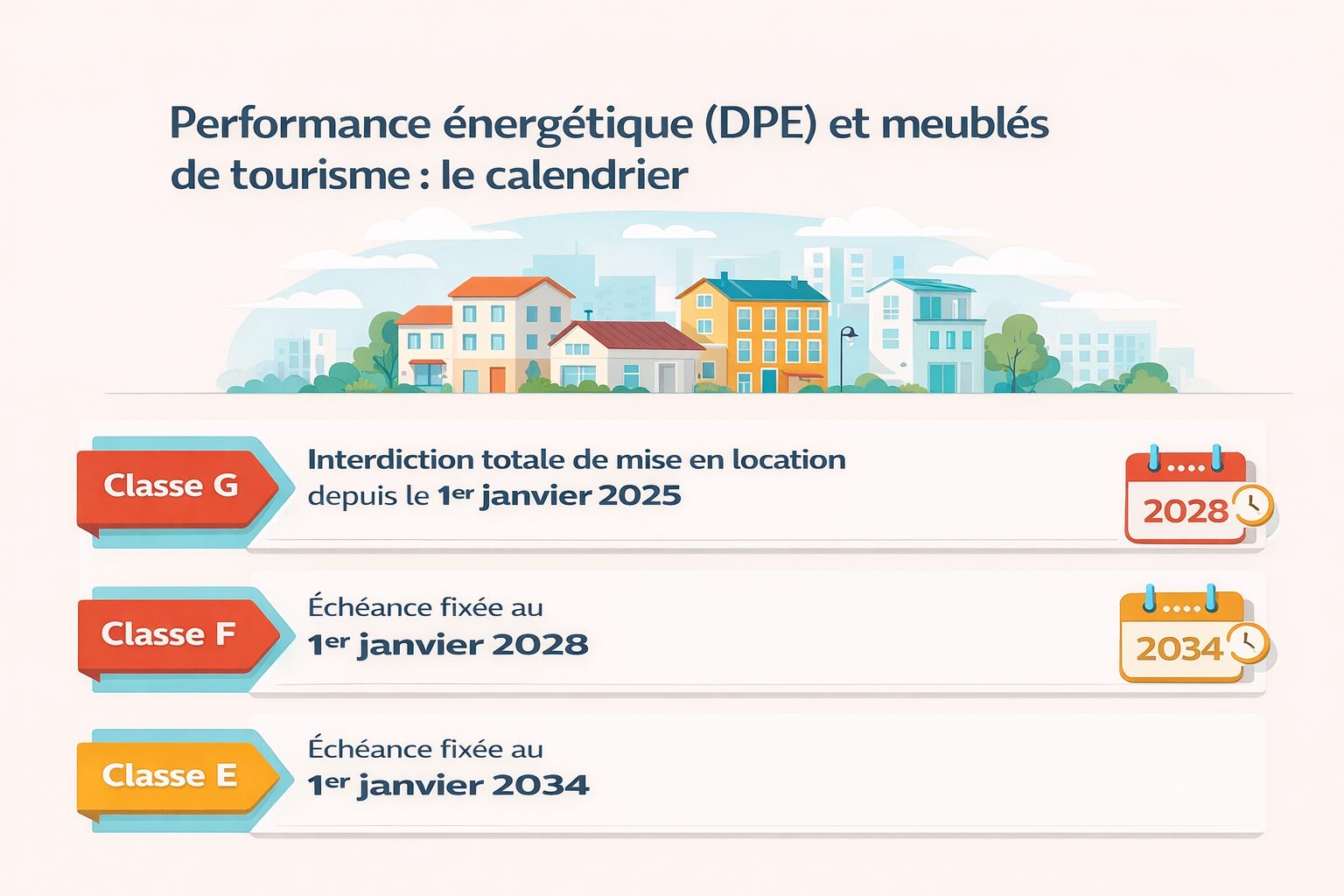
En 2026, le critère de décence est devenu une barrière à l’entrée. Le calendrier est désormais aligné sur celui des baux d’habitation classiques :
G class : A total ban on lettings from January 1, 2025.
Class F : Maturity date: January 1, 2028.
Class E : Maturity date: January 1, 2034.
Case in point: > Pierre owns a small mountain listed G à cause d’une isolation inexistante sous le toit.
The risk: S’il tente de publier son annonce en 2026, les plateformes (obligées de vérifier le DPE) bloqueront techniquement la diffusion de son offre.
The penalty: En cas de contrôle, Pierre s’expose à une amende et à l’obligation de réaliser des travaux de rénovation énergétique pour retrouver le droit de louer.
Le DPE comme condition au « Changement d’Usage »
Dans les communes ayant mis en place un règlement sur le changement d’usage (comme Paris, Lyon, Annecy ou les communes du Pays Basque), la mairie subordonne désormais son autorisation à un niveau de performance énergétique minimal.
The rule: To convert a property into a furnished tourist accommodation, the local authority may require that the property be classified as a "furnished tourist accommodation". at least E from 2026.
L’exemple : > You are buying former commercial premises in Bordeaux to convert them into Airbnb. Pour obtenir l’autorisation de la mairie, vous devez prouver, DPE à l’appui, que votre rénovation atteint une performance décente. Si le résultat est F, your rental project is administratively blocked.
Greater control for mayors
The Le Meur law gives mayors the power to suspendre le numéro d’enregistrement.
Procedure: Si un doute subsiste sur la décence du logement, la mairie peut exiger la transmission du DPE. Si le propriétaire ne le fournit pas ou si le logement est classé G, le numéro d’enregistrement est désactivé sous 45 jours.
Le numéro d’enregistrement national : Comment l’obtenir avant mai 2026 ?
Jusqu’à récemment, l’obligation d’obtenir un numéro d’enregistrement était réservée aux grandes métropoles en « zone tendue ». La Law no. 2024-1039 (Art. L324-1-1 of the French Tourism Code) has generalized this system to create a single national directory géré par un portail numérique d’État.
A general obligation
From now on, any person who offers for rent a furnished holiday home, qu’il s’agisse de sa résidence principale ou secondaire, doit procéder à une déclaration préalable.
Change in 2026: Même si votre commune n’avait pas instauré de délibération spécifique auparavant, vous devez obtenir ce matricule à 13 chiffres pour pouvoir publier une annonce sur n’importe quel site internet.
The step-by-step procedure
L’obtention est immédiate et se fait entièrement en ligne :
Login : You log in via FranceConnect on the national furnished accommodation portal.
Statement: Vous renseignez les caractéristiques du bien (adresse, nombre de pièces, capacité d’accueil, statut de résidence principale ou secondaire).
Reception : Un accusé de réception vous est délivré instantanément avec votre numéro d’enregistrement.
Case in point: Nadine rents a small outbuilding in her garden to Sarlat. Elle pensait être exemptée car Sarlat n’est pas Paris.
In 2026 : Nadine reçoit un email de sa plateforme de réservation (ou de son site d’annonces) lui demandant son numéro sous peine de désactivation. Elle se connecte au portail national, remplit le formulaire en 5 minutes, et récupère son numéro. Elle peut alors mettre à jour ses annonces et continuer à louer légalement.
Sanctions and traceability
Le numéro d’enregistrement est l’outil de contrôle principal du fisc et des mairies :
Penalty for missing number : Jusqu’à 5 000 € d’amende civile.
Automatic control : En 2026, l’API du portail national communique directement avec les sites de location. Si un numéro est invalide ou « doublonné » sur plusieurs adresses, l’annonce est automatiquement signalée aux services municipaux.
Did you know? Les plateformes ont désormais l’obligation légale de retirer toutes les annonces qui n’affichent pas ce numéro d’ici le mois de mai 2026.
Our tips for maintaining your profitability despite the reform
Avec la baisse des abattements fiscaux (passant de 50 % à 30 % pour les non-classés), la pression fiscale augmente mécaniquement. Pour un propriétaire, 2026 est l’année où il faut impérativement optimiser ses autres postes de dépenses pour ne pas voir son bénéfice net fondre.
Reduce or eliminate commissions: Lever #1
The commission charged by the major platforms (OTA) generally varies between 15 % and 18 %. Sur une année, cela représente souvent plusieurs milliers d’euros, soit bien plus que le montant de votre impôt.
Strategy: En basculant une partie de vos réservations en « Direct » via un site comme cparici.com, you immediately recover this margin.
Case in point: > For 15 000 € de chiffre d’affaires annuel :
On a classic platform : You pay about 2 250 € expenses.
Live on cparici.com : You pay 0 € commission.
The balance sheet: Ces 2 250 € économisés couvrent largement le surplus d’impôts généré par la nouvelle loi. Le direct devient votre véritable « bouclier fiscal ».
Obtenir le classement « Meublé de Tourisme »
Le classement n’est plus une option, c’est un investissement financier. Le coût (environ 200 € pour 5 ans) est dérisoire face au gain.
Calculation : Pour 10 000 € de revenus, être classé vous permet d’être taxé sur 5 000 € (allowance of 50 %) instead of 7 000 € (allowance of 30 %).
The board: Classify your property now to benefit from the reduced rate on your next tax return.
Anticipating energy renovation
Plutôt que de subir l’interdiction de louer, utilisez les aides à la rénovation (MaPrimeRénov’ sous conditions) pour améliorer votre DPE.
L’avantage : A well-insulated home (class C or D) rents more cheaply, more easily in winter, and guarantees the continuity of your business beyond 2028 and 2034.
Building loyalty so as not to depend on algorithms
In 2026, the algorithms of the industry's giants are increasingly opaque.
Cparici's advice: Use platforms to acquire new customers, but encourage them to book their next stay directly on your ad. cparici.com. Vous créez ainsi une base de clients fidèles qui vous coûte 0 € en frais d’acquisition.
Conclusion
La Loi Le Meur marque la fin de l’ère du « tout-facile » en location saisonnière. Mais pour les propriétaires rigoureux qui s’adaptent (classement, DPE, réservation directe), elle offre aussi une opportunité de se démarquer d’une concurrence moins préparée. En reprenant le contrôle sur vos réservations sans commission, vous transformez ces contraintes en un modèle économique plus sain et plus durable.

