

Tour de France
Visit Tour de France 2025, the 112th edition of this prestigious cycling race, took place from July 5 to 27, 2025. The route is entirely mapped out within borders French stages, a first since 2020. The riders will pass through 11 regions and 34 departments, with a itinerary Designed to offer a variety of challenges, especially for climbers.
Visit Tour de France 2024 took place from June 29 to July 21, 2024, marking the 111ᵉ edition of this iconic cycling race. This year was special in that, for the first time, the finish was not at Parisbut to Nice, due to preparations for the Olympic Games in Paris 2024.
In this article, we'll tell you everything about the 2024 Tour de France, the 2025 Tour de France, and the 2026 Tour de France.
2026 Tour de France: Route, Highlights, Stages, and Participating Teams
The 2026 Tour de France will take place from July 4 to 26, 2026, with the Grand Départ in Barcelona and the final finish in the Champs-Élysées, in Paris. This 113th edition will feature 21 stages covering a total of 3,333 km, including 7 flat stages, 4 hilly stages, and 8 stages of mountain, 1 team time trial, 1 individual time trial, and 2 rest days.
The most distinctive feature of this edition is its start in Spain, the 27th Grand Départ held abroad and the 3rd held in Spain. The 2026 Tour promises to be very mountainous, with five summit finishes: Gavarnie-Gèdre, Plateau de Solaison, Orcières-Merlette, and two finishes at Alpe d’Huez. The route will traverse the Pyrenees, the Massif Central, the Vosges, the Jura, and the Alps, with the Col du Galibier as the highest point at 2,642 m.
All the stages of the 2026 Tour de France
The 2026 Tour de France features a particularly challenging route through Spain, the Pyrenees, the Massif Central, the Vosges, the Jura, and the Alps, culminating in a final finish in Paris. Discover all 21 stages of the 2026 Tour de France.
- Step 1 – Saturday, July 4: Barcelona → Barcelona (19.7 km) – Team time trial
- Step 2 – Sunday, July 5: Tarragona → Barcelona (182 km) – A challenging stage
- Step 3 – Monday, July 6: Granollers → Les Angles (196 km) – First mountain finish
- Step 4 – Tuesday, July 7: Carcassonne → Foix (182 km) – Hilly stage
- Step 5 – Wednesday, July 8: Lannemezan → Pau (158 km) – Flat stage
- Step 6 – Thursday, July 9: Pau → Gavarnie-Gèdre (186 km) – High Pyrenees
- Step 7 – Friday, July 10: Hagetmau → Bordeaux (175 km) – A stage for sprinters
- Step 8 – Saturday, July 11: Périgueux → Bergerac (182 km) – Flat stage
- Step 9 – Sunday, July 12: Malemort → Ussel (185 km) – Rugged terrain
- Monday, July 13: A Day of Rest in the Cantal
- Step 10 – Tuesday, July 14: Aurillac → Le Lioran (167 km) – Massif Central
- Step 11 – Wednesday, July 15: Vichy → Nevers (161 km) – Flat stage
- Step 12 – Thursday, July 16: Route from Nevers Magny-Cours to Chalon-sur-Saône (181 km)
- Step 13 – Friday, July 17: Dole → Belfort (205 km) – The longest stage of the Tour
- Step 14 – Saturday, July 18: Mulhouse → Le Markstein (155 km) – Mountain stage in the Vosges
- Step 15 – Sunday, July 19: Champagnole → Solaison Plateau (184 km) – A major Alpine stage
- Monday, July 20: A Day of Rest in Haute-Savoie
- Step 16 – Tuesday, July 21: Évian-les-Bains → Thonon-les-Bains (26 km) – Individual time trial
- Step 17 – Wednesday, July 22: Chambéry → Voiron (175 km) – Transition stage
- Step 18 – Thursday, July 23: Voiron → Orcières-Merlette (185 km) – Alpine stage
- Step 19 – Friday, July 24: Gap → Alpe d’Huez (128 km) – High Mountains
- Stage 20 – Saturday, July 25: Le Bourg-d’Oisans → Alpe d’Huez (171 km) – The Final Major Battle in the Mountains
- Step 21 – Sunday, July 26: Thoiry → Paris-Champs-Élysées (130 km) – Final finish
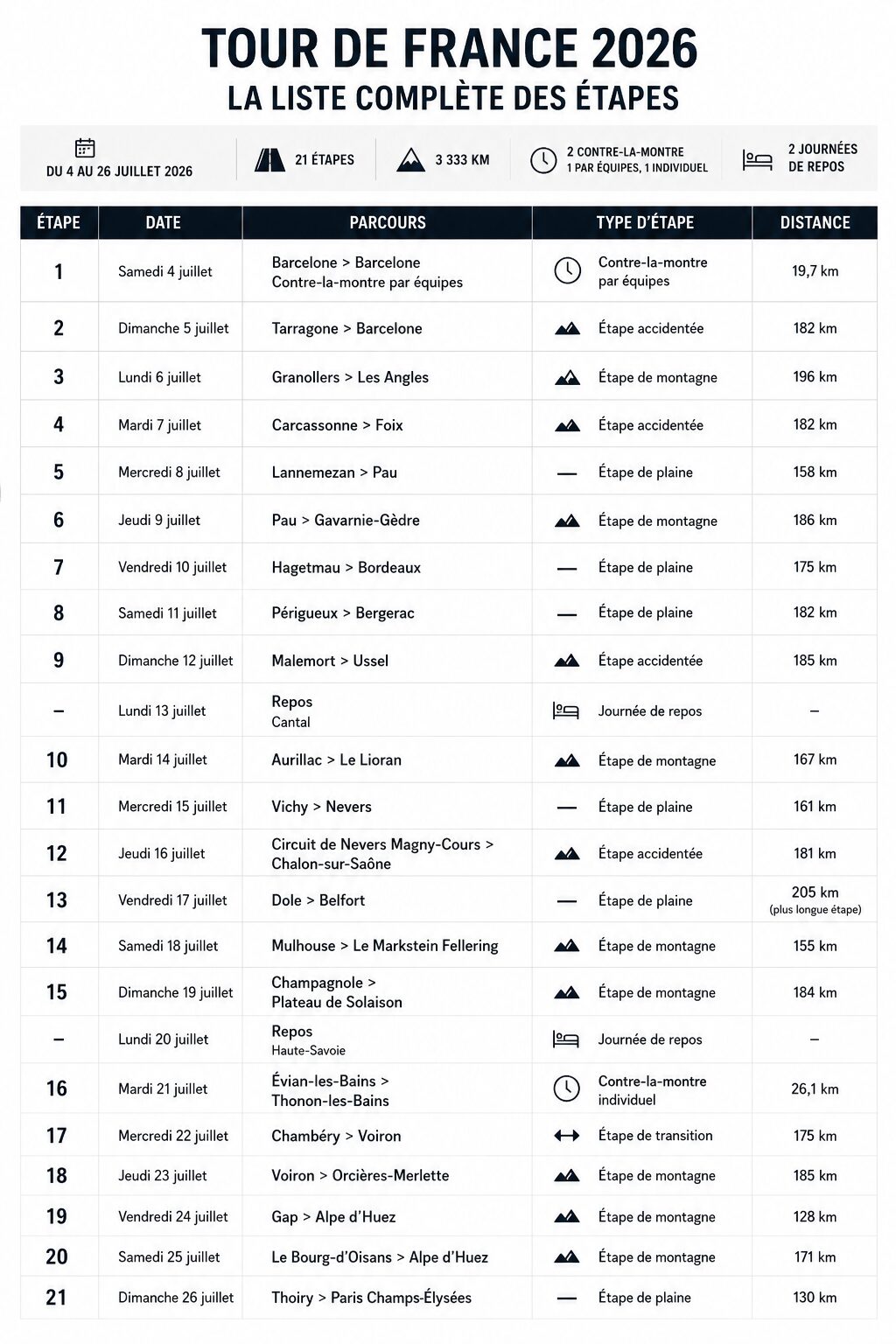
The race will begin on Saturday, July 4, with a team time trial in Barcelona, followed by a second stage from Tarragona to Barcelona on Sunday, July 5. On Monday, July 6, the riders will leave Granollers for Les Angles, the first mountain stage. On Tuesday, July 7, the Carcassonne–Foix stage will feature rugged terrain, followed on Wednesday, July 8, by Lannemezan–Pau, which is more favorable to sprinters. On Thursday, July 9, the Pau–Gavarnie-Gèdre stage will mark one of the first major high-altitude challenges, followed by Hagetmau–Bordeaux on Friday, July 10, and Périgueux–Bergerac on Saturday, July 11. On Sunday, July 12, the Malemort–Ussel stage will feature rolling terrain before the first rest day in the Cantal region on Monday, July 13.
The second week will resume on Tuesday, July 14, with Aurillac–Le Lioran, a mountain stage in the Massif Central. On Wednesday, July 15, the peloton will ride from Vichy to Nevers, then from the Nevers Magny-Cours circuit to Chalon-sur-Saône on Thursday, July 16. On Friday, July 17, Dole–Belfort will be the longest stage of this year’s race at 205.8 km. The weekend will be decisive with Mulhouse–Le Markstein Fellering on Saturday, July 18, followed by Champagnole–Plateau de Solaison on Sunday, July 19, before a second rest day in Haute-Savoie on Monday, July 20.
The final week will begin on Tuesday, July 21, with a 26.1-km individual time trial between Évian-les-Bains and Thonon-les-Bains. On Wednesday, July 22, the Chambéry–Voiron stage will serve as a transition before three major Alpine stages: Voiron–Orcières-Merlette on Thursday, July 23; Gap–Alpe d’Huez on Friday, July 24; and Le Bourg-d’Oisans–Alpe d’Huez on Saturday, July 25. The Tour will conclude on Sunday, July 26, with the Thoiry–Paris Champs-Élysées stage.
As for the teams, 23 squads will be at the starting line in Barcelona: the 18 UCI WorldTeams, which are automatically invited, and 5 UCI ProTeams. The five selected ProTeams are Tudor Pro Cycling Team, Q36.5 Pro Cycling Team, and Cofidis—which qualified directly—as well as TotalEnergies and Caja Rural–Seguros RGA, which were invited by the organizers. A total of 184 riders are expected at the starting line.
Stages of the Tour de France 2025
Visit Tour de France 2025The 112ᵉ edition of this prestigious cycling race will take place from July 5 to 27, 2025. This year, the route is entirely within French borders, a first since 2020. Riders will cross 11 regions and 34 départements, with a route designed to offer a variety of challenges, especially for climbers.

The route comprises 21 stages
- 7 flat stages
- 6 accident-prone stages
- 6 mountain stages, with five high altitude finishes:
- Hautacam
- Luchon-Superbagnères
- Mont Ventoux
- Courchevel (Col de la Loze)
- La Plagne Tarentaise
- 2 individual time trials
List of stages for the Tour de France 2025
Week 1: North, Normandy, Brittany, Centre-Val de Loire
Saturday, July 5th : Lille Métropole → Lille Métropole - 185 km (plain)
Sunday, July 6 : Lauwin-Planque → Boulogne-sur-Mer - 212 km (hilly)
Monday, July 7th : Valenciennes → Dunkerque - 172 km (plain)
Tuesday, July 8 : Amiens Métropole → Rouen - 173 km (hilly)
Wednesday, July 9th : Caen → Caen - 33 km (individual time trial)
Thursday, July 10 : Bayeux → Vire Normandie - 201 km (hilly)
Friday, July 11 : Saint-Malo → Mûr-de-Bretagne Guerlédan - 194 km (hilly)
Saturday, July 12 : Saint-Méen-le-Grand → Laval Espace Mayenne - 174 km (plain)
Sunday, July 13 : Chinon → Châteauroux - 170 km (plain)
Monday, July 14th : Ennezat → Le Mont-Dore (Puy de Sancy) - 163 km (mountain)
Tuesday, July 15 : Day off in Toulouse
Week 2: Occitania, Pyrenees
Wednesday, July 16 : Toulouse → Toulouse - 154 km (plain)
Thursday, July 17 : Auch → Hautacam - 181 km (mountain)
Friday, July 18 : Loudenvielle → Peyragudes - 11 km (uphill time trial)
Saturday, July 19th : Pau → Luchon-Superbagnères - 183 km (mountain)
Sunday, July 20 : Muret → Carcassonne - 169 km (hilly)
Monday, July 21st : Rest day in Montpellier
Week 3: Provence, Alps, Jura, Île-de-France
Tuesday, July 22 : Montpellier → Mont Ventoux - 172 km (mountain)
Wednesday, July 23rd : Bollène → Valence - 161 km (plain)
Thursday, July 24th : Vif → Courchevel (Col de la Loze) - 171 km (mountain)
Friday, July 25 : Albertville → La Plagne - 130 km (mountain)
Saturday, July 26th : Nantua → Pontarlier - 185 km (hilly)
Sunday, July 27 : Mantes-la-Ville → Paris (Champs-Élysées) - 120 km (plain)
Rest days
Two rest days are planned, in Toulouse and Montpellier.
Elevation gain
The Tour 2025 will have a total vertical drop of 51,550 meters, with notable climbs in the Massif Central, Pyrenees, Alps and Jura. The Col de la Loze, culminating at 2,304 meters, will be the highest point of this edition, climbed for the first time on its eastern side from Courchevel.
Tour 2025 stage cities
Eight sites or stage towns will be appearing for the first time in the Tour's history:
- Lauwin-Planque (start of the 2ᵉ stage)
- Bayeux (start of the 6ᵉ stage)
- Chinon (start of the 9ᵉ stage)
- Ennezat (start of the 10ᵉ stage)
- Le Mont-Dore Puy de Sancy (finish of the 10ᵉ stage)
- Bollène (start of the 17ᵉ stage)
- Vif (start of the 18ᵉ stage)
- Mantes-la-Ville (start of the 21ᵉ stage)
The Grand Départ takes place in Lille on July 5, and the race traditionally finishes on the Champs-Élysées in Paris on July 27.
For a detailed description of the stages, please visit the official Tour de France website.
Visit Tour de France 2024
Visit Tour de France 2024 marked the history of cycling with an exceptional edition, rich in twists and turns and memorable performances. For the first time, the Grande Boucle started in Italy and finished in Nice, departing from the Paris tradition because of the Olympic Games. This 111th edition was dominated by Tadej Pogačar, who achieved a historic double by winning both the Giro d'Italia and the Tour de France in the same year, a first since 1998. The route, the milestones, the individual performances and the highlights made this edition one of the country's most unforgettable events.
A unique and demanding course
Visit Tour de France 2024 was distinguished by its innovative route, starting in Florence, Italy, and ending in Nice, France. This unique layout presented riders with an unprecedented challenge, with varied stages passing through landscapes picturesque and challenging terrain.
Departure for Italy: a historic first
For the first time, Le Tour de France 2024 took to the skies from Italy, paying tribute to the centenary of Italy's first victory in 1924. The first three stages allowed riders to discover Italian roads, with passages through Florence, Bologna and Turin, offering a mix of flat and hilly terrain.
A mountainous and technical course
The route of this year's Tour de France 2024 included five high-mountain stages, nine hilly stages, including one partially on gravel roads, five flat stages and two individual time trials. Riders tackled iconic passes such as the Col du Galibier and the Col de la Couillole, putting their endurance and strategy to the test.
Outstanding performances
Tadej Pogačar: a historic double
Slovenia's Tadej Pogačar dominated this edition, winning six stages, including the last three, and taking the yellow jersey with a lead of over six minutes over his pursuer. He thus becomes the first rider since Marco Pantani in 1998 to complete the Giro-Tour double in the same year.
Mark Cavendish: a legend in action
Britain's Mark Cavendish made history with his 35th Tour stage win, surpassing the record held by Eddy Merckx since 1975. This exceptional performance underlines the longevity and talent of the sprinter, who left his mark on this edition.
Biniam Girmay: an African first
Eritrean Biniam Girmay shone, winning three stages and taking the green jersey in the points classification. He became the first African rider to win a stage in the Tour, paving the way for a new generation of talent from the continent.
Race highlights
Stage 4: the Col du Galibier climb
This stage of the Tour de France 2024 was marked by a decisive attack from Pogačar in the final kilometers of the climb, enabling him to extend his lead over his rivals and consolidate his position as leader.
Step 9: Gravel paths
A new stage with gravel sections tested the riders' technique. France's Anthony Turgis came out on top on this demanding stage.
Stage 21: the final time trial
The Tour concluded with a 33.7 km time trial between Monaco and Nice. Pogačar once again demonstrated his superiority by winning this final stage, sealing his overall victory.
The Main Stages of the Tour de France 2024
Here's a look at the key stages of the Tour de France 2024:
- June 29: Florence - Rimini (206 km)
The Grand Départ took place in Florence, marking the first time the Tour started in Italy. This hilly stage ended on the shores of the Adriatic in Rimini. - June 30: Cesenatico - Bologna (199.2 km)
Starting in Marco Pantani's hometown, the riders tackled the first difficulties, with some notable climbs, before arriving in Bologna. - July 1: Piacenza - Turin (230.8 km)
A long, flat stage taking the cyclists from Piacenza to Turin, offering opportunities for sprinters. - July 2: Pinerolo - Valloire (139.6 km)
As the first high-mountain stage, the riders crossed the Alps with some demanding climbs. - July 21: Monaco - Nice (33.7 km - Individual time trial)
For the first time since 1989, the Tour concluded with an individual time trial, offering a thrilling finale on the Côte d'Azur.
Final rankings
Yellow jersey (general classification) : Tadej Pogačar (SLO)
Green jersey (points classification) : Biniam Girmay (ERI)
Polka-dot jersey (best climber) : Richard Carapaz (ECU)
White jersey (best young rider) : Remco Evenepoel (BEL)
Team rankings : UAE Team Emirates
Practical information
To attend the Tour de France, it's essential to plan ahead. Accommodation in the stage towns fills up quickly, and it's advisable to get to the sites early to secure a good spot. Detailed information on routes, schedules and traffic restrictions is available on the official Tour de France website.
The Tour de France Principle
The Tour de France is an annual cycling race held mainly in France, with occasional forays into neighboring countries. Riders cover some 3,500 kilometers over 21 stages, including flat, hilly and mountainous courses, as well as time trials. Each stage is timed, and the rider with the lowest cumulative time wears the prestigious yellow jersey.
History of the Tour de France
Visit Tour de France is one of the world's most prestigious sporting competitions and the most famous of all cycling races. Created in 1903It has become a major cycling event, attracting the best riders and millions of spectators to the roads of France every year. This multi-week race traverses the country's varied landscapes, from plains to mountains, and traditionally finishes on the Champs-Élysées in Paris.
The origins of the Tour de France
The birth of a myth (1903)
Visit Tour de France was created by journalist Henri Desgrangeeditor-in-chief of L'Autoin response to competition from The Bike. The aim was to promote L'Auto by organizing a national cycling race.
Visit first edition of the Tour took place in 1903with six steps and a 2,428 km. The race started at Montgeron, in the Paris suburbs, and passed through cities such as Lyon, Marseille, Toulouse, Bordeaux, and Nantes before returning to Paris. Maurice Garin was the first winner of the Tour de France.

The evolution of the Tour de France
The difficult beginnings (1903-1914)
The first editions of the Tour were very different from those of today. The roads were in poor condition, and the riders often rode from night over extremely long distances. Despite this, popular enthusiasm for the race grew rapidly.
Visit 1904An edition marked by cheating (including train travel) almost put an end to the Tour. Henri Desgrange had to tighten the rules to preserve the integrity of the race.
With the arrival of the World War Ithe Tour de France was suspended between 1915 and 1918.
The interwar period and professionalization (1919-1939)
The Tour resumes in 1919 with several innovations:
- The yellow jersey is introduced to distinguish the overall leader (carried for the first time by Eugène Christophe).
- The race is beginning to include more difficult mountain stages, particularly in the Alps and Pyrenees.
- Race time and distance increase.
In the 1930s, the organization imposed national teams rather than trademark teams to avoid conflicts of interest.
The modern era and the globalization of the Tour (1947-present)
After the World War IIthe Tour resumes in 1947 and is gradually becoming an event international. Notable innovations include :
- The arrival of sponsorswhich finance professional teams.
- The introduction of televisionwhich further popularized the race.
- The addition of time-trial stages.
In the 1980-1990iconic champions such as Bernard Hinault, Miguel Indurain and Greg LeMond mark the history of the race.
Visit XXIᵉ century saw the emergence of new figures such as Lance Armstrong (disqualified for doping), Chris Froome, and Tadej Pogačar. Despite several doping scandals, the Tour remains cycling's most watched event.
Milestones in the history of the Tour de France
First ascents of the major passes
Visit 1910the Pyrenees make their appearance in the Tour with mythical passes such as the Tourmalet. The following year, the Alpswith the rise of l'Alpe d'Huez and Galibierwhich add even more difficulty.

The Tour de France today
The organization of Tour de France is based on a well-established structure, involving team selection, route design and stage planning. Each edition is orchestrated by Amaury Sport Organisation (ASO), in collaboration with the Union Cycliste Internationale (UCI).
Team selection
For the 2025 edition, the field will comprise 23 teams, an increase on previous years. This selection is made up of the 18 UCI WorldTeams, which benefit from an automatic invitation, the two best ProTeams from the previous year, and three teams invited by the organizers. For 2025, these are Tudor Pro Cycling Team, TotalEnergies and Uno-X Mobility. .
Course design
The Tour's route is carefully designed to offer a balance between different types of stages:
Mountain stages : crossing the Alps and the Pyrenees, they are crucial to the overall classification.
Lowland stages : often favourable to sprinters, they offer opportunities for mass finishes.
Hilly stages : with their rugged terrain, they are ideal for breakaways and adventurers.
Time trial : individual or team, they measure the pure performance of the riders.
The route is designed to cross various French regions, highlighting the country's geographical diversity. For example, the 2025 Tour will start in Lille and cross the Alps, the Pyrenees and the Massif Central.
Stage planning
The Tour de France generally comprises 21 stages spread over three weeks, including two rest days. Each stage is carefully planned to offer a top-quality sporting spectacle, while ensuring the safety of the riders and the logistics required for such an event.
The route and innovations
Today, the Tour de France is made up of 21 steps over a period of three weeks. The route varies each year, with stages :
- Platesfavoring sprinters.
- Mountainwith a focus on climbers.
- From time trial to time trialfor individual effort specialists.
The modern edition uses advanced technologies such as GPS tracking, live analysis and improved cycling equipment.
Winners of previous editions of the Tour de France
Here are the winners of recent editions of the Tour de France:
- 2024 Tadej Pogačar (SLO)
- 2023 Jonas Vingegaard (DEN)
- 2022 Jonas Vingegaard (DEN)
- 2021 Tadej Pogačar (SLO)
- 2020 Tadej Pogačar (SLO)
The last few years have been marked by the dominance of young talent, notably Pogačar and Vingegaard.
The Legendary Passes of the Tour de France
The Tour de France is famous for its legendary climbs that put riders to the test:
- L'Alpe d'Huez With its 21 emblematic bends, this 13.8 km climb with an average gradient of 7.9 % is a must on the Tour.
- Mont Ventoux Nicknamed the "Giant of Provence", this pass rises to 1,909 metres and is feared for its steep slopes and lunar landscape.
- The Col du Tourmalet Located in the Pyrenees, it is one of the most frequently climbed passes in the Tour, with an altitude of 2,115 meters.
Iconic riders who have won several Tours de France
Jacques Anquetil (France): 5 wins
Eddy Merckx (Belgium): 5 wins
Bernard Hinault (France): 5 wins
Miguel Indurain (Spain): 5 wins
Christopher Froome (Great Britain): 4 wins
The Tour de France 2023
The key stages of the Tour de France 2023
Departure for the Basque Country
The Grand Départ was held in Bilbao, Spain, a first since 1992. The first two stages showcased the hilly landscapes of the Basque country, with victories for Adam Yates in Bilbao and Victor Lafay in San Sebastian.
Back from Puy de Dôme
Stage 9 marked the return of the legendary Puy de Dôme, absent since 1988. Michael Woods came out on top, putting in a memorable performance on this historic climb.
Decisive time trial
Stage 16, a time trial between Passy and Combloux, was the turning point of the Tour. Jonas Vingegaard opened up a significant gap over Tadej Pogačar, consolidating his position as leader.
Final rankings
Yellow jersey (general classification) : Jonas Vingegaard (Jumbo-Visma)
Green jersey (points classification) : Jasper Philipsen (Alpecin-Deceuninck)
Polka-dot jersey (best climber) : Giulio Ciccone (Lidl-Trek)
White jersey (best young rider) : Tadej Pogačar (UAE Team Emirates)
Team rankings : Jumbo-Visma
Super-combative : Victor Campenaerts (Lotto Dstny)
Tour highlights
Duel Vingegaard-Pogačar : An epic clash between the two champions, with twists and turns right up to the final week.
Jasper Philipsen's exploit : Four stage wins for the Belgian sprinter, dominating the mass finishes.
Return of Thibaut Pinot : An emotional performance in the Vosges, acclaimed by the audience.
Frequently asked questions
What is the yellow jersey?
The yellow jersey is worn by the rider with the lowest cumulative time in the overall classification. It symbolizes the race leader.
How are stage towns chosen?
Stage towns are selected by the Tour organizers on the basis of logistical, historical and geographical criteria.
How many teams are taking part in the Tour?
Typically, 22 teams take part, each made up of 8 riders, for a total of 176 participants.
What is a time trial?
This is an event in which riders set off individually at regular intervals, the aim being to achieve the best time on a given course.
How do riders prepare for mountain stages?
Cyclists train specifically for the mountains, working on their endurance and power, and adjusting their diet to optimize their performance on climbs.
Official website of the Tour de France


Type your paragraph here
